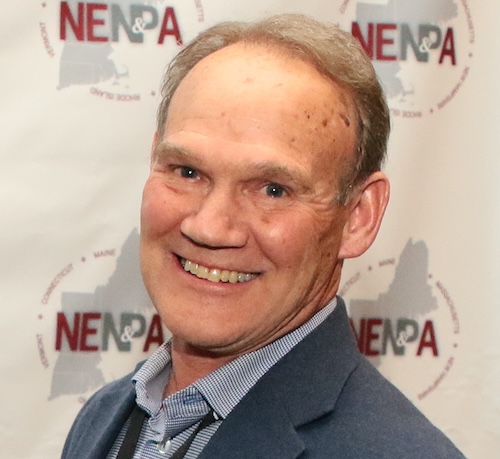
This week’s writer is Anders Holm, a resident of Ferrisburgh and owns a building in downtown Middlebury beside the Middlebury Falls.
I have extensive personal experience with solar power (since 1987). I am not offering ideology. I am describing the facts I have lived while using multiple forms of locally generated renewable energy.
I am a huge fan of solar power, and I have walked the walk for most of my adult life. Solar is a fantastic option, and it has improved dramatically over the last four decades. However, I also acknowledge intrinsic limitations that become unavoidable in the heart of a Vermont winter — precisely when we are most dependent on electricity for heat, light and safety.
Bill McKibben’s book “Here Comes the Sun: A Last Chance for the Climate and a Fresh Chance for Civilization” is a wonderful summary of the clear benefits of solar power and the hopeful possibilities that come with scaling it responsibly.
My own experience and conclusions align closely with McKibben’s call for a responsible path forward.
I recognize that some may perceive an intrinsic bias in any person who speaks strongly about energy. But anyone who has used solar seriously, through multiple winters, will recognize the same concern: output is not simply a matter of enthusiasm or policy. It is constrained by physics — short days, low sun angle, storms and snow cover. These are universal and unchangeable constraints in a northern climate.
Unless we develop truly massive seasonal battery storage — at a scale that is, at present, economically unfeasible — solar alone is not going to generate sufficient power during the winter months. That means other sources must be entertained seriously, not as ideological adversaries but as practical partners in a reliable portfolio.
My personal “experiment” with solar began as something simple and practical: recharging the batteries for my Walkman using small solar panels in Stockholm — a high‑latitude city (north by any American measure, though still south of the Arctic Circle).
Even back in 1987, I could tell that solar power worked magnificently during the summer months — when days are extraordinarily long in Sweden — and that it did not work nearly as well in the winter months.
Solar power works. Over decades, what began as an early experiment became a way of life: two Vermont homes powered by the sun, one of them net‑positive over a full year.
My homes were grid‑tied, and I was grateful for that. When panels produced richly in June, the grid absorbed the excess. When the roof was a snowfield in January, other sources of generation kept daily life stable. That is what a serious energy system does: it turns seasonal extremes into continuity.
This is why Vermont’s debate over removing older dams deserves a rational, historically literate discussion. Many of these structures were built by Vermonters at great expense for clear public purposes — often power. Some are truly obsolete hazards and should come out. But if a site still produces — or could be modernized to produce — local renewable electricity with lower‑impact technology, then removing it casually means something permanent: that generation potential is unlikely to be recovered on that river in our lifetimes.
And it is not hard to imagine a future where Vermonters look back on today’s choices and say: we built these solar farms with pride, and later we removed them with equal conviction. That’s not an argument against solar — it’s a warning about moral certainty and about confusing “installed” with “solved.”
The same sober reassessment is emerging around biomass. Wood heat is part of Vermont’s lived winter culture, and advanced wood systems can be efficient. But “biomass is automatically clean” is no longer a free pass. Biomass is receiving increasing scrutiny, and some in Montpelier are beginning to consider legislation to curtail the burning of wood in Vermont.
Then there’s the quiet lesson written on the landscape: the near‑absence of small residential wind turbines. That absence isn’t because Vermonters forgot wind; it’s because small wind is brutally site‑dependent and often unreliable unless the site has sustained, clean airflow — conditions most backyards simply do not have. If it were dependable at a household scale across most of the state, we would still see it everywhere.
Japan makes the reliability point even more starkly — because its geography forces the same physics Vermont faces. Japan has pursued solar aggressively, and parts of Japan sit at a similar latitude to Vermont. Yet even with aggressive deployment, Japan has recognized that solar alone is insufficient for a modern society’s constant demand and has moved to resume nuclear power in many plants as part of its reliability and decarbonization strategy — even after the Fukushima disaster. This is not a cultural preference; it is an acknowledgment that the laws of physics still apply.
So the conclusion remains simple and non‑ideological: all energy has impacts. Hydropower’s impacts tend to be local and tangible; large solar’s land‑use impacts are real and often under‑discussed; biomass is increasingly contested; small wind is highly situational. Meanwhile, climate change is already delivering catastrophic floods and punishing droughts that can overwhelm the very riparian systems we claim to protect.
At the national level, there are renewed discussions and major investments aimed at building modern nuclear power plants. If pursued at scale, this will be done at massive expense — borne either by taxpayers or by utility payers. These are simply facts we face in our current environment.
I write as the President of Middlebury Electric Company, and I recognize that some may presume an intrinsic bias because I have personal interest in restoring a run‑of‑the‑river hydroelectric facility. I acknowledge that perception up front. But the seasonal variability of solar exposure at northern latitudes is not a matter of opinion — it is well documented, predictable and experienced by anyone who has relied on solar power through multiple winters. For that reason, my central point is not “hydro versus solar.” It is that a diversified portfolio is absolutely necessary if we want dependable electricity and wish to avoid unpleasant consequences when winter demand is high and solar output is lowest.
As local history tells it, the emergence of hydroelectric power in downtown Middlebury brought electric lighting to the village for the first time and sharply reduced dependence on oil‑based lighting — an illumination method that, in many communities, carried a well‑known fire hazard. The arrival of electric light was met with celebration, and the facility operated seamlessly for decades until 1966, when it was removed — ironically, in the era when nuclear power was rising to prominence.
We have kicked the can down the road for decades because we have had access to sources of electricity that were irresponsible or dangerous — and every one of those choices has carried consequences. It is time for Vermont to engage in a realistic and preemptive discussion about how to most responsibly utilize our local resources for maximum benefit and minimum impact. This must be done with clear eyes: all power production has impacts, but those impacts pale in comparison to the increasingly devastating effects of climate change, which are the direct result of an irresponsible and shortsighted past. A diversified portfolio is not a slogan; it is a necessity.