
“We need to attack them all (health care, housing, property taxes and education) if we’re going to make Vermont an affordable place to live.” — James Douglas
MIDDLEBURY — Middlebury’s James Douglas spent eight years (2003-2011) managing the general health of the Green Mountain State as its 80th governor.
He’s now leading a group advocating for the physical health of Vermonters.
Douglas, 74, is co-chair of Vermont Healthcare 911 (VHC911), a self-described “broad coalition of Vermonters insisting on a sustainable, long-term health care system that supports quality, reduces costs and ensures access to care in all regions of the state.”
The coalition includes medical professionals, business leaders, school officials and rank-and-filed Vermonters concerned about the rising costs of healthcare and its impacts on the wellbeing, quality of life and success of residents and the economic vitality of the state.
Douglas, during a recent interview at the Independent, discussed his involvement with VHC911 and its just-released report titled, “Affordability in Vermont Healthcare: 2025 Snapshot and Path Forward.”
“Having the most expensive health premiums in the nation impacts the state’s affordability, hurts businesses and strains family budgets,” reads the report’s introduction. “Getting health costs under control is vital if we want to grow Vermont’s economy. Creating a strong, sustainable health system focused on quality and access is essential for Vermont’s future and the quality of life of our residents.”
Douglas was invited to co-helm VHC911 just before its launch in January of 2025. Health care, housing, property taxes and education were the four challenges in an “affordability” crisis he underscored during his time as governor.
“We need to attack them all if we’re going to make Vermont an affordable place to live,” Douglas said.
Fifteen years after leaving Montpelier, the same four challenges remain, he noted.
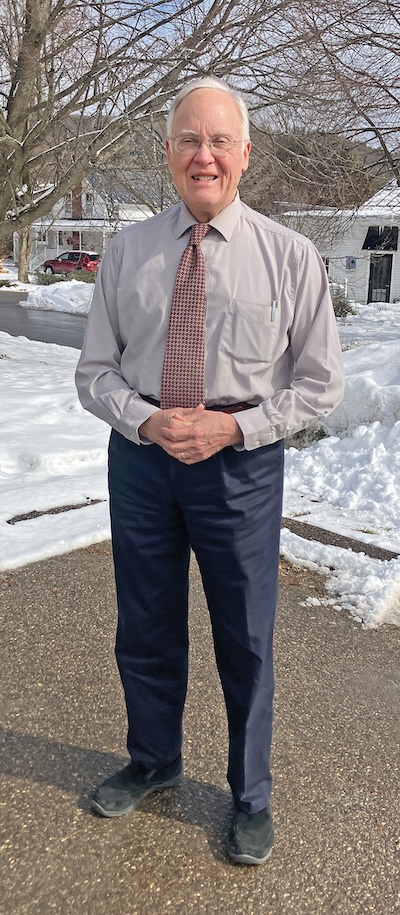
Independent photo/John S. McCright
“The message from employers is the same — ‘health care costs are squeezing us,’” Douglas said. “And a quarter of the increase in school budgets last year was related to the rise in health care (premiums).”
How deep is Vermont’s health care crisis? The new VHC911 report includes some of the following food for thought:
- In 2025, Vermont had the most expensive health insurance premiums of any state.
“Our costs were 2.5 times the national average and are far more expensive than our neighbors in Maine and New Hampshire,” the report states.
- Vermont’s primary care providers are struggling. Its Federally Qualified Health Centers (FQHCs), which serve roughly one-third of all Vermonters, ran a combined $8.5 million deficit last year.
- The state is on track to be 100 short of the primary care physician needs by 2030.
- In 2020, the Kaiser Family Foundation found Vermont had the fourth-highest health care spending per person of any state. Since 2021, Vermont hospital spending has grown from 35% to 44.5% of total health care spending.
- Vermonters spend 19.6% of their personal income on health care, the highest rate in the country, according to a Vermont Chamber of Commerce study.
- As a state, Vermont’s hospital safety ratings rank 48th in the country with no Vermont hospitals having an “A” rating.
- Changes in federal health care subsidies will hit Vermont hard. According to AARP-VT, an estimated 30,000 Vermonters will go uninsured as federal Obamacare assistance sunsets, and Republicans in Congress, with President Trump’s encouragement, have refused to extend subsidies passed under President Biden. Further, as many as 45,000 low-income Vermonters will lose coverage from Medicaid.
“Both of these dynamics will mean people get sicker or even die because they aren’t getting the care they need. It will also increase charity care pressure in our hospitals, forcing hospitals to make up those costs elsewhere (ie. commercial insurance rates),” the VHC911 report states.
Not all the news is gloom and doom, however.
Douglas and his VHC911 colleagues noted steps the state Legislature and hospital administrators took in 2025 to start bending the curve on health care spending and affordability. Those steps included:
- Act 68 which called on the Vermont Agency of Human Services to develop a statewide health care delivery strategic plan, requiring collaboration among providers to reduce hospital spending “by at least” 2.5% in fiscal year 2026. Act 68 also mandates that the state’s Green Mountain Care Board (GMCB) implement hospital reference-based pricing by fiscal year 2027, setting maximum payments for services pegged to Medicare rates.
- Act 55, which capped the profit Vermont hospitals could enjoy through the Federal 340B prescription drug program at 120% of cost.
- Act 49, which expanded the GMCB’s authority to adjust hospital reimbursement rates and ability to appoint a hospital observer.
- Vermont’s promised receipt of $195 million in federal grants — potentially for each of the next five years — as part of the “Rural Health Transformation Grant.” That money, coupled with new leadership Blue Cross/Blue Shields of Vermont and UVM Health Network, “may be our best chance to change the culture and get all players pushing to create an affordable system appropriate for our rural state,” reads the VHC911 report.
“(Lawmakers) took a lot of positive steps on their own to push this process along,” Douglas said.
TOP-HEAVY ADMIN
VHC911 officials are making some recommendations of their own, including that hospitals pare their top-heavy administration. Compared to their peers across the Northeastern U.S. — and adjusted for bed capacity, population and the like — Vermont hospitals spend 31% more than their peers on labor costs devoted to non-patient care, according to the report.
The group also stressed that Vermont hospitals “must bring costs down to be more in line with Medicare reimbursements.”
In 2023, UVM Medical Center lost $116 million treating Medicare patients, putting it in the top 10 worst performers out of 107 comparable hospitals.
Douglas is glad he signed up with VHC911 and believes it’s been making a difference. The group doesn’t lobby; it functions on donations and a small paid staff.
“We’re going to keep our foot on the gas. We’re encouraged by these early signs that we’ve seen. This is a marathon, not a sprint. We need to focus on bringing those costs down so they’re not so disproportionate compared to other states and other systems,” Douglas said.
Jessica Holmes is a member of the GMCB, as well as being a professor of Health Economics & Public Policy and director of Global Health at Middlebury College. She said VHC911’s work has been helpful.
“Efforts to raise public awareness about the drivers of Vermont’s rising health care costs are always welcome,” she said. “VHC911 has contributed thoughtful, evidence-based analysis that helps Vermonters better understand the challenges our health care system faces and the difficult choices ahead.”
John Flowers is at [email protected].