
During the Vietnam War, my first husband, Ken Mayberger, was a conscientious objector. For his service, he raised money for a Land Rover and drove it from New Hampshire to New York City. From there, he and the car boarded a ship that traveled through the Panama Canal to a jungle hospital outside Pucallpa, Peru, where he was to volunteer. Suddenly, he was dwelling amidst indigenous people in a way few foreigners had. While living among the Shipibo and Conibo tribes, he stayed in a grass-roof hut built many feet above the ground where everyone slept in hammocks.
Ken found traditional practices fascinating. In the early 60s, the U.S. was shifting to industrialization. The goal was to build new machines to make life easier. It had become unfashionable to do things by hand. Ken watched native women in their backstrap looms, weaving. They would put some strings around a tree and sit on the ground, wrapping the other ends of the strings around their backs. A board like a comb lifted first half the strings, and then the other half and they threw a shuttle full of yarn across with each change. They made all their clothing and material in this way.
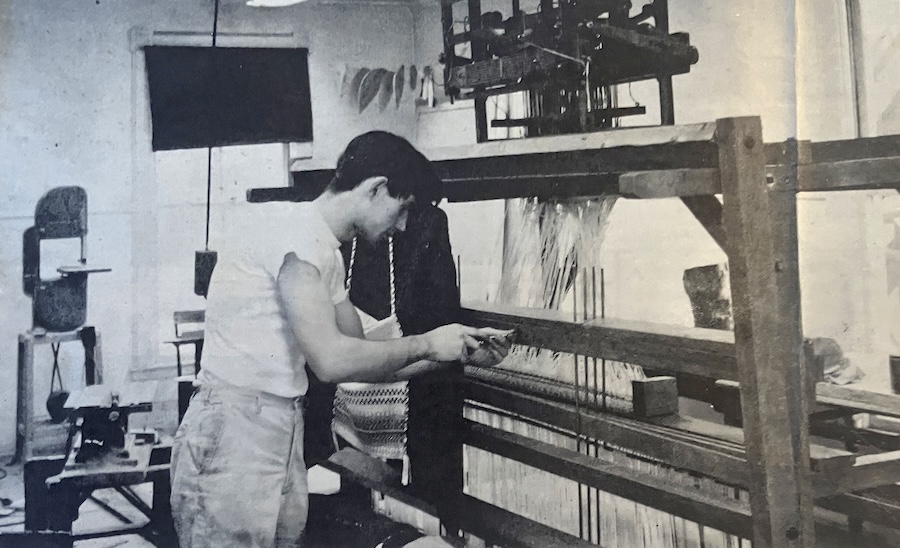
When Ken got back to college in New Hampshire, he decided that he wanted to preserve traditional ways like weaving. He started teaching himself how to weave and visited many woolen mills still active in New Hampshire and Vermont. He tried weaving with a simple loom but got frustrated by the lack of pattern options. At mills around New England, he learned that a Jacquard loom offered flexibility to create unique patterns. When he learned about that option, he decided to research and build a Jacquard loom for his major project. Using maple and mahogany, he built a frame six feet wide and got a Jacquard head from a factory, where the practice of using a Jacquard was phasing out. He placed the head on top of the frame and hooked it up.
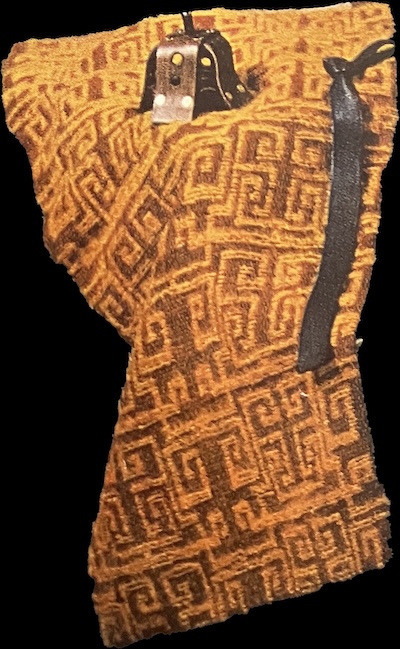
The Jacquard loom is often considered the first computer. If you know how dot matrix works, this is the same. The Jacquard head provided unlimited patterns depending on the holes that he punched into cardboard cards. Each string could be programmed to come up individually, without a repeat pattern. Handlooms at that time were usually two or four harnesses with pedals to lift them, which meant there were only two or four sets of changes. The new patterns were not limited by harnesses threaded by yarns of the warp. Each string moved independently.
Middlebury College Museum of Art had a talk recently about a new purchase of a damask “napkin” from Netherlands. The table-sized piece was made by lifting various strings which created the pattern. It reminded me of Ken and his weaving. When I mentioned Ken’s work from 60 years ago to the speaker Justin Squizzero, who directs the Newbury Weaving School in Vermont, he was very interested. “What ever happened to the Jacquard head? Those are more rare than hens’ teeth.” He wondered where the wall hangings Ken made are now. It felt very similar to us trying to patch pieces together about the past.
When I got home, I called Ken in Albuquerque and asked about the Jacquard head. “It dissolved into the Universe,” he said. I wondered if he still had some wall hangings. Yes. He says he will communicate with Justin.
The ’60s saw a revival of handcrafts in Vermont, as reported in Vermont Life in Issue XXII, Winter 1967. Judging from the large audience attending the Middlebury College lecture, there must be a new revival of fiber arts today, too.
—————
Sas Carey spent the winter knitting, swimming, and listening to books. Maybe the spring and summer will be more active. See her work at www.nomadicare.org and www.lifeenergyheal.com.