MIDDLEBURY — You will soon have an opportunity to learn more about a key part of Japanese history and culture — the kimono.
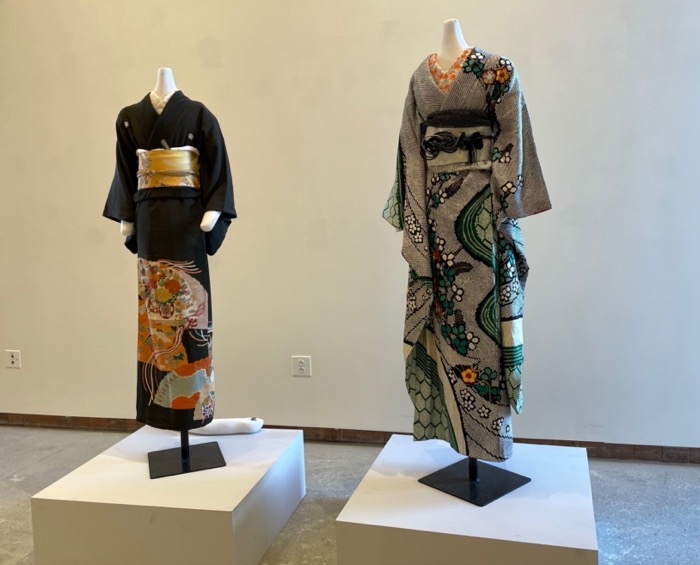
An exhibit at Middlebury College’s Johnson Gallery called “Cultural Fabrics: The Kimono Through Literary, Cross-Cultural, and Practical Lenses” opens on Feb. 9. It’s been brought to life by a group of college faculty, staff, students and other contributors. In addition to showing beautiful garments, parts of the exhibit explore the kimono through its connection to Japanese literature and Western aesthetics.
“It’s been a joy to get to share something that is both kind of wearable art and also a dying skill and a dying set of industries with people,” said Shannon Palmer, associate director of admissions at the college and one of the organizers of the exhibit. “This is a lot more than just, ‘This is what people wear.’ It’s a conversation about heritage and art preservation.”
Along with Palmer, the exhibit has been organized by Summer Jack, visiting assistant professor of theatre; Otilia Milutin, assistant professor of Japanese Studies; and HaQuyen Pham, assistant director of digital marketing.
The idea behind the exhibit began forming last year when the college’s historic clothing collection received a kimono donation along with other items. Jack, who oversees the clothing collection, began brainstorming with Milutin about opportunities to tie the pieces to her studies as part of an exhibit.
That led the pair to collaborate with Palmer and Pham, both of whom brought extensive knowledge on different aspects of the kimono to the project. Jack noted the group has received additional support and pieces for the exhibit from other collaborators.
“It’s been a lot of really serendipitous things that came together and really benefit the exhibit and the idea of spreading this information to the students,” Jack said.
INSIDE THE EXHIBIT
Focuses of the exhibit reflect the organizers’ areas of expertise. Milutin has put together “The Kimono in Literature,” a section of the exhibit that highlights the Heian period — from 794-1185, often called the golden age of classical Japanese culture — and “The Tale of Genji,” an 11th century novel by Murasaki Shikibu.
“I’m highlighting a quotation from ‘The Tale of Genji’ in which one can clearly see the importance … of garments as cultural indicators of status, of rank, of refinement, of education, with a lot of social implications in their use,” Milutin said.
The section also draws from 1920s in Japan, a period that Milutin noted saw significant Western influence, though youth remained interested in the kimono. A quotation from the novel “Naomi” by Tanizaki Jun’inchirō is included in this part of the exhibit.
“Both texts highlight the importance of, one, clearly the kimono, the other, of garments in general in Japanese literature and culture,” Milutin explained.
The exhibit features some pieces from the college’s historic clothing collection, as well as items acquired for the display. Jack has worked on “The Kimono in the West,” a part of the exhibit that highlights how Western fashion has been influenced by the kimono and Japanese traditions. For example, the exhibit includes a 1920s dress made out of kimono fabric and pieces made for the Western market.
“It’s a great way for all of us to learn more about the culture and to share that with our students,” Jack said. “I think that’s one of the biggest ideas behind this whole exhibit is to show that cross-cultural excitement; for me, it’s one of the things I’ve learned the most from this exhibit.”
Milutin noted another highlight of the exhibit is an uchikake, an outer robe traditionally worn by brides in Japan. Surrounding the uchikake in the exhibit are four other styles of the kimono, ranging from “informal to highly formal,” Milutin said.
Other aspects of the exhibit center around “The Kimono in Everyday Life” and “Crafting Kimono: しぼり (Shibori) Dyeing.”
“The word ‘shibori’ kind of is an encompassing term for the art of essentially manipulating fabric; binding it, tying, twisting, pleating, folding and then dyeing, so that it is a resist dye process,” Pham explained. “So, wherever you fold, it resists the dye, and so you create all these intricate patterns as a result.”
Pham noted the oldest examples of the art form in Japan are from the 8th century.
“Shibori is used on banners, in clothing, it has been used in religious ceremonies, for royalty in terms of drapes and banners,” she said.
The exhibit also points to present day Nagoya, a part of Japan where shibori craftsmanship has been prevalent for centuries.
“There’s specific towns where this was an industry that drove the economy,” Pham said. “There’s some people, 15 generations of family have been doing this specific piece, whether that’s a specific dye, whether that’s a technique of binding cloth, whether it is making the cloth or making the finished products.”
Milutin noted the section will include an interactive station where visitors can get a close look at and feel different fabrics.
COLLABORATIVE EFFORT
Pham will lead a “Shibori & Indigo Dye Demonstration” on Thursday, Feb. 19, at 2:30 p.m. in the Makerspace in the Johnson Building, not far from the exhibition space. At that event, community members can learn more about shibori techniques, and some will have the opportunity to make their own piece.
“I think that’s one of the goals of the exhibit, is to show these things on a technical level,” Jack said.
Later this month, Palmer will offer a “Kimono Dressing Demonstration,” showing how “a kimono and its components are layered, tied and worn for different occasions.” That event is scheduled for Wednesday, Feb. 25, at 5:30 p.m. in the Johnson Building.
Palmer has lots of experience with the kimono, including having worked in a formal kimono rental shop in Japan.
“(I’m) very excited to be able to show everyone the things that go into the creation of the finished product because there’s a lot of cultural meaning that goes into how you choose what goes together and the season that you’re wearing this in, and all of these other things,” Palmer said.
Organizers credited those who’ve helped pull the exhibit together, a team that includes collaborators Mihai Lazar, Colin Boyd and Douglas Brooks. The exhibit is located in the same space as the Japanese teahouse constructed by 12 Middlebury College students during a J-term course led by Brooks last month.
Middlebury College freshman Josephine Coan is one of several student collaborators who’ve contributed to the exhibit.
“I incidentally wrote a paper on the Japanese kosode (an earlier form of the kimono) for Professor Jack’s class, not knowing she was planning an exhibit on the same thing for J-term,” Coan told the Independent. “I have had a lot of fun and have learned so many new things from this experience, so I’m glad my interests randomly aligned with hers!”
Coan assisted Jack with research on the intersection of Western and Japanese fashion in history, as well as helped dress the kimono mannequins and write labels for pieces in the exhibit.
“My favorite part about helping with this exhibit was researching some of the real historical garments, including a silk men’s dressing gown that is part of the East Meets West area,” Coan said. “I enjoyed searching for where the robe was originally sold, what year it was from, and finding out what the small Japanese characters on it meant. I also learned a substantial amount about Japanese motifs and their symbolism while interpreting the garments.”
Jack noted students have also worked with Boyd in the Johnson Gallery to design the layout and texts on the walls of the exhibit.
“It’s very fun to have students be able to be involved in these things,” she said.
Organizers are hoping to eventually develop the focus of the exhibit into a course at the college, one that would offer students an opportunity to travel to Japan and put together their own exhibit as part of the class.
“It’s a long, long process, but this is a first step,” Milutin said.
The exhibit is free, open to the public and will run until March 19. For more details visit middlebury.edu/cultural-fabrics.