“Many of my students have never driven a nail with a hammer. It’s amazing, this generation, how divorced they are from craft.” — Douglas Brooks
VERGENNES — In fishing villages and municipalities along the coastline of Japan, a Vergennes man is known by the keepers of ancient traditions simply as “the American.” Although, in one particular village, Douglas Brooks says, they call him “the crazy American. Because nobody could believe that a foreigner would come along and want to study this craft.”
Brooks is bringing building practices learned in Japan to Middlebury College students this month, and will work on a documentary film on his work later this winter.
“This craft” is that of building wooden boats, or “ukaibune,” the creation of which, depending on the exact type in question, dates back some 1,300 years to Gifu, where cormorant fishing first took root in Japan. Some 500 years ago, an emperor showed up there with imperial caravan in tow to observe the cormorant fishermen at their work, which brought out the noblemen in imitation of his example. Today, and in fact for the past 125 years, cormorant fishing aboard traditional wooden vessels is performed mainly for tourists. Prior to the mid-20th century, the majority of those tourists were Japanese, still following the example of that long-ago emperor.
Brooks showed up more recently. His first trip to Japan was in 1990, shortly before his 30th birthday, at the behest of Nobu Hayashi, a former college roommate who is a native of Hiroshima. Brooks had been working for five years as the resident boatbuilder at the Maritime Museum of San Francisco, helping the curator maintain the collection of historic boats and making replicas for public exhibition. For years he had been saying “no” to Hayashi’s repeated entreaties to his dear friend to come visit his native country, until one day a plane ticket arrived in the mail. Hayashi had finally given Brooks no choice but to oblige.
As opposed to the average tourist to Japan, Brooks was “always pursuing boats,” and he had had his fill of the well-known sites before his focus turned toward the water. It was fairly early in his interactions with Japanese masters of boatbuilding that Brooks realized how in attempting to maintain the master-apprentice system these builders had written almost nothing down.
In the United States, the apprentice system died out, by and large, over a hundred years ago.
“The Industrial Revolution did not just industrialize the means of production; it industrialized education,” says Brooks. “We had a birth of vocational schools. We took craft training into a school-based situation. Whereas in Japan, it remained … largely an oral tradition.”
Brooks was utterly stunned to recognize as much, as the realization dawned on him that these ancient practices were at risk of dying out with the masters who held the secreted knowledge.
Photos courtesy of Douglas Brooks
He recounts an exchange with one of the first boatbuilders to whom he apprenticed himself. The boatbuilder brought out a plank of wood and said, “These are my father’s drawing. These are my grandfather’s drawings.”
It didn’t take long for Brooks to see, “Wait a second, these are all incomplete. You can’t build a boat from any of these (drawings).”
“That’s right,” the master said, looking him in the eye. “There’s information missing. Those are my secrets.”
Through tact and sensitive inquiry over tea, Brooks was able to learn those secrets.
“You have no idea how unthinkable it is for me to share this with you,” the master told Brooks.
Years later, at a different apprenticeship, another master told Brooks, “If you’d have walked in here 10 years ago, I’d have thrown you out.”
When another discovered that Brooks’s father had served on the American side during World War II, the man and his wife took the deepest of breaths. And the man asked, “Doko?” Or ‘Where.’
Europe, said Brooks.
And the master breathed a sigh of relief.
What had changed to encourage the sharing of boatbuilding secrets? All of these builders, to a man, were aging, and following the upheaval of World War II and Japan’s joining the world economy, the young men who would formerly have served as apprentices had moved to the big cities to work for multinational corporations or the like. Brooks has now apprenticed to nine boatbuilders in Japan; he was the sole apprentice to seven.
“There’s no way to reverse-engineer (an ancient Japanese craft),” Brooks says. “Unless you work alongside a master, there’s no way to interpret what little documentation they leave behind. The goal of my work is to leave a record that is sufficient for a competent woodworker to replicate these boats.”
One of Brooks’s books, published in Japanese, has helped drive a revival of local crafts in Japan itself.
SHARING SECRETS
Brooks is now in his mid-60s and set to return to Japan in February to apprentice with his 10th, and perhaps final, master. A couple of years ago the Japanese-American documentary filmmaker Chikara Motomura approached Brooks. Motomura documents craftspeople in his films, and felt that Brooks would make an excellent subject.
But Brooks did not know whether he’d be able to make anything happen. Most of the masters he had worked with had either passed away or retired, which brought Brooks to Hirofumi Tenkyou, a master whose acquaintance he had previously made, but with whom he had not yet been able to line up an apprenticeship. The prospect seemed indefinite, until last spring when Tenkyou wrote to Brooks saying, “I’m retiring. I’m building my last boat. And you have to be here to document it.”
The project will take place in Miyoshi, “a beautiful spot where three rivers come together,” and cormorant fishing has been pursued, according to local lore, for some 450 years during the May to October “ayu” fishing season. Brooks and Motomura are currently fundraising for the trip. Learn more about the documentary film project online at givebutter.com/aWCc2y. Tax-deductible donations can be made to the Brooks/Motomura “Building the Cormorant Fishing Boat” project through checks payable to the Center for Arts and Learning, with ‘Douglas Brooks/BOAT’ in the subject line, and mailed to Center for Arts and Learning, 46 Barre St., Montpelier, VT 05602.
While the community in Miyoshi has been extremely welcoming, going so far as to donate housing and an automobile while launching a standalone website, American philanthropists have recognized the value, even the necessity, of preserving a dying craft. Brooks speculates that this is due to cultural reasons.
“As Vermonters,” says Brooks, “we’re surrounded by our cultural heritage and we appreciate it, we love it, and we want to preserve it. We get that.”
In point of fact, it was the formerly Vermont-based Freeman Foundation, once located in Stowe, which first gave Brooks a grant for his work.
“I wouldn’t be here [today] without them,” he says.
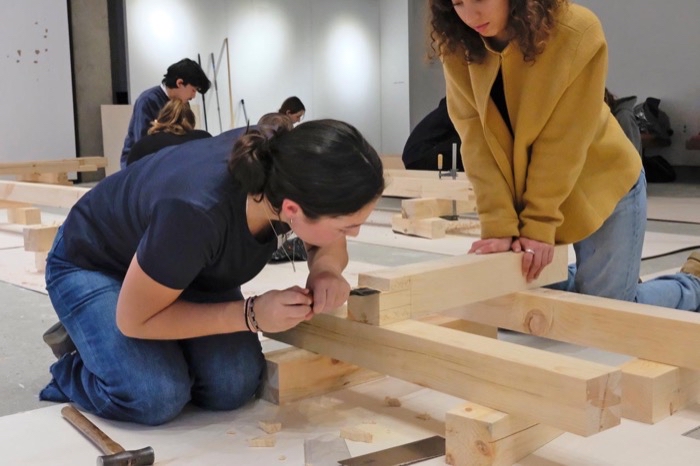
Photo courtesy of Douglas Brooks
AMERICAN STUDENTS
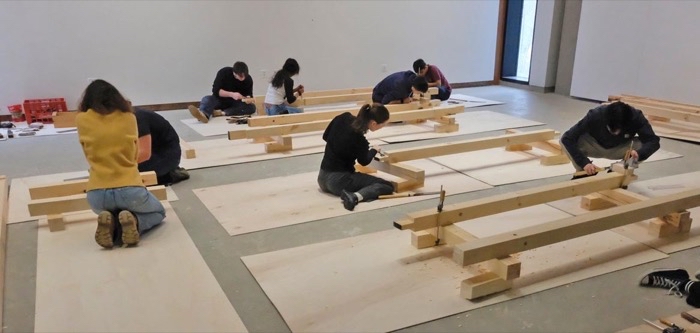
Further, the knowledge and practices that Brooks receives in Japan he is more than willing to teach to American students, including those at Harvard, Cold Springs and Middlebury College. This J-term, he is leading another Japanese building course here in Middlebury up on the hill.
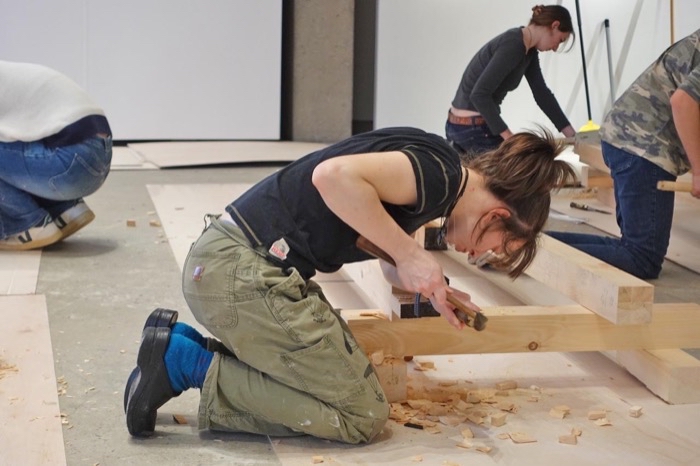
“Many of my students have never driven a nail with a hammer,” Brooks says with rueful affection. “It’s amazing, this generation, how divorced they are from craft.”
His students are continually surprised to learn on the first day of class that the course will be taught in silence, as is the old way in Japan.
“The most common comment is, ‘I thought I knew what it meant to focus and this class just took that completely beyond anything in my imagination.’”
While some of his abler students have some degree of upbringing within the practice of carpentry — “a grandad with a shop in the garage,” for example — Brooks finds that oftentimes his best students tend to be women.
“The ones who have no experience woodworking. [Too often] the guy who has a shop and builds birdhouses is the student you can’t seem to reach. Because he thinks he has to project this knowledge. Because we’re doing woodworking. And [he feels he must] a priori be an expert. No. Let it go. Shut up. And let it in.”
This is the fifth Winter Term course Brooks has taught at Middlebury College. The students are building the timber frame for a small Japanese teahouse, which will be unveiled in a public ceremony at the college on Jan. 29. Construction of the teahouse serves as a backdrop for students to explore the technical aspects of Japanese carpentry and the cultural underpinnings of apprentice learning.
It is hoped that students will see how the apprenticeship system stands in stark contrast with our Western notions of teaching and learning. Exploring how apprenticeship and tea ceremony reflect aspects of Buddhist training will shine a light on students’ accepted notions.
Brooks says the approach he uses in class is very Zen Buddhist. Invariably, the first step during any apprenticeship Brooks has undertaken in Japan is grabbing the broom and sweeping the boatbuilding shop to perfection. Then, and only then, does the master permit him to take the next step.
In the Western mentality, it’s too frequently about “how great I am,” Brooks says.
He acknowledges that in his younger years, he has been that guy himself:
“I made mistakes initially. And I’ve learned to be humble. I’ve learned how to embrace it.”