
Sports
Matthew Dickerson: Intrepid anglers love to go ‘blueing’
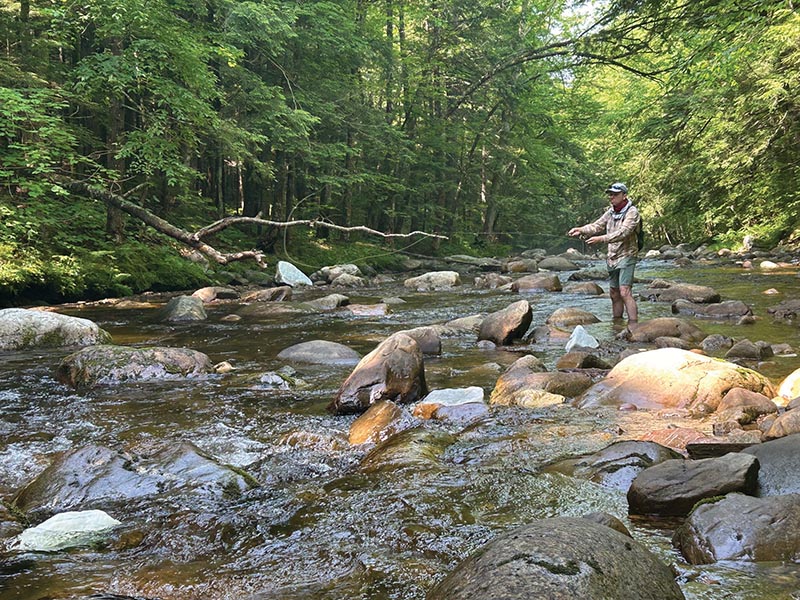
It was my friend Drew YoungeDyke who introduced me to the term “bluelining.” At the time, Drew had recently taken a job as national communications director for Trout Unlimited, and we were both serving on the board of directors for the Outdoor Writers Association of America. When our annual winter board meeting was scheduled in New River Gorge National Park with a free morning to explore built into the week’s itinerary, Drew and I planned in advance to do some fishing together. When he suggested we go bluelining, it took me at most a half minute to parse the phrase and deduce what he meant.
If you take a look at a map — not just a street map with driving directions, but the more detailed kind that shows geographic features — you may notice all the squiggly blue lines of varying widths. Indeed, if you are an angler, those are the first features you notice in a map. Things like roads and highways and towns are afterthoughts: merely ways to access the blue lines. Because in most cases the blue lines represent streams, brooks, rivers, creeks and other natural forms of running water. Bluelining, simply put, means finding one of those blue lines on the map and exploring it with a fishing rod, hoping to find fish.
MATTHEW DICKERSON
To be clear, not all river and stream fishing is bluelining. If I head out to some favorite spot I have fished before, I am not bluelining. If I am traveling somewhere and I hire a guide who takes me fishing on some famous river, that isn’t bluelining either. Bluelining is when you look at a map, find a blue line where you haven’t fished before (and maybe don’t even know its name until you find it on the map), and you go fish there because it’s a blue line. Perhaps it has some features that catch your eye, like a long stretch away from roads and development, or surrounding forest that promises cold clean water, or perhaps a steep gradient that will keep the water tumbling and well aerated. Maybe after finding some prospective blue lines and looking up their names, you might do a little research to learn something about that particular river or stream. But the key thing is that it’s all about exploring.
Now the truth is, I had been bluelining many times in my life, long before I heard the term from Drew. In my younger days, it was done with a Delorme Atlas. In my teens and twenties, I owned one for several different states that I had visited or gone to school in or had relatives in. More recently, I have swapped to a more convenient phone app called Stream Map that has a complete map of every little flowing section of water across the region with the bonus of using the phone’s GPS to show you exactly where you are in relation to those blue lines.
In our case that late March day in West Virginia, Drew and I were hoping to find some wild trout. Or even some stocked ones. The stream we explored together was promising. Online information was spotty, but there were at least a few hints that it harbored some fish. And we certainly found it to be beautiful when we arrived, with spring wildflowers in bloom all along the trail. Though not very large — only about the size of some of the named tributaries of the Middlebury and New Haven rivers — the water was cold and clean beneath a thickly forested canopy as it came down off the bluffs on the north side of the gorge, tumbling over waterfalls and cascades as it dropped hundreds of feet of elevation in just a few miles before flowing into New River.
But neither of us caught or even saw any trout.
That possibility is always part of the exploratory nature of bluelining. Thankfully, we didn’t surprise any rattlesnakes either, which was one of our concerns based on what we’d read about the area. In any case, the lack of fish didn’t make the trip a failure in any sense. We had a very enjoyable time exploring together, and we learned a few things that might (or might not) make a later bluelining trip more likely to lead to trout. (At the minimum, I learned of one blue line that I won’t return to if I ever get back to the New River Gorge.)
A few days later, without Drew, I headed out bluelining again on a small river on the opposite side of the gorge and caught my first ever tiger trout — a sterile cross between a brown trout and a brook trout.
Since then, I have been doing more bluelining back in Vermont. Sometimes alone, but sometimes with a friend. A wonderful thing about Addison County and the surrounding parts of Vermont is that there are myriad blue lines on the maps. Every river coming down off the mountains on both sides has dozens of tributary brooks, and even the main rivers still have miles of water I have not yet explored in my nearly four decades of fishing in Addison County. When my friend Dave was visiting a couple weeks ago, we went bluelining up in the Green Mountain National Forest and found a stream with an abundant population of little brook trout.
The problem with doing that, though, is that when we went fishing the next day we returned to the same spot. At which point it ceased to be bluelining. Which actually wasn’t a problem at all.
More News
Sports
VUHS boys’ hoops triumphs over Winooski on path to Barre
The Commodores triumphed over Winooski for a third time this season. But the victory was t … (read more)
Sports
Playoffs on tap for three local teams
The VUHS boys’ basketball, MUHS boys’ hockey and MUHS girls’ hockey teams all upset their … (read more)
Sports

Panthers hockey teams drop league tournaments, miss NCAA tournament
Neither Middlebury College hockey team made the NCAA tournament this year.