
Education News
Teens earn wings with the Flying Tigers
MIDDLEBURY — A new club has been creating quite a buzz at the Patricia Hannaford Career Center.
A buzz? Some might compare it to a swarm of angry mosquitos.
Jokes aside, we’re talking about the Flying Tigers Drone Club, which took flight for the first time this past winter. And it’s attracting a growing number of middle and high school students who enjoy programming and piloting unmanned aerial vehicles.
The Independent attended a recent club session at the Career Center, and it didn’t disappoint.
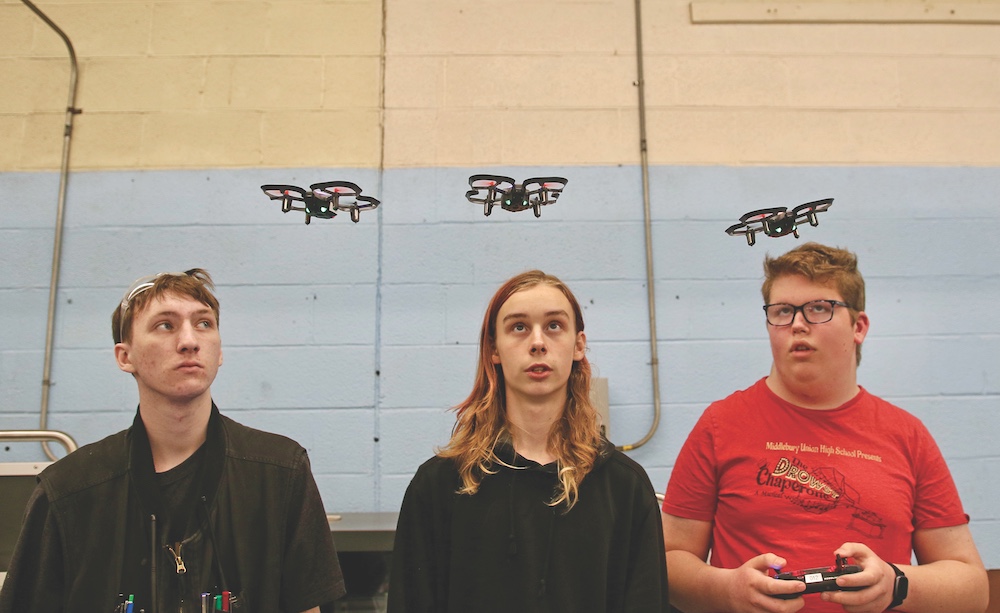
While club supervisor Dan Arensmeyer looked on, young pilots Eben Smith, Raphael Mitchell and Alden Sherry picked up their controllers and activated the four propellers on their respective drones, each of them roughly five square inches in size. Following a gentle liftoff from a table in the school’s Advanced Manufacturing lab, the drones — in almost perfect unison — began to hover at eye level in front of each of the pilots.
But that was just a warmup.
The trio soon had their drones zipping around the room, evading desks, computers, machinery and other potential collision points.
Their short mission concluded, each teen brought their drone back to a gentle landing, at their feet.
Mission accomplished … until the next one.
Arensmeyer is perhaps the perfect commander for the Flying Tigers. He holds a commercial drone pilot’s license and is a PHCC faculty member, teaching Advanced Manufacturing & Engineering, and Intro to STEM.
“Both programs focus on computer-aided design and manufacturing, with 3-D printing, laser cutting and engraving, waterjet cutting, a little bit of plasma cutting,” he explained.
It’s Arensmeyer’s first year teaching at PHCC; he previously taught at the Stafford Technical Center in Rutland.
He wasn’t always an educator, though; in his prior professional life, Arensmeyer worked 31 years for the U.S. Navy — most on active duty as a submariner.
So how did a man who served his country while submerged in a massive metal tube come to embrace the idea of teaching students to manipulate aerial devices weighing just a few hundred grams?
“I found that teaching teenagers how to fly drones or operate CNC machines isn’t that different from teaching 20-year-olds how to operate a nuclear reactor,” he said with a grin. “There are a lot of the same skills involved.”
FLYING & PROGRAMMING
The club’s genesis can be traced back two years ago, when Arensmeyer attended a career development day in Connecticut, at which he was introduced to the concept of using drones as a teaching tool in a classroom. It wasn’t just about the flying; it was also about programming the drones using the Python programming language, which is commonly used in robotics.
Arensmeyer embraced it and got very good at it. More than good enough to teach it to young folks in grades 9-12.
He insisted it’s not difficult to get in on the ground floor of the Flying Tigers.
“There are different learning objectives, but the nice thing about the drones is, there’s nothing to build first,” he said. “You can dive right into it and begin programming.”
Programming can allow the drone to go on autonomous flight paths.
The Flying Tigers meet every Wednesday at 3:30 p.m. The career center serves students in the Addison Central, Addison Northwest and Mount Abraham school districts. Club participants have a great time putting their drones into motion, swapping ideas and having little races. They also get a few chances each year to measure their piloting skills against teens from other tech centers.
“There’s the competition aspect to it,” Arensmeyer said.
For example, on Feb. 2, the Flying Tigers traveled to Springfield to compete in the second annual River Valley Aerial Drone Competition. Twenty-one teams from Vermont, New Hampshire and Massachusetts competed at the event. The Tigers’ “Flight A” made up of high schoolers, advanced to the semifinals and finished in the top four, while the club’s middle school team finished sixth overall in the “piloting and autonomous skills” competition.
Competitions are about careful drone guidance and pilot dexterity. Club members demonstrated their prowess on a competition course set up in a separate room at PHCC. The obstacle course includes a series of props with holes through which the pilots must guide their drones; short stands from which the drones must knock off bean bags; and a network of PVC pipes through which pilots guide balls using the air generated by the drone propellers.
It’s a timed course, with the fastest times (and fewest mistakes) earning the most points.
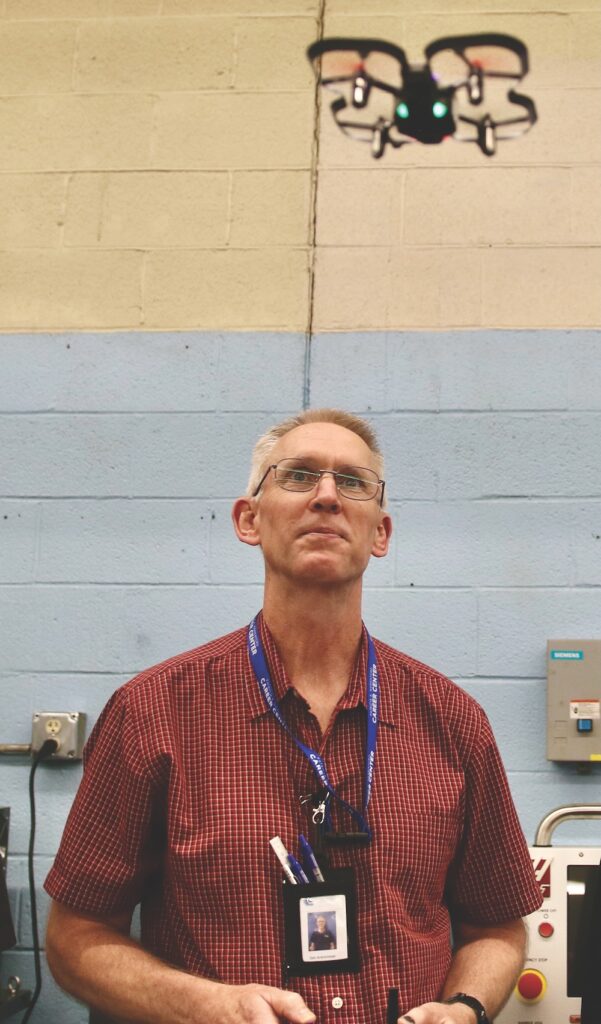
DAN ARENSMYER IS supervisor of the Flying Tigers club, but his primary role is as a teacher of Advanced Manufacturing & Engineering and Intro to STEM at Middlebury’s Hannaford Career Center. Arensmeyer is also a U.S. Navy veteran.
Independent photo/Steve James
And let’s be clear that fast, when it comes to drones, isn’t always a good thing, Arensmeyer noted.
The drones used by the Flying Tigers can reach speeds of around 20 miles per hour but have a limited range — less than 100 feet.
“Races aren’t conducive to the longevity of the drones,” he said with a chuckle. “They’re pretty durable and will take a hit. But they’re not indestructible. We have four that don’t fly anymore; they’re just for parts now.”
Since drones are part of the Intro to STEM course, the Career Center purchased 10 of the devices, which are also used by the Flying Tigers. As those drones wear out, Arensmeyer hopes to replace them through alternative funding streams and donations. This way, club members can continue to have a fun, educational experience without having to come up with around $250 for their own programmable done. These drones aren’t equipped with cameras or GPS.
MEET SOME TIGERS
Sherry is a ninth grader at Middlebury Union High School. He’s been involved with the local Lego League for the past six years and has been flying drones recreationally for the past few years.
“A bunch of my friends were (joining the Flying Tigers), and I decided to do it,” he said.
Sherry finds the drome programming and the flying equally fun.
He’s enjoyed the competition, which he said are an opportunity to “have fun and meet the other teams.”
He’s still working on his FAA certificate and wants to dive deeper into drone technology and use.
Smith, an MUHS 10th grader, developed an interest in drones last summer, after his dad purchased a high-speed racing drone.
“We were flying them when I went into this school year, when I had chosen the STEM program,” he said.
He was among the charter members of the Flying Tigers when the club launched in January.

ALDEN SHERRY AND Raphael Mitchell, two members of the Flying Tigers Drone Club, get ready to put their flying machines through the paces of a competition obstacle course at the Hannaford Career Center.
Independent photo/Steve James
Smith has found the program very enjoyable.
“Getting to be able to design stuff, run code, getting the drones to fly up, forward, avoid obstacles and land,” he said of his favorite club activities. “It’s also part of STEM, which is of great interest; I love working with my hands, mathematics, technology.”
Mitchell, rounding out his sophomore year at MUHS, has been interested in drones since he was around 8.
“I got a little helicopter then, and when I was 12, I got a decent-sized drone,” he recalled.
“I managed to put both of them in trees around 10 times,” he confessed with a smile.
Since he’s joined the Flying Tigers, he’s learned a lot more about drone programming.
But, for him, it all boils down to takeoff.
“I love the flying. I’m the flyer of the group, communicating with other people, trying to get tasks done,” Mitchell said.
Other devoted Flying Tigers members this year included students Zephyr Haugan, Chris Bunt, Killian Barry and Finn Roark. Check out the club on Instagram.
What will the young aviators take away from their Flying Tigers experience? An understanding of aerodynamics, how drones are constructed, how they fly, how to control them and how to repair them. Club members earn an “FAA Trust Certificate” — in essence, a license to fly recreational drones. Some Flying Tigers could take the added step of earning a commercial drone flying license, which would position them to potentially fly drones for law enforcement, real estate or other professional purposes.
Drones also make learning a lot more fun.
“It’s so fun to see young people get interested and engaged in something,” Arensmeyer said, as he gazed upon the room of focused pilots and acrobatic drones. “When it gets to a point where they’re driving their own learning and I’m there to help them, that’s nirvana.”
John Flowers is at [email protected].
More News
Crime News
One killed, another seriously injured in Orwell crash on Sunday
Twenty-eight-year-old Michael Guess, who was pronounced dead at the scene of the crash, wa … (read more)
News

Gov. Douglas pivots to health care reform
Middlebury’s James Douglas spent eight years managing the general health of the Green Moun … (read more)
News

Shoreham Democrat announces House bid
Jonathan Hescock has served Shoreham as a planner, library trustee and historical society … (read more)