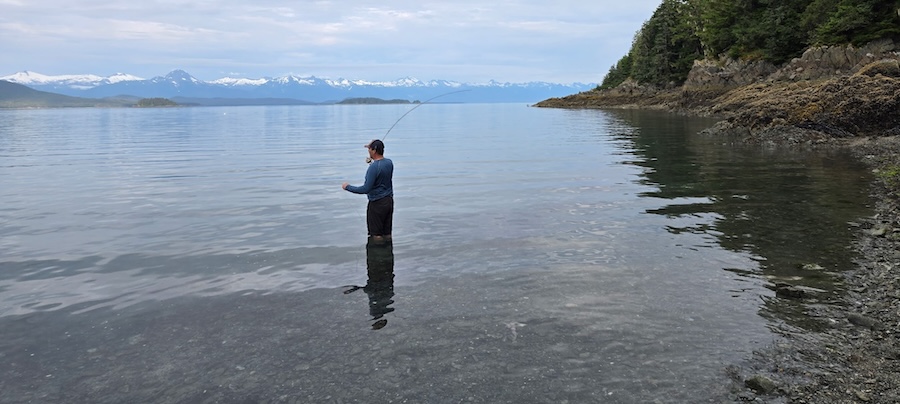
Pink and chum salmon are jumping and cruising all across Amalga Bay, some out in the deep water and others in the shallows close enough to the beach to see them underwater. A large school is stacked up at the river mouth waiting for the tide to come in high enough to lift them over the small waterfall so they can begin their spawning journey. Several hungry bald eagles look down from the tall, lichen-draped Sitka spruce and Douglas fir that line the hillside above shore.
It’s early morning. Wendy, Deborah and Jeff are still back at the house, but Jim has been down by the water for a while, watching the black bears, eagles, sea gulls and seals dining at the feast. Randy and I have just walked the quarter-mile through the woods down to the water to join him. I have my saltwater salmon rod with me and after a few minutes I rig it up with a heavy salmon fly. It takes me several minutes of casting out among the cruising fish before I entice one to strike, and am able to bring in a seven- or eight-pound female chum salmon — also known as a dog salmon or keta.
This salmon, though it is strong and fights hard, has already started to change colors, taking up the mottled purple and green smears particular to its species. Soon, it will lay its eggs and die. It is far enough into the process that its flesh will not be very good to eat. I hold it up for a photo and then release it so that it can make more salmon. I take a few more casts, and then we head back to the cabin to join the others for a morning outing.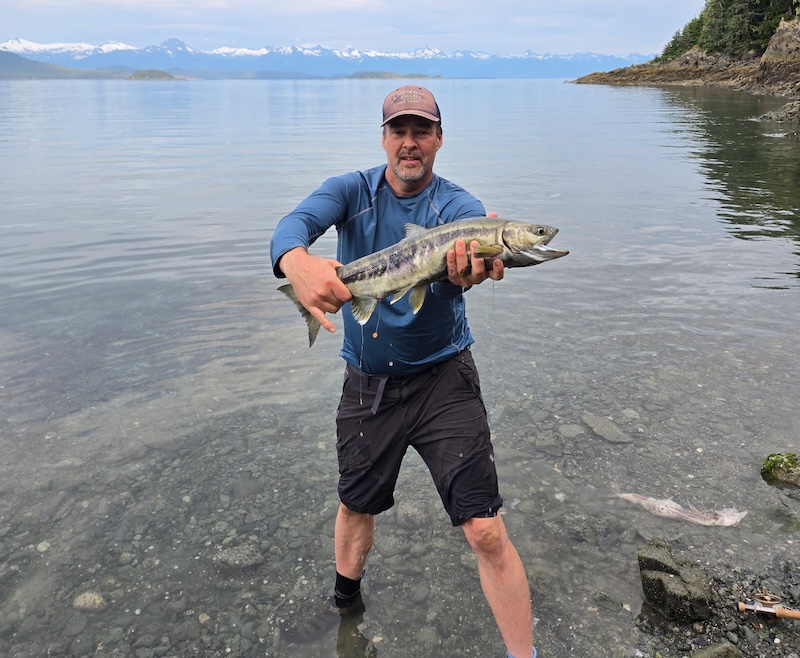
It’s our first morning together in Juneau: six Vermonters, five of whom are from Addison County, and all, except me and Deborah, are visiting Alaska for the first time. Two years earlier, when I served as an artist-in-residence for Alaska State Parks at the nearby Ernest Gruëning State Historic Park, I discovered the Eagle Valley Center run by the Parks and Rec Department of Juneau. Part retreat center and part nature preserve, it sits on the edge of the beautiful Amalga Meadows down a long, quiet, gravel driveway, far from the nearest house but only a quarter mile from Amalga Bay. In addition to the short trail down to the bay, it has a longer trail that follows the coast up to Eagle River and connects to miles of trails into the Tongass National Forest. When I learned it sleeps up to 14 in three bedrooms, and has a full kitchen, a large and comfortable meeting space, and a beautiful deck looking over the meadow, I made a mental note that it would be a lovely place to bring a small group one day for an Alaskan retreat. When our friends Jeff, Jim, Randy and Wendy all expressed interest in joining me in Alaska this summer, I reserved the center for our first four nights.
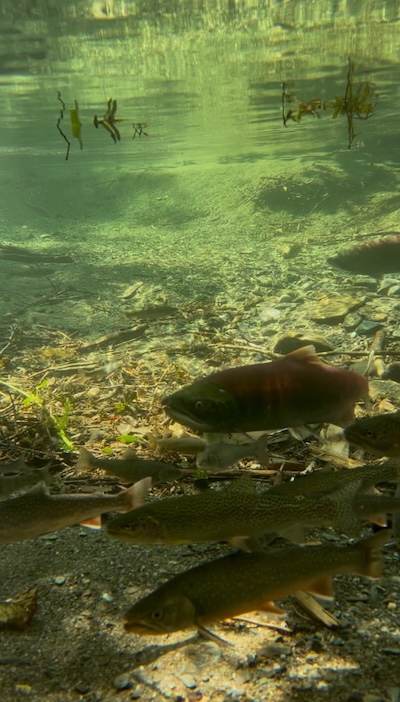
Photo courtesy of Matthew Dickerson
Returning from the bay to the large retreat-center cabin, we gather the crew and take a longer hike north along the coast up to Eagle River where we see — to nobody’s surprise but everyone’s delight — a whole lot of bald eagles up and down the wooded riverbank where yet more salmon are spawning and dying. When we return two days later to the state park on the other side of the large glacial river, I count 14 eagles visible from one spot on the shore.
After a lunch and nap back at the cabin, we drive back down the highway and visit the central outdoor attraction for many visitors to the Juneau area: the famous Mendenhall Glacier. Since 2001, as yet another sign of dramatic climate change, a massive late summer release of water has been flooding the valley nearly every year — sometimes with catastrophic damage. With a report that the flood is due any day, we decide to visit as soon as possible. We are not disappointed. The glacier and mountainous background is impressive and spectacular, as is the thunderous Nugget Falls that pours into the lake from the cliff on the south side. But it is the quiet, mile-long, wooded loop walk called the “Trail of Time” that I enjoy the most. When the bridge crosses a small stream, we look down into the water and see several sockeye salmon spawning in the crystal-clear water, surrounded by cutthroat trout and Dolly Varden char that are circling about hoping for a meal of salmon eggs. The scene is iconic and beautiful.
And it is also a good warmup for the next day when we drive to the northern end of the Glacier Highway and Randy, Wendy and I spend the morning fishing for Dolly Varden in the cold, green-tinted water of Cowee Creek amid schools of spawning pink salmon. For weeks we have been following the Juneau-area weather, and the daily forecast has been very consistent: rainy with daytime temps in the low 60s and nights in the low 50s. Except we woke this morning to clear skies and a forecast of 75, with four more days of the same in the forecast.
I’m not sure whether I’m more delighted to watch Wendy catch her first Dolly (which we bring home to eat for supper that night) or when a big pink salmon takes her lure and she manages to land it in a heavy current. Though landing a 19-inch Dolly of my own was pretty fun, too. That evening, Jeff and I take a walk over to the state historic park and the cabin where I served my artist residency. We are partway down the road when a black bear sow with two cubs steps out of the woods only 20 yards in front of us, gives us a quick glance, ignores us, and waddles down the road with her cubs behind her.
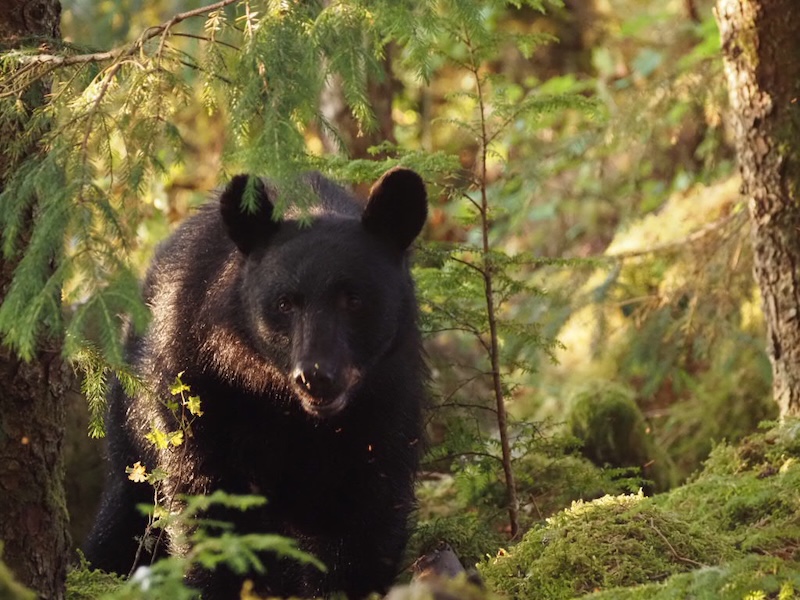
Photo by Randy Provencer
The next morning, Randy and I return alone and Randy manages to catch several Dollies. While we are gone, Deborah and Wendy walk to Amalga Bay. They see a different pair of bears, and get to watch them fishing for salmon. The weather stays sunny. The floods come to the Mendenhall Valley, but they are milder than in some past years and damage is minimal.
All in all, it is an amazing first visit to Alaska for several Vermonters, with an amazing gift of weather. And it isn’t over. Our schedule for the last three days is to ferry over to Glacier Bay National Park. But you’ll have to wait for our next column to hear more about that one.