MIDDLEBURY — “Carry on.”Two short-but-profound words we will always associate with our friend and colleague Karl Lindholm. Those words gained even greater symbolism last Tuesday, May 26, after Karl — our award-winning sports columnist and the Emeritus Dean of Advising and Assistant Professor of American Studies at Middlebury College — made our collective hearts skip a beat due to a health scare.
Karl is someone you might call a “loquacious raconteur.”
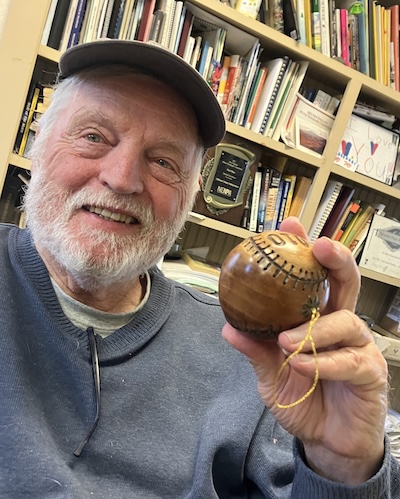
In other words, Karl likes to chat.
And at the age of 81, Karl has banked considerable knowledge and life experiences that make his stories well worth a listen. On one day, it might be about a trip to Maine to see a dear high school buddy; on another day, it might be an insightful account of how Middlebury College dumped its fraternity system.
A lover of baseball and student of the Negro leagues, Karl might randomly offer a mesmerizing recap of the no-hitter that Atlantic City Bacharach Giants pitcher Nip Winters threw against the Indianapolis ABCs back on July 26, 1922.
If I have time, I swivel my newsroom seat to give Karl my full attention. If I don’t have time, I pretend to type on my laptop and listen anyway.
Karl is our beloved Siri/Alexa with a camouflaged off switch, though he’s always sympathetic to colleagues’ deadlines — he has one too, for his column. And he lets you know, with two words, when he’s wrapping up his reminiscence du jour:
“Carry on.”
On that Tuesday morning, Karl came into the Independent newsroom to touch up his column for the May 28 edition of the paper. But first, he wanted to catch up with his peeps; it’s something I’ve learned not to take for granted. Then, seeing my computer cursor dangling at mid-paragraph, Karl whispered those two words to me while gently clasping my shoulders:
“Carry on.”
But five minutes later, Karl had stopped carrying on. To our collective horror, he had suddenly slumped forward in his chair just a few feet from my own, after letting out a loud groan.
He drew in a deep breath and then promptly stopped breathing.
Suddenly, the world stops turning, and fear — of the unknown, of the gravity of the situation — takes hold.
In a newsroom where we work to break stories, Karl was broken and we didn’t know how to fix him.
But thanks to the application of basic lifesaving techniques, we were able to buy Karl time until the pros — the folks from Middlebury Regional EMS (MREMS) and the local police — came to the rescue.
It was a team effort, knitted together with three critical letters: C-P-R, otherwise known as cardiopulmonary resuscitation.
While fellow reporter Sophia Keshmiri called 911, news editor John McCright and I laid Karl on the floor, on his back. I harkened back to my high school days circa 1977 and recalled a dummy on which we’d practiced chest compressions and mouth-to-mouth. But Karl is no dummy and this was no drill. I pumped a few breaths into him and fumbled with some chest compressions until a disembodied voice (an emergency responder whose name I wish I knew) provided critical speaker-phone guidance on the rate and depth of the required pushes on his sternum.
Arts editor Elsie Lynn Parini had gone through CPR training just a few years ago. Cool as a cucumber, she jumped into the fray, and together we spelled each other during what became a steady stream of chest compressions. Karl was thankfully groaning and gulping the occasional breath. Between those, however, his body was motionless — lifeless — except for the raucous jerking caused by the forceful chest compressions Elsie and I were administering.
Everyone in the office that morning played a role. Production Manager Sue Leggett sought contact info for Karl’s family. Circulation Manager Sean Dougherty, whose father is himself a first responder, cleared the doorways to ensure that MREMS could bring in a stretcher. Everyone else was sending caring, compassionate thoughts Karl’s way and ensuring responders would have everything they needed. And MREMS officials arrived in just four or five minutes. Like a well-oiled machine, the MREMS team gracefully stepped in, continued the compressions and provided Karl with some medicinal and tech help until he’d been stabilized for his trip to the University of Vermont Medical Center.
Graphic designer Shannon Hart — certified in First Aid and CPR — had by this point arrived and stood by in case MREMS needed an extra pair of hands.
On Wednesday, Karl was still in the hospital, but we’re happy to report that he is on the mend.
BE PREPARED
After decompressing from what was a very stressful situation, we asked ourselves — what if Karl had decided to finetune his sports column at home, alone? What if Karl had suffered his cardiac event in a setting far removed from an ambulance association or first responder group?
But “what ifs” are irrelevant, because the past is permanent.
Better to be prepared, according to MREMS Executive Director Kate Rothwell, who was on the crew that came to Karl’s rescue on May 26.
“It’s absolutely crucial,” Rothwell said of the basic CPR knowledge, which can be enhanced with the presence of an Automatic External Defibrillator, known as an AED. An AED is a portable device that delivers an electric shock through the chest to the heart when it detects an abnormal rhythm and changes the rhythm back to normal, according to the American Heart Association.
Middlebury police carry AEDs in their cruisers. The devices can also be seen in shopping areas, larger office complexes and at some sports facilities in Addison County.
Sometimes, though, it has to be the hands-on approach, Rothwell acknowledged.
“That first five minutes, compressions are the most important,” she said.
You can find CPR details online at tinyurl.com/36635s66. But here’s an overview:
- If the person does not respond to taps or shouts and is not breathing or only gasping, call 9-1-1 and get equipment, or tell someone to do so.
- Place the person on their back on a firm, flat surface and kneel beside them.
- Place two hands centered on the patient’s chest, with your shoulders directly over your hands, elbows locked, and press to a depth of at least two inches. Administer 100 to 120 chest compressions per minute, 30 at a time. Allow the person’s chest to return to normal position after each compression.
- Give two breaths. Open the airway to a past-neutral position using the head-tilt/chin-lift technique. Pinch the nose shut, take a normal breath, and make complete seal over the person’s mouth with your mouth.
Ensure each breath lasts about one second and makes the chest rise; allow air to exit before giving the next breath. Please note that if the first breath doesn’t cause the chest to rise, re-tilt the head and ensure a proper seal before giving the second breath. If the second breath does not make the chest rise, an object may be blocking the airway.
- Continue giving sets of 30 chest compressions and two breaths. Use an AED as soon as one is available. Minimize interruptions to chest compressions to less than 10 seconds.
How crucial is CPR to the recovery of a heart patient?
Generally, every minute without CPR can decrease the person’s chances of survival by approximately 7%-10%, according to Rothwell, quoting from AHA statistics.
“As you can imagine these are exceptionally challenging odds in rural areas with response times,” she said.
While the Independent’s offices in the Marble Works are only a couple miles from the MREMS headquarters on Collins Drive, it’s a considerably longer trek from Middlebury to Orwell. And that’s why local first-response crews and a knowledgeable citizenry are so important to good patient outcomes.
In 2025, MREMS responded to 31 cardiac arrest incidents where resuscitation efforts were performed, according to Rothwell.
Seeing your local rescue squad pull up to a medical emergency is a huge comfort — especially in this day and age.
“Paramedic-level crews can provide nearly all interventions in a cardiac arrest that would be performed in the hospital,” Rothwell said. “Due to this, in most cases an Advanced Life Support resuscitation is performed on scene to ensure focus on critical interventions rather that rushing immediately to the hospital.”
GROUP TUTORIALS
The folks at MREMS would like to see you in situations other than just emergencies. Rothwell and her crew — when they’re not out saving lives — can give groups tutorials in CPR, and how to recognize and remedy choking, strokes and bleeding. Call 802-388-3286 for more details.
Rothwell is pleased that community members have been taking advantage of the MREMS education offer.
On May 17, during National Emergency Medical Services Week, MREMS held two community CPR, Stop the Bleed and Stroke recognition classes that delivered training to more than 50 local people.
“These are the skills that become another link in the chain of survival where seconds matter most,” Rothwell said.
A chain of survival that’s now linked to Karl Lindholm.
Carry on.
John Flowers is at [email protected].