MIDDLEBURY — As executive director of Middlebury’s Henry Sheldon Museum of Vermont History, Coco Moseley is used to handling artifacts collected over many years by museum’s storied namesake. She and her colleagues can dip into a deep reservoir of exhibit inspirations, including maps, folk art, glassware, fabrics, furnishings, militaria… The list goes on and on.
But an item doesn’t necessarily need to be old to find an honored place at the Sheldon. In fact, Moseley has joined 99 other people — many of them Middlebury-area residents — in crafting a new display at the Sheldon that will chronicle climate change in Addison County during the past 101 years (1923-2024).
It’s called a “tempestry” — an amalgam of the words “temperature” and “tapestry.” It’s knitted fiber art, using different colors to evoke annual temperature shifts through the course of time. Once completed, the Sheldon’s tempestry will measure 12.6 feet long and be displayed inside the stairwell area linking the Sheldon’s first and second floors.
Picture a king-sized scarf comprised of an assortment of 1.5-inch lines of varying blue and pinkish hues. The color scheme, for each year, is determined by the average temperature for the year represented by that individual 1.5-inch line. The colder the year, the darker the blue. The warmer the year, the more vibrant the pink.
“To me, it represents the direction of the museum, where we think about community-led and community-engaged projects, conversations that are relevant to our community, and ways we can bring in the collection,” Moseley said. “It’s not only thinking about who we were; we’re also thinking about where we’re going. The arts & humanities aren’t going to solve the climate crisis, but it’s a way to help us grapple with it and understand about resiliency. Maybe it reengages out commitment to thinking about what we can do differently.”
It was around two years ago that Ellery Foutch approached Moseley with the tempestry idea. Foutch is president of the Sheldon board and is an associate professor of American Studies at Middlebury College. Her classes focus on the art and material culture of the United States and critical museum studies.
“People are using knitting and crocheting as a means to communicate the changes we’re seeing in temperature,” Moseley said. “You can purchase kits that come with yarn.”
But Moseley and Foutch wanted to put a special spin on the Sheldon tempestry project.
“Where my brain went with the project is, ‘How can we do this as a community?’” Moseley said. “It’s one thing to knit your own tempestry, but in terms of the Sheldon, our new mission is about being engaged in community conversation, inviting people to bring their skills, curiosity, questions. Climate change looms large for a lot of us. We see so much defunding of green energy and pulling out of the Paris Accord.”
Moseley reasoned that localizing the project would prevent it from becoming a contributor to climate change.
“I wanted to see is use local wool; we didn’t want to purchase kits and have them shipped here,” she said.
As luck (and generosity) would have it, Donna Perrin was able to donate two large boxes of Romney wool skeins from her family’s Creek Road sheep farm.
The New Haven and Lincoln libraries each loaned a yarn swift that Moseley used to unfurl the skeins. She found that one skein contained enough yarn to knit three tempestry years. Each year — 1.5 inches wide by 3 feet long — requires around 38 yards of wool string to knit.
But before farming out the wool, Moseley had to do some careful planning. She devised a chart with calculations leading to dye mixtures corresponding to the colors needed to represent temperatures for each tempestry year. Middlebury Energy Committee member Mike Roy provided a huge assist in assembling the temperature data, pulled from the National Oceanic and Atmospheric Administration. Among the findings: The average temperature in Addison County in 1923 was 39.6 degrees Fahrenheit, compared to 45.6 degrees in 2023.
“You can see that the winters used to be colder,” Moseley said. “We’re getting longer stretches of higher temperatures. We still have cold; there’s just a large variation in how long that cold lasts.”
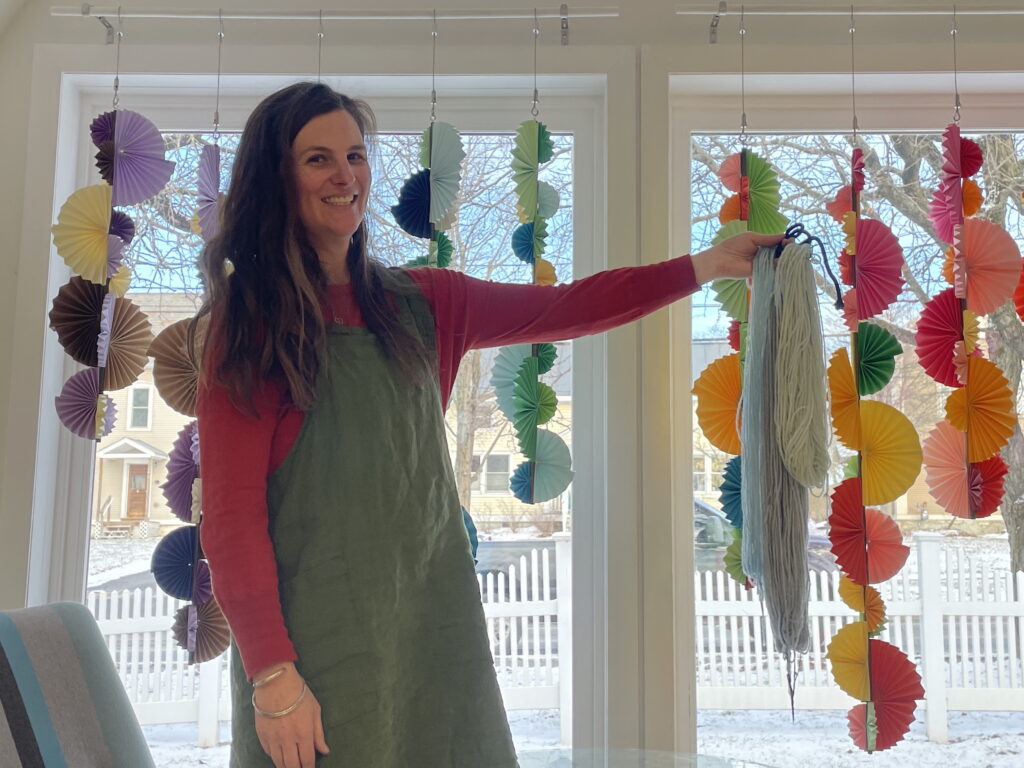
With the temperatures plotted and color formulae established, Moseley began to dye the wool skeins. She was indeed the perfect person for that job. In addition to her museum and library director credentials, she’s raised sheep and is a knitter and a spinner.
But she realized her own kitchen was ill-suited to a large-scale wool dyeing process.
Fortunately, Middlebury Studio School Executive Director Sarah Briggs invited Moseley to use the studio’s dyeing facility at 94 Court St.
“This has been really key to the project,” Moseley said, as she transferred coils of newly tinted yarn from a dye pot to a drying rack on Friday. “I have space where I can spread out and do my work.”
As of this writing, 65 people has signed up to knit a year of the Sheldon climate tempestry. If you want to get in on it, check out tinyurl.com/4m4uetx2. Do it quickly.
“I have no concerns about not having enough (knitters). They just keep coming.”
Once each volunteer knitter has completed and submitted their “year,” Moseley will bind them all together for display of the tempestry beginning this May, through January of 2027.
Complementing the tempestry exhibit will be an assortment of mid-to late 20th-century winter tools and artifacts culled from the Sheldon collection. The display will include such things as snow shovels, ice skates, earmuffs and quilted bonnets.
Assisting in the curation of the exhibit are several Middlebury College J-term students born after the 20th century ended. The students are studying the art and the material culture around winter.
Were he still alive, Henry Sheldon would probably have enjoyed the tempestry exhibit, Moseley believes.
“He kept registers and journals and often referred to the weather,” she said. “We are a weather-oriented species and we’re offering the museum as a space to engage in that conversation.”
Major weather events have historically brought out the best in Addison County residents, Moseley noted, with neighbor helping neighbor during floods and snowstorms.
“We’re able to be there for each other. This is another opportunity for people to come together, to knit it.”
Briggs is a big fan of the tempestry project and is pleased the Middlebury Studio School could be a part of it.
“Tempestry is a creative and collaborative project that shines a light on the climate crisis while also highlighting local artists. I think it’s wonderful that Coco sourced local wool and rallied volunteers for our community for the project,” Briggs said. “The materials and method of the project itself reflect practices that are better for our earth. And the process has been so fun to watch… MSS is always excited to partner with artists and organizations in creative ways. Watching Coco and Ellery experiment with dyes to create varied shades of blue, the studio felt like a lab; there was such a beautiful blend of science and art in their work. I think that when people see the finished work, they will experience a similar awe, which hopefully will highlight the severity of the climate crisis we are facing.”
John Flowers is at [email protected].