
News
Porter doctor returns from the brink
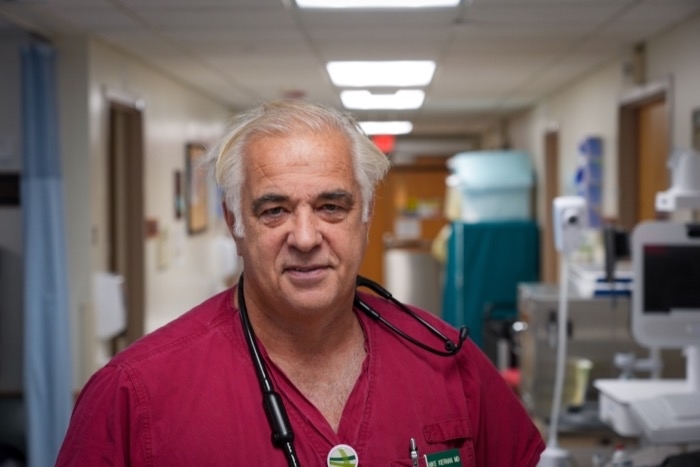
To all of a sudden be the person who needs help, it’s an abrupt change.
— Dr. Mike Kiernan
MIDDLEBURY — Dr. Mike Kiernan has treated thousands of patients during his almost quarter century with Porter Hospital’s Emergency Department. He’s done it with skill and compassion, crossing paths with folks having some of their worst — and sadly, sometimes last — days.
And last year, for the first time in his then-65 years, Kiernan had one of his own worst days, one that would see him suddenly flip from physician to patient, ironically, and thankfully, while he was on the job.
The life-threatening incident occurred at around 9:30 a.m. on Wednesday, April 3, 2024 — sandwiched between a late-winter snowstorm and a total solar eclipse.
It began much like any other morning for a seasoned ED doc like Kiernan: caring for someone other than himself and doing it well.
“We were having a good day. We had a number of (patients), but it was going really well,” he said.
As he was noting improvement in a patient about which he had previously been particularly concerned, Kiernan felt a sensation in his own chest that he can now sardonically recall as being “surprisingly specific.”
“I felt a ‘tearing’ sensation, but it wasn’t severe. It literally felt — and I don’t know why this flashed in my mind — like a young child’s fingers were digging through layers of sand at the beach, trying to get a shell; these cold little fingers were (digging) in a persistent way,” he said.
Kiernan has an admirable facility with the English language that allows him to paint in paragraphs. It also allows him to specifically describe to fellow caregivers exactly where and why he’s hurting.
“It was around 10 centimeters below my super-sternal notch, where the collarbones meet, and another 15 centimeters in the chest,” he said, flipping the switch from Thoreau to DeBakey.
But other than perspiring a little, Kiernan felt fine, like it might be a passing episode.
“I didn’t have shortness of breath, didn’t feel like I was going to pass out; it wasn’t terribly uncomfortable, but it was certainly something,” he recalled thinking.
Kiernan turned to unit Clerk Gail Mannigan and asked her to summon Porter Emergency Department Director Dr. Amanda Young. He then asked one of the unit nurses to meet him in one of the ED rooms.
“I went and laid down, and everyone looked a little concerned about me. They could tell I didn’t look quite well,” Kiernan confessed.
Ever the physician, Kiernan thought about what might be happening within his chest. It didn’t feel like a heart attack was supposed to feel — no crushing chest pain, shortness of breath or uncontrolled sweating. His mind then turned to his dad, who had died at age 65 and one month from a ruptured aneurysm in his abdomen. Here, now, was the son, facing the same potential fate at 65 years and two months.
If it wasn’t a heart attack, Kiernan reasoned it was his aorta, the main artery in the body supplying oxygenated blood to the circulatory system.
Sure enough, a chest CT scan showed what he called “a subtle tear” in his aorta.
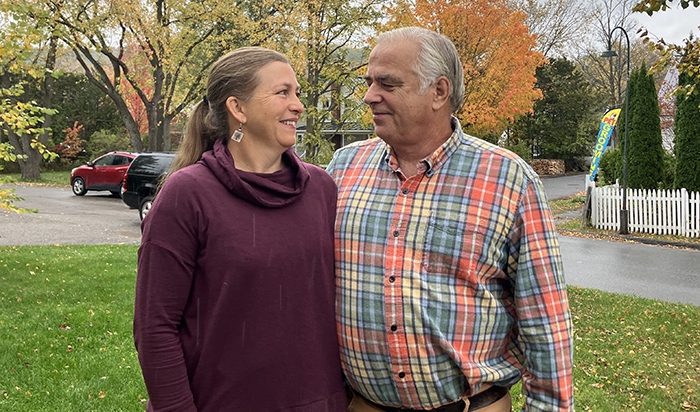
DR. MIKE KIERNAN, shown with his wife, Dr. Tawnya Kiernan, is feeling lucky more than a year removed from a major medical crisis that saw him flip from physician to patient while on duty at Porter Hospital’s Emergency Department.
Independent photo/John S. McCright
At this point, Mike reached out his wife, Dr. Tawnya Kiernan, a physician at Rainbow Pediatrics.
“I get this text that says, ‘Hey Sweet, can you reach out when you get a chance?’” Tawnya said.
She calls him, he says he’s being evaluated for a tear in aorta but urges her not to fret or hurry. So a stunned Tawnya starts to tie up loose ends at work prior to her departure until one of her staff meets her in the hallway and says, “You need to get to the ER now.”
“Both of our brains are going a mile a minute about, ‘Where’s this all going to end?’” Tawnya said. “I’m so thankful this happened in the ED and not elsewhere,” Tawnya said.
That’s because “elsewhere,” for Mike Kiernan, could be a lot of different places.
In addition to his medical duties, Mike is the founder and chief protagonist of “Bee the Change,” a nonprofit effort to expand pollinator gardens throughout the region — at homes, solar farms, schools and residential properties. The organization is now shepherding habitats in four different states.
“I might have been anywhere, and far from anything, when this (aorta issue) happened,” Mike acknowledged
But luck was on his side. Porter Hospital officials readied Mike for his ambulance ride north to University of Vermont Medical Center, whose cardiac surgeons had been prepped on the incoming patient-doc’s condition.
As he’s being readied for transfer, Kiernan is trying to update his colleagues on patients he’d be leaving behind in the ER.
Young tells him not to worry, and to do something he doesn’t like to do — focus on himself.
Mike was now seeing — from a patient’s perspective — how the docs, nurses, EMTs and support staff provide great care and positive reinforcement.
“When we go to work as docs, we prepare ourselves to be ready to help people with whatever they present with, all day long,” Kiernan said. “That feels good and that’s our role. To then be doing that job and all of a sudden be the person who needs help, it’s an abrupt change. It was pretty amazing and phenomenal to be received into the hands of Porter.”
TOUCH AND GO
Mike knew the severity of his situation.
“A tear in the aorta can go any number of ways, including complete tearing and a bleed-out, or some kind of bleed into the chambers that surround the heart,” he said. “Then the heart can’t fill effectively, and that’s when it can be a touch-and-go thing.”
The approaching April 8, 2024, solar eclipse was nothing compared to the constellation of good fortunes for Kiernan on this particular day. Time was of the essence, and he needed a seamless transition to UVMMC.
Had his heart crisis occurred 10 years earlier, he might have had a different outcome, he noted.
“It used to be if I were the ER doc, I would have to call a thoracic surgeon or cardiologist and get someone to accept the admission (at UVMMC) before I could even start an ambulance,” Kiernan said. “And the ambulance would be coming from Burlington, so it could be a three-hour round trip. That’s three hours lost. Now, you call the transfer center at UVMMC. On the other line is a nurse with critical care experience who knows exactly what our resources are and who’s able to get me connected to the right person, or the second-best person. There’s no longer half an hour on the phone when you have a critically ill patient.”
Did Dr. Kiernan rest during his ride to UVMMC?
Of course not.
“There are some reports that I was giving orders, but that can’t possibly be true,” he grinned.
But he was certainly using his cellphone.
You don’t go through medical school and treat hundreds of very ill patients in an ED setting without knowing the fragility of human life. When the healing powers of modern medicine and a caregiver’s skilled hands aren’t enough to bring a patient back from the brink, Mike Kiernan has been known to tenderly place a cell phone to that person’s ear to hear final goodbyes from loved ones unable to be there during the waning moments.
Knowing a tear in the aorta can quickly worsen, Kiernan put into practice for himself the farewell outreach he had previously facilitated for others.
“At a moment like that, it’s possible you could be facing the end of your life,” he said. “In that ambulance, I wasn’t being brave or courageous; I was serene. I had gratitude and a profound sense of appreciation for life and the people in my life. So I was calling people and saying, ‘I love you… I’m so happy we are friends.’”
Were Kiernan’s goodbyes premature?
The ensuing 10 hours made that a difficult questions to answer, but Kiernan knew he was in the right hands. His team of three surgeons sprang into action “and took exquisite care of me, right from the moment I got there,” he recalled. “Dr. (Elizabeth) Pocock said, ‘I am exactly the surgeon to take care of you.’”
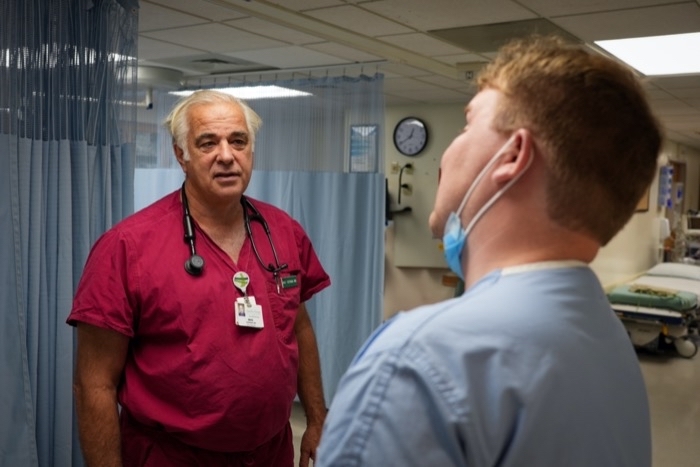
DR. MIKE KIERNAN talks with a colleague in the Emergency Department at Porter Hospital in Middlebury this week. Photo by UVM Health
Kiernan asked if his aortic tear might be solved with a “sleeve,” a non-operative approach where surgeons essentially put a new aorta over your torn one.
Pocock told him “No,” that his case would require cutting his chest open.
“She said, ‘For the next eight to 10 hours, I will be operating on you,”” he recalled.
With that, caregivers started wheeling Kiernan into a UVMMC operating room.
And just in time, because that’s when his heart decided to check out.
“They lost my pulse; I was ‘coding,’ as they say,” Kiernan said, borrowing from second-hand accounts that cover his resuscitation.
Again, with his professional training and smarts, Kiernan can’t resist speaking frankly and dispassionately about the temporarily deceased human that was him.
“They needed to restore my pulse, and that’s a little bit hard, because you want to compress the chest enough to make the heart pump, but you have a split aorta, so you don’t want to push with too much pressure,” he said, as if he was a disembodied observer peering over the shoulders of the surgeons who controlled his fate.
Pocock and the team, including Dr. Fuyuki Hirashima, handled the situation beautifully, Kiernan said.
“I would love to see a video of it,” Kiernan said. “In an extraordinarily short period of time, they did a number of major interventions — including opening my chest and getting the clot from around my heart that was preventing it from pumping They took off a section of the septum that divides the two ventricles and then got to work repairing the aorta.”
While Kiernan was asleep during procedure, his spouse, their two grown children, and an abundance of other family and friends were not.
Tawnya was on her way to the UVMMC and hoped to see her husband before he went under the knife. Pocock and Tawnya connected by phone as the latter was on route.
“She asked me where I was, and I said, ‘I’m at the Kwiniaska Golf Club (near Shelburne),” Tawnya recalled. “She said ‘I can’t wait. We’re taking him in now.’”
Tawnya was glad her husband’s caregiver knew not only about anatomy, but also about local geography.
BLESSING AND CURSE
Kiernan’s surgery began the early afternoon of April 3 and ended late that night. A lot of anxiety, commiserating, tears, trepidation for those waiting for the outcome. Mike Kiernan had been on cardiac bypass for five hours. A steady snow was accumulating outside.
“They had their work cut out for them; I knew that,” said Tawnya. “The blessing and the curse of being in medicine is I kind of knew what they were doing … That was good and hard at the same time.”
Indeed, her medical mind wandered to the hodgepodge of life preserving equipment that was sustaining her husband as surgeons toiled in his chest. They would install a new aorta made of GORE-TEX — pretty much the same material as a raincoat.
“He’s sedated, he’s intubated, machines are breathing for him, a lot of arterial lines and IVs — all monitoring how well his heart is pumping,” she imagined.
After what seemed like an eternity, the Kiernan family got the good news — Mike had survived and had begun the first of many steps toward recovery.
“Everyone (in the family) wanted to see him,” Tawnya said of Mike, who had been transferred to the Intensive Care Unit. “He made it through the surgery, but he wasn’t yet awake.”
What was it like to open one’s eyes after dying, being brought back, then being subjected to nine hours of cutting?
Was it like heading toward a bright light, waving goodbye to loved ones lost with the words “not yet,” or perhaps the fading sound of harps?
Mike Kiernan’s wakeup call conjured the sweet smell of baked goods and classic rock.
“When I came to, the song in my head is Steppenwolf’s ‘Magic Carpet Ride’ — the long, trippy midsection that’s random, free and kind of wanders, before the chorus returns,” Mike said. “And oatmeal raisin cookies; an oatmeal raisin cookie is pretty close to perfect.”
With Mike out of surgery, the family could breathe a little easier. Tawnya turned her attention to finding accommodations closer to UVMMC. She stopped at a hotel on Williston Road, hoping to book a room for two or three days — not an easy feat, given the imminent influx of people hoping to see the solar eclipse.
In moments of crisis, acts of kindness stand out. And Tawnya, who’s done her best to hold her composure through the interview, thinks about how the hotel clerk greeted her at the desk and she can’t help tearing up.
As she was making her lodging request, the clerk — a woman she believed hailed from a Caribbean country — saw Tawnya’s state and showed the best of humanity. “She said, ‘Hang on a second.’ She came around (from behind the counter) and said, ‘You look like you’ve been going through a lot, can I give you a hug?’ And she just held me.”
PLENTY OF TLC
Back at UVMMC, Mike was waking up and gesturing. He was given a message board on which to write, as he couldn’t yet speak.
One of his first written requests (after reconnecting with family)? He wanted his surgery explained to him.
Another early request: A copy of Stephen A. Marshall’s book, “The Fly.”
His family politely declined, as “The Fly” is a 10-pound book unsuited to bed confinement.
“It was a good sign, though, that he felt up to studying flies,” Tawnya chuckled.
Indeed, Mike’s love of nature remained omnipresent. He enjoyed the view from his ICU window, noting on one day a murder of crows dodging and diving amid some pine trees.
“I told (the nurses) that crows can live up to 35 years and live in multi-generational families,” he recalled, then imagined the nurses might think he was too sedated, as he was talking about crows just a few days removed from major heart surgery.
After plenty of TLC, Mike left UVMMC to begin his rehab. He and Tawnya like to garden, and Bee the Change gives him a lot of opportunities to get out and exercise. He’s also a regular participant in cardiac rehab at Porter.
Mike’s expectations seem reasonable.
“I’m now 66 years old. If you can look toward to something where you’re getting stronger over time, that’s about as much as you get to ask for,” he said. “What I’ve been having is continuing recovery. I feel great.”
His goal was always to return to his ER job at Porter, which he did around six months after his heart event.
“Being … a physician in a community — it’s one of the most fortunate occupations you could ever find on Earth. I don’t have any inclination to stop doing it,” he said.
Always thirsty for knowledge, Kiernan has learned a few things from his own medical crisis.
To speak up when he doesn’t feel well.
To enjoy life to the fullest.
To continue to appreciate his friends and family. He looks upon Tawnya as a partner and teammate.
“My relationship with the health profession has been something I enjoy as a provider, but rarely as a consumer,” he said. “This is a chapter in what I would submit is one of the luckiest lives that’s ever graced the planet. It’s unbelievable that of all the things that could have happened, on a day when a 21-year-old’s body (Lia Smith) has been found, that I’m 66 years old and this was my first medical event.”
John Flowers is at [email protected].
More News
Homepage Featured News

Local pastor witnesses ICE turmoil in Minnesota
Elizabeth Gleich, a native Minnesotan and associate pastor of the Congregational Church of … (read more)
News
Primary care a key issue this legislative session
Addison County lawmakers are among those who have written or co-sponsored bills aimed at r … (read more)
News
ACSD board OKs school choice, sets limits
The Addison Central School District board on Monday overwhelmingly endorsed K-5 school cho … (read more)