

Op/Ed
Climate Matters: Behold the magic of heat pumps
Energy is all around. It’s in the air, the ground, the water, in everything. Energy is what we need to heat our homes, run our cars, power our electronics and cook our food. So why don’t we just grab that free energy, and be done with fossil fuels and their climate-changing greenhouse emissions?

Emeritus Professor of Physics Richard Wolfson at Middlebury College’s McCardell Bicentennial Hall. Photo: Brett Simison
If it weren’t for the Second Law of Thermodynamics, we could fill a tank with water, let it separate into hot and cold, discard the cold, and use the hot to heat our home (or, in summer, discard the hot and use the cold for cooling). No cost, no climate-warming greenhouse emissions, no pollution. But no: The second law says the water will never spontaneously separate into hot and cold.
The key word here is spontaneous. We can separate lukewarm water into hot and cold — but only, says the second law, by using an external energy source. Your kitchen refrigerator effects exactly that separation. Put lukewarm water in your ’fridge, and it becomes cold. The refrigerator has extracted heat from the water and pumped that heat into your kitchen — where you could use it to make hot water. But the fridge won’t work unless you plug it in! Electricity is the external energy that you supply.
How does the refrigerator do its magic? Try this experiment: Put the back of your hand in front of your mouth, open your mouth wide and blow. You’ll feel your hot breath on your hand. Repeat the experiment, but close your lips down so there’s just a small hole, and blow again. Now your breath feels cool. That’s because the air lost energy as it expanded coming through that small hole. Your refrigerator does the same thing: It pumps fluid through a loop of tubing, where the fluid expands through a small hole, cools, and thus cools the refrigerator’s contents. The fluid is then compressed so it’s ready to repeat the process. But it gets hot when compressed, and that heat is expelled to the surrounding kitchen. Included in the expelled heat is the energy that was extracted from the refrigerator’s contents. Bottom line: The refrigerator removes heat from its interior and pumps it into your kitchen.
Your kitchen refrigerator is one example of a heat pump — a device that extracts heat from a cool region (the refrigerator’s interior) and transfers it to a hotter region (the kitchen). Heat doesn’t spontaneously flow from cooler to hotter (that’s another statement of the second law), but a heat pump, with the help of an external energy source, makes this unnatural heat flow happen.
Here’s the beauty of heat pumps: They move more energy than they require to operate. A typical heat pump used for home heating takes heat from outside air delivers about three units of heat for every unit of electrical energy it consumes. You pay for that one unit through your electric bill, but you get the other two for free. And Earth suffers the environmental insults of just one unit of electrical energy generation. Here in Green Mountain Power territory, where our electricity is nearly carbon-free (mostly hydro and nuclear), heat pumps deliver without climate-changing greenhouse emissions.
 That number three is the coefficient of performance, or COP, and it’s for an outdoor temperature around 30°F. At 0°F, the COP drops to about 2, and it’s worse at sub-zero temperatures. That’s why popular air-source heat pumps don’t work so well on our coldest winter days. An alternative is the ground-source heat pump, which extracts heat from the ground or groundwater, where the temperature in Vermont is 45-50°F year-round. That translates to a higher COP, more free energy for you, even less environmental impact, and performance in the coldest winter. The downside is much greater expense, and the complication of drilling wells or laying underground piping.
Heat pumps are reversible, so in the summer they can extract heat from inside your house and dump it outside. Thus they provide cooling as well as heating.
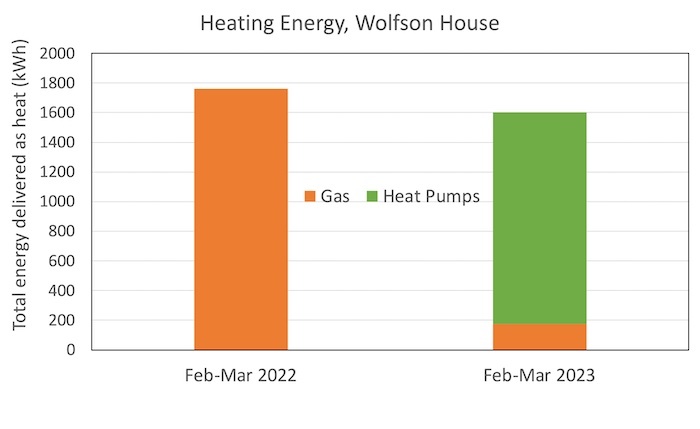
Now for the practical part: We Wolfsons installed Mitsubishi air-source heat pumps at our Middlebury home in May 2022. We didn’t intend to entirely replace our natural-gas heating, so we installed just one heat pump in our living room and one in our bedroom. We’ve been pleasantly surprised that the heat pumps supply more of our overall heating than we had expected. The chart shows that heating energy supplied by gas dropped to less than one-eighth of its original value. There are a few caveats here: We also heat water with our gas-fired boiler, and I’ve subtracted that usage, which didn’t change significantly from 2022 to 2023. Weather conditions vary from year to year, resulting in somewhat less overall heating energy in 2023. I’ve converted natural gas energy to kilowatt-hours (kWh), used mostly for electrical energy but nevertheless a unit that measures any kind of energy. And there are only two of us in the house; a larger family would probably have wanted more heat pumps than we have.
Heat pumps aren’t just for houses: You can now buy a heat-pump clothes dryer, a heat-pump dishwasher, a heat-pump water heater (which also serves as a dehumidifier and would, in our case, eliminate what’s now our family’s greatest use of fossil fuel). If you have an electric vehicle, its heater is probably a heat pump that’s saving precious battery energy for propelling the car. All these heat-pump applications enjoy the same magic — a technology that delivers more energy as heat than it consumes in electricity.
Rich Wolfson is Middlebury College Professor of Physics & Environmental Studies, Emeritus. He lives in Middlebury.
More News
Op/Ed

ICE and CBP: Legislators could do more to protect Vermonters’ rights
“[Legislators] would be wise to also reconsider how to protect Vermonters in the near-cert … (read more)
Op/Ed

Legislative Report: We must act now to address food insecurity
“I strongly believe we have an opportunity in this legislative session to strengthen our f … (read more)
Op/Ed

Ways of Seeing: America’s reign of cruelty is not new
“The government-sanctioned violence that we are witnessing across the nation has historica … (read more)