MIDDLEBURY — Middlebury College President Ian Baucom just got to town this month, but he’s already got a sense of how tied the institution is to the community that surrounds it.
“From its origins, Middlebury understood itself as the town’s college — that really struck me,” Baucom said during a recent interview. “As I think about how that unfolds over time and what it means, a question that is in my mind is, ‘What does it mean for us to continue to be the town’s college, and Vermont’s and the nation’s and the world’s and the planet’s?’”
Baucom will help the institution answer that question in his new role as college president, a post he stepped into on July 1. He succeeds Interim President Steve Snyder and former President Laurie Patton.
The Independent spoke with Baucom about what led him to Middlebury and the work he hopes to accomplish in the months ahead. That will include tackling issues like the future of Middlebury College’s graduate school in Monterey, Calif., and ongoing efforts to balance the institution’s budget.
That work will also unfold amid a challenging backdrop for higher education institutions across the country, which are continuing to navigate not only a changing economy but also various federal actions targeting colleges and universities.
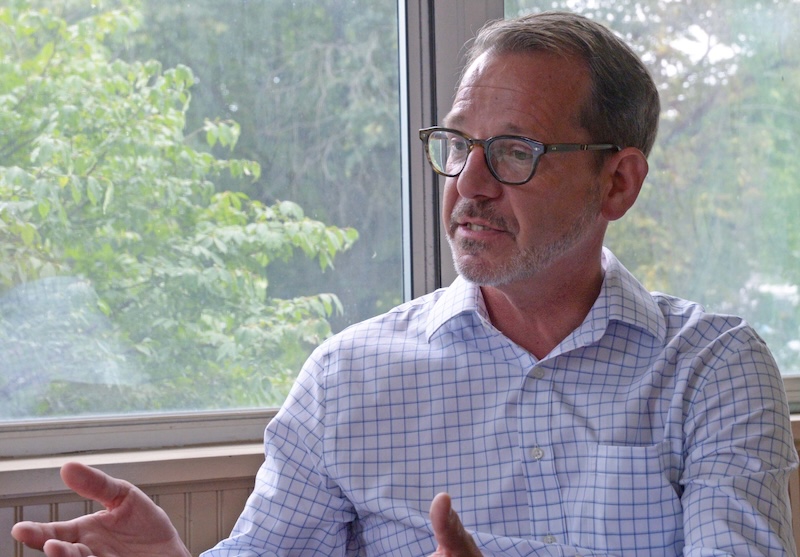
Discussing what’s ahead for Middlebury College and higher ed institutions at large, Baucom expressed a sense of optimism and a commitment to listening to and learning from members of the local college community.
“My responsibility is to be the president of everyone who’s part of Middlebury,” he said. “I need to go to where their offices are. I need to see their labs. I need to be outside of the main administrative building.”
Baucom’s path to Middlebury has been shaped by a career in higher education and an appreciation for the power of education that he gained while growing up in South Africa (see related story here).
He most recently served as executive vice president and provost of the University of Virginia and as the Robert C. Taylor Professor of English at the university. Prior to that, he served in various roles at UVA, Duke University and Yale.
He received his bachelor’s degree in political science from Wake Forest University, an experience that was influential in his aspiration to one day lead a liberal arts college.
“There were 3,200 (undergraduate) students when I was there, and I had that experience of great classes and two professors who just poured themselves into my life,” Baucom recalled. “I got to experience that, and I wanted to be part of that again.”
There were other aspects of Middlebury College that drew Baucom to the institution, including the college’s dedication to the arts, the environment and languages.
A commitment to the arts and languages is one aspect of Patton’s legacy Baucom aims to carry on, along with the former president’s work around data literacy and conflict transformation.
BALANCING THE BUDGET
Baucom has identified some other areas of focus for the coming months, including working with members of the college community around how to build a stronger financial future for the institution. This past spring, administrators announced compensation cuts and other steps the institution would take as part of an effort to balance its budget.
Faculty, staff and students have pushed back against those measures, which included new limits on retirement benefits and growing undergraduate enrollment.
Asked how the institution will work to tackle its deficit while incorporating feedback from the college community, Baucom said internal discussion — including disagreement and criticism of administrative actions — is important and welcomed.
“It’s part of what a healthy community is,” he said.
Baucom is looking to do more of the work he’s begun over the past few weeks, which has included meeting with the college’s faculty council and individual faculty members.
“Much of this is to sit, listen, make a commitment, and as we work through ongoing budget challenges that’s how I want to approach things,” he said.
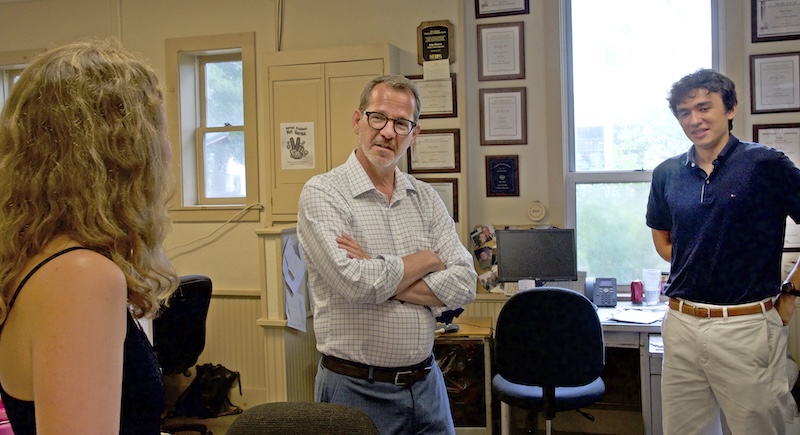
Independent photo/John S. McCright
He acknowledged that much of the hard work related to balancing the budget has happened over the past year.
“The college is in a much stronger financial position than it was,” he said. “I’ll be getting ongoing updates on having this resolved, and my intention is to keep working with our constituent groups to figure out the best way for us to have a path forward and try to get that balance right between counsel, insight, shared deliberation, and the moment where someone has to make a decision and making sure we get that all and to pay deep attention to shared governance and the various responsibilities that have been delegated to us.”
FUTURE OF MIIS
Related to ongoing budget discussions is the question of the future of the Middlebury Institute of International Studies at Monterey, or MIIS.
College students and faculty have pointed to losses the institution has experienced since it acquired MIIS more than a decade ago. In May, college faculty passed a Sense of the Faculty Motion asking college officials to begin a comprehensive restructuring of MIIS and close the campus within three years.
In a July 1 message to the college community, Baucom stated that “resolving the future of MIIS and its range of academic programs” is one the institution will answer within his first year as president.
“This is a crucial thing for us to do, and we have to be involving our community in this, but that is a decision that needs to be made and we will make,” he told the Independent.
Baucom noted that as the institution resolves that question it can begin thinking about areas central to its core mission as a residential liberal arts college, such as financial aid and faculty.
“All of our community — our faculty, our staff, everyone — we need to be compensating and supporting them well, and there are particular issues with faculty compensation that we have to pay attention to,” he said.
Strengthening the institution’s core is among Baucom’s other priorities for the months ahead. He said the foremost of those priorities is sitting and talking with members of the college community.
“I’ve only been here for 25 days, so just the priority of making time, going for long (walking meetings), being with all our community, that’s an absolute first priority,” he said.
Other priorities include connecting to the whole of who Middlebury is.
“Connecting to the whole is making the MIIS decision and then in parallel, asking how we best connect the various pieces of Middlebury — the core of the college, its schools abroad, its language schools, its various research centers,” Baucom explained.
Baucom has also identified “meeting our moment” as an area of focus for Middlebury College. He’s acknowledged this moment is a complex one for the college and for all of higher education. Since President Donald Trump took office in January institutions across the country have weathered several federal actions attacking colleges and universities, from the funding they receive to international students and diversity initiatives.
How can Middlebury College work to uphold those and other aspects of higher ed institutions’ work?
“You start by asking yourself, ‘Are we a values-driven institution or not?’ and the answer is ‘Yes,’ but that’s where you start, and then ‘Will we continue to be a values-driven institution?’” Baucom said. “Political currents change, values don’t. To understand the political current, you have to understand what your values are and make a decision and then you have to name the values.”
For Middlebury College, those values include academic freedom, and caring for the future of the environment and planet, and “the diversity and richness of the world’s languages and cultures,” Baucom said.
“I think that’s where you start, is by saying ‘What are the values’ and ‘Will we defend them,’ and I just want to be clear; we will,” he said.
While this moment may be new, Baucom noted higher ed institutions have a long history to refer to and build off of.
“Other than religious institutions, colleges and universities are the longest-enduring form of civil society in the world,” he said. “In this moment we live toward the future, but we do live with the enduring power of education behind us. I take comfort and inspiration in that.”