Victor Nuovo
-

Victor Nuovo: Heraclitus and the unity of opposites
Heraclitus was the first to make paradox a philosophical theme.
-
Victor Nuovo: Xenophanes, the free thinker
Xenophanes was a wandering poet. The times of his birth and death are unknown, but he is said to have “flourished,” that is, been active, around the middle…
-
Victor Nuovo: Pythagoras and his school
Imagine how hard it would be, if not impossible, to think coherently if we lacked the number 1, which is the very idea of Unity.
-
Victor Nuovo: ‘The mother of all knowledge’
Philosophy has been called “the mother of all knowledge.” However, since this was said by a philosopher (viz. Aristotle), there may be reason to doubt its truth.
-

Victor Nuovo: The Rule of Law
It is commonplace to refer to the United States of America as a democracy. But those who speak this way, although they speak sincerely, state it incorrectly.
-
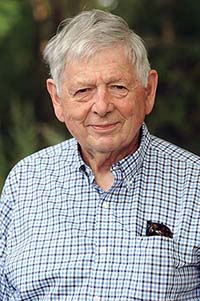
Victor Nuovo: William Ernest Henley (1849-1903): Unconquered
Robert Louis Stevenson, who was William Ernest Henley’s lifelong friend, fashioned the character of Long John Silver after him, particularly on “his maimed strength and masterfulness.”
-
Letter to the editor: Nuovo’s work appreciated
In recent weeks I’ve found myself wondering if we’d ever be lucky enough to get another column by the inestimable Victor Nuovo.
-
Community Forum: Growing old can be a joyful wisdom
When I was 70, I felt as though my life was beginning. At 80, I began to sense that there are limits. But now, at 91, I know…
-

Victor Nuovo: The irony of war
The theme of this essay occurred to me while reading a new history of the Second World War entitled “Blood and Ruins, The Last Imperial War.”
-
Victor Nuovo: Time and eternity: Human focus on here and now results in untold suffering
13th in a series I concluded last week’s essay with a question: whether human history has any meaning. And I suggested that an answer might be found in…
-
Letter to the editor: Letter writer had a point
I write in response to Kris Diehl’s letter in your April 21 issue. He raises a good point.
-
Victor Nuovo: Does a look at our history have moral purpose?
Shakespeare’s “Tragedy of Macbeth” is about a man who would be King; who, motivated by envy and ambition, achieved his life’s goal by committing murder, only to be…
-
Letter to the editor: Column partial to Christianity?
I didn’t want to write this letter without time to more clearly spell out my feelings. But I also don’t want my displeasure to go un-noted, because I…
-
Victor Nuovo: Defining the Good itself
The theme of my last four essays has been Good and Evil, but so far I have failed to define these words.
-
Victor Nuovo: The best of all possible worlds
The philosopher Gottfried Wilhelm Leibniz believed that God was the ultimate cause of existence, that God created the world from nothing.
-
Victor Nuovo: How can God allow evil to exist?
What is the problem of evil? The fact that there is evil, that bad things happen, is undeniable. But this doesn’t constitute a single problem; rather it presents…