
Sports
Ed (and Gary) meet the great Mosconi
 Any of you recognize the name Willie Mosconi?
If you do, you’re old (like me) or you are a serious pool player or historian of the game, called “pocket billiards,” not pool, in polite company.
The last column I wrote in this space (June 11) was inspired by sports cartoonist Vic Johnson of the Boston Herald who sent me an original cartoon as a gift when I was 11. It depicted a Red Sox doubleheader sweep of the White Sox in the summer of 1956.
When my lifelong friend Gary Margolis of Cornwall saw this illustration, he enthused, “I have one too!”
In fact, he does, but not by Vic Johnson, and not about baseball. Gary’s is an original drawing by another cartoonist, Bob Coyne, that appeared in the Boston-Record American in 1954.
Coyne was prominent, perhaps preeminent, among these newspaper artists in Boston of the time, drawing over 15,000 sports cartoons in his 47-year career as an artist for several Boston newspapers.
His subject in this drawing is Willie Mosconi, the greatest pool player of his era, and perhaps of all time. In the 1940s and ’50s, Mosconi won the World Straight Pool Championship 19 times. To this day, he owns the official run record of 526 consecutive balls in a match in Ohio in 1954. He was a well-known public figure, nicknamed “Mr. Pocket Billiards.”
This drawing by Coyne appeared in the Boston-Record American in 1954 when Mosconi was at the zenith of his career. It is a wonderfully busy piece, vertically oriented (10 1/2” X 28”) with a close-up rendering of Willie in the center, lining up a shot, and six other smaller illustrations, along with about 200 words of descriptive prose.
It promotes the upcoming appearance of Mosconi in Boston playing “150-point matches at Bond Bowling and Billiard Center and two more at the Huntington Alleys Cue Room.”
And how did this magnificent artifact come into Gary’s hands?
Well, that’s the story:
In fact, Gary’s dad, Ed Margolis, and Gary’s uncle on his mother’s side, George Binen, owned both of these two prominent Bowling and Billiard establishments in downtown Boston where Mosconi was appearing.
Right on Washington Street in the heart of downtown, Bond Bowling and Billiards was in an area known colloquially as “the Combat Zone,” adjacent to Chinatown and the theater district. The billiards room (25 tables) was on the second floor and the bowling alley (30 lanes) on the third, fourth, and fifth floors.
Huntington Avenue Alleys and Cue Room, described online as a “massive venue,” was a “legendary” multi-lane bowling complex (55 lanes) and billiard parlor. Huntington Avenue was a major entertainment artery in midcentury Boston, adjacent to Symphony Hall and Northeastern University.
Both sites frequently hosted major tournaments and exhibitions. Interest in candlepin bowling especially (small balls, low scores), including the annual Harry Agganis Record-American Tournament, saw a post-World War II boom. Ed Margolis also owned a pool room (“Garden Billiards”) in the Boston Garden/South Station complex.
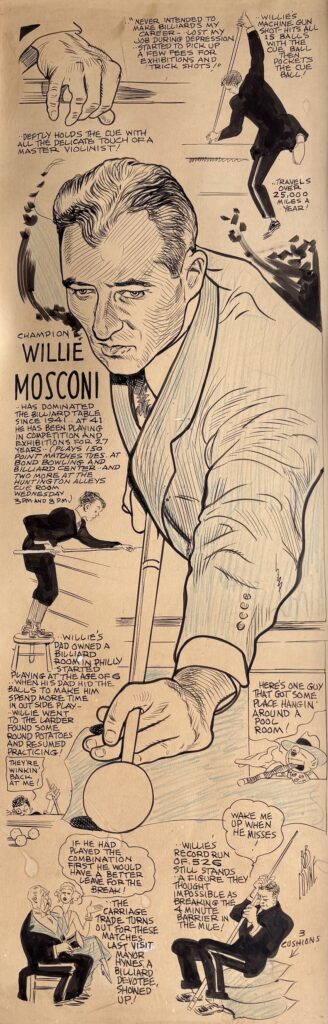
This profile of Willie Mosconi, world champion pocket billiards (or pool) player in the 1940s, ’50s and ’60s, drawn by Bob Coyne, appeared in the Boston Record-American in 1954. It is now on the wall in the Cornwall home of Gary Margolis.
I met Gary Margolis the day freshmen arrived at Middlebury College in September of 1963. We were roommates for two years, and colleagues at the College for 35 years.
Gary was not always this happy burgher from Cornwall, Vt., the Town Poet as well as the Town Constable and Justice of the Peace. Growing up, he was hardly attuned to the smell of the woods or the verdant landscapes of Vermont.
He was a city kid from Boston, one who came to love the countryside.
The first Margolis home was an apartment on Lansdowne Street in the shadow of the Fenway Park. The family moved to Brookline when Gary was four and lived in two homes located right next to T stops that brought downtown within easy reach (the “T” is what Bostonians call their transit system).
“When I was nine or ten years old, my friends and I would walk to the T stop, hop on the Green Line and go to day game at Fenway,” Gary told me last week. “We could watch a game for 75 cents, sit in the bleachers on the wooden benches.”
“I think riding into the city on the T, the subway, was the beginning of my becoming a poet and counselor. I kept my eyes open. I would ask, ‘What’s their story?’ I was curious but careful and gained confidence. I started to really notice things around me.”
In the summer after our sophomore year Middlebury, I visited Gary in Boston at his job site, parking cars in a lot his dad owned next to the Christian Science Building in downtown Boston. “An old Mainer, Ray Cummings, took me under his wing,” Gary said, “and showed me how to park 250 cars.”
“My favorite part of that job was lunch! I would go to ‘Joe n Nemo’s’ and get a hot dog for a dime, hamburger for 15 cents, and an orange drink from the machine for a nickel.”
To me, the kid from Maine, a job parking cars in a major metropolitan city made Gary a truly exotic college pal. I remember tooting around Boston with Gary at the wheel of his little red Chevy Corvair, him entirely at ease in city traffic, me utterly terrified.
Gary was trained in multiple jobs at Bond Bowling and Billiards, including elevator operator (before elevators had buttons you could push to get to your floor): “A bell would go off, and I would lower the elevator to the street level and bring the people up. I ran the cash register, swept up, cleaned the cue dust off the felt tabletops.
“I was never a pin boy — that was too dangerous. The pin boys sat on a little bench at end of the alleys and those pins would fly everywhere. When automatic pinsetters came in (in the late ’50s), I learned how to clean them.
“The worst job I ever had was when I had to restripe and relacquer all the candlepins, boxes and boxes of them. So boring.”
The Mosconi drawing was originally up on the wall at Bond Billiards, and then in Ed’s study in his retirement. Gary inherited it when his dad died in 2016 at 96 and it now owns a prized spot on a wall in his Cornwall home.
It’s summertime and the livin’ was easy for two old guys sitting on the porch with a cold drink, happily reminiscing and remembering their dads.
-
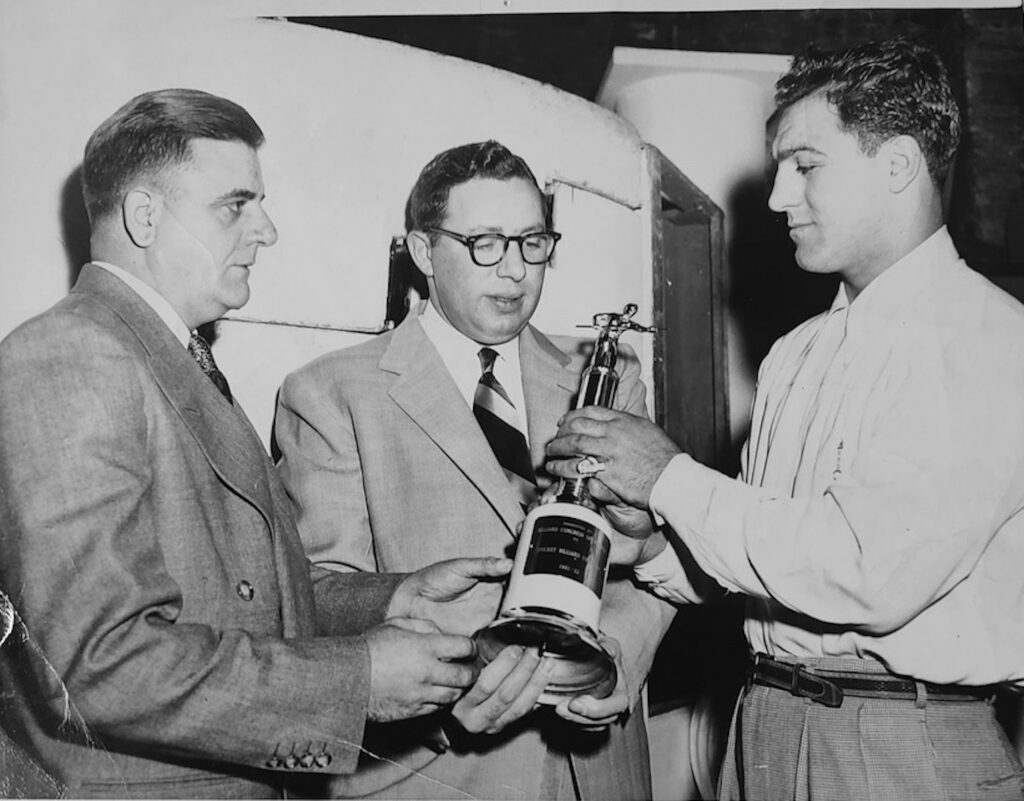
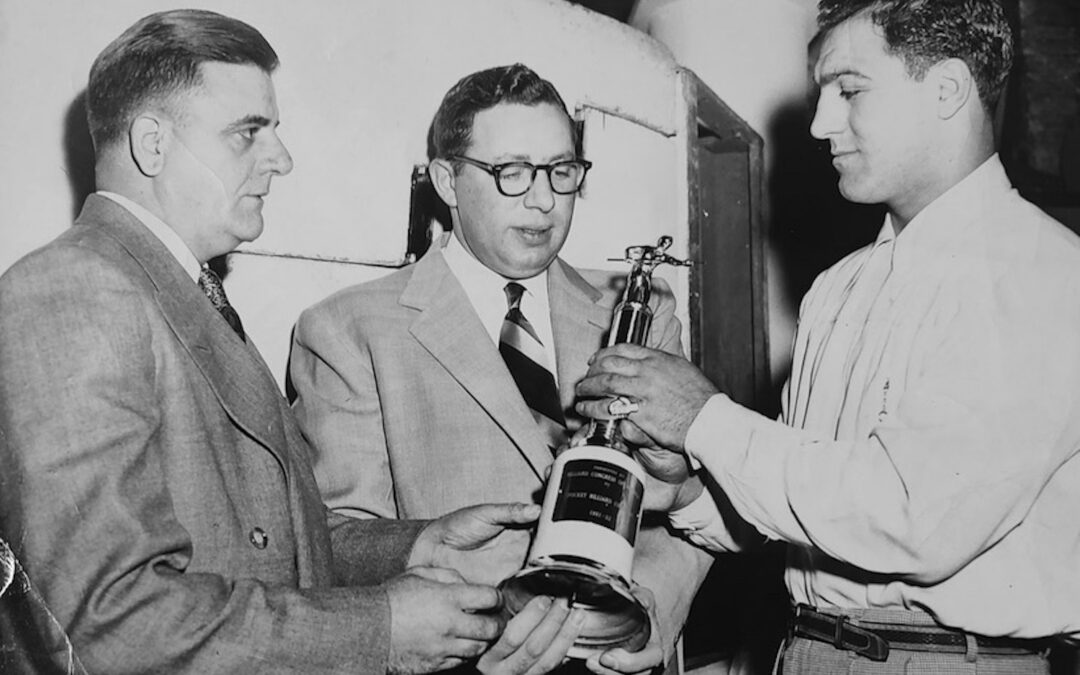
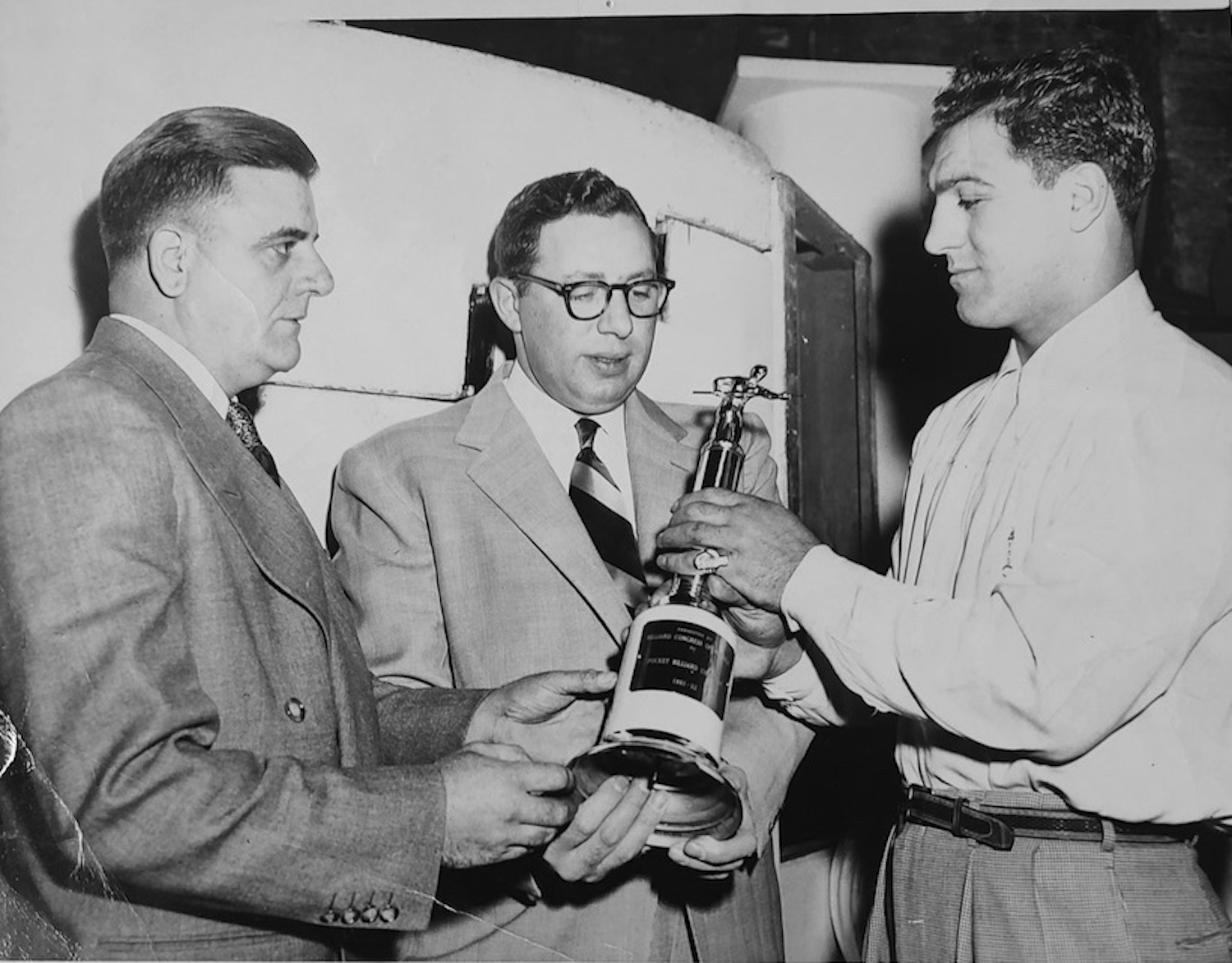
- Ed Margolis (center) was owner and proprietor of Boston’s Bond Bowling and Billiards, a major center for bowling and pool exhibitions and tournaments in the 1950s and ’60s. Here he presides as World Heavyweight Boxing Champion Rocky Marciano awards a winner’s trophy to an unidentified billiards player.
-
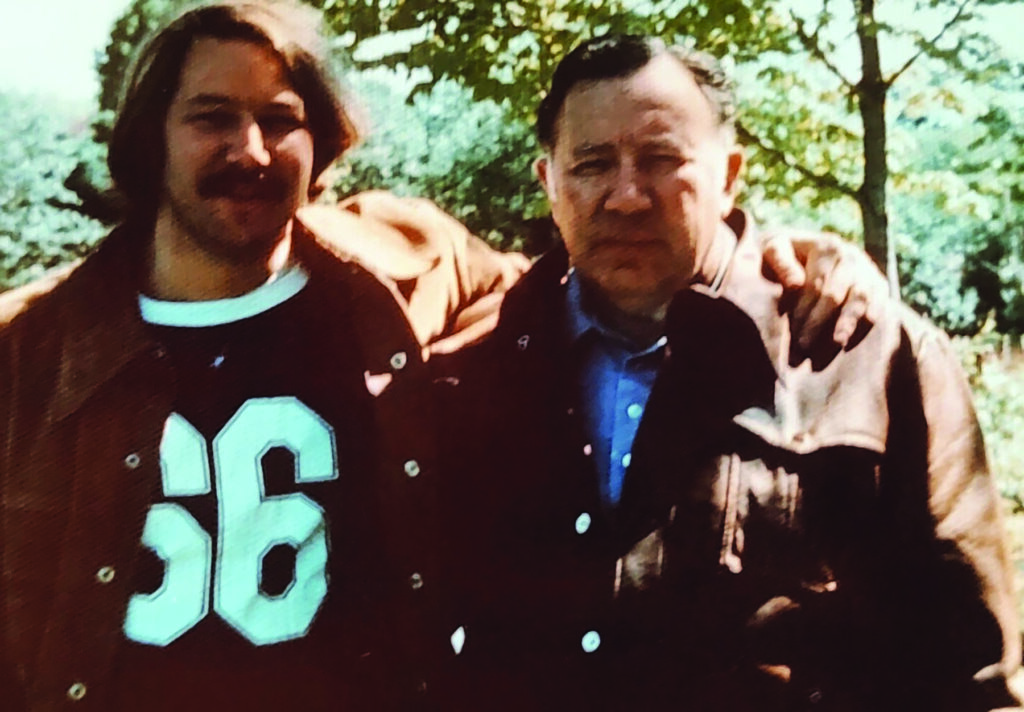
- Ed Margolis, shown circa 1975 with his son, Gary, kept the Mosconi drawing showcased in this column on the wall of his billiard parlor and then in his study for six decades.
—————
Karl Lindholm is the Middlebury College emeritus dean of advising and assistant professor of American Studies (retired). Email him at [email protected].
More News
Sports

Top-shelf goal starts VUHS girls’ soccer season
It only took one early goal for the Commodores to take down MUHS.
Sports

Vermont Sun race series closes summer with final triathlons
The event featured many options, including Olympic-length and team races.
Sports

Defense-minded Panther women’s soccer looks to score goals in 2026
The Panthers start their season this Saturday.