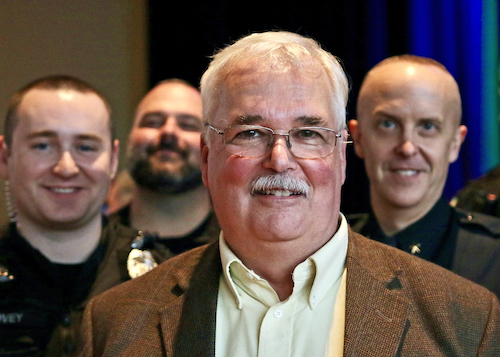
“Everything on the (pamphlet opposing the battery) is factual. But you can replace ‘BESS’ with ‘airplane’ or ‘robots’ or ‘electric vehicle’ and these facts basically all still hold true.” — UVM Professor Mads Almassalkhi
VERGENNES — More than 250 people have signed a petition opposing a Virginia company’s proposal to install five shipping container-size lithium-ion batteries at 99 Panton Road in the Little City.
The 4.99 megawatt energy storage system could reduce electric bills for Vermonters and improve delivery to homes and businesses and hasten integration of renewable energy on the grid.
But among petition signatories concerns are the possibility the huge batteries could catch fire, resulting in flames spreading to other structures and toxins from the burning battery polluting the environment.
Experts put those concerns in perspective. The chances of such a battery fire starting and spreading are very low, according to a University of Vermont professor, who said that gas stations pose the same risks as the systems.
And Vergennes Fire Chief David DiBiase says he’s comfortable with the infrastructure, which in his opinion would pose comparable danger to other properties considered “high risk” in Vergennes.
“Whether or not it’s right for the community or the space, I’m not going to weigh in on that,” he said.
“But I think as far as from a safety aspect, they’ve been with us. We’ve had some meetings, we’ve expressed the concerns. We’re working through some areas of emergency planning we think would be helpful for people to see and understand from a third party with them, and we’ll see what it looks like in the future.”
Vergennes first got wind of the battery energy storage system (BESS) project last October when a representative from the Virginia company, LightShift, informed the city council about its plans.
Formed in 2019, the company touts seven operational BESS projects and 10 under construction. Those span Massachusetts, Virginia and Vermont. LightShift’s first Green Mountain State projects, in Northfield and at Global Foundries in Essex, are expected to come online this summer, according to the company.
The Vergennes project is by no means set in stone. So far, LightShift has only submitted a 45-Day Advance Notice to Vermont’s Public Utility Commission, the entity which will determine the merits of the project and decides whether to grant permission for it to move forward.
The advance notice was submitted in December and sent to the landowners, adjoining landowners, and municipal and regional entities such as the Vergennes City Council, and provided to various state agencies, as required ahead of filing a petition for a certificate of public good with the regulator.
LightShift Managing Partner and Co-Founder Michael Herbert said the company plans to take that step this year, which would trigger the regulatory body’s review process.
“The PUC evaluates the project under statutory criteria, including environmental impacts, land use considerations, system stability and reliability, public safety, and overall impact on the general good of the state of Vermont,” according to information on the City of Vergennes website.
The Vergennes BESS would serve Green Mountain Power, which provides power to the majority of the state and all of Vergennes, and the ISO-NE market, New England’s regional grid operator.
LightShift’s advance notice letter states the Vergennes BESS “will likely provide peak shaving services,” a process by which energy stored in the battery is released at times when electricity demand is highest in an effort to reduce the cost during those times, “and may also respond to signals from the regional grid from the ISO-NE and be dispatched to manage existing renewable energy generation.”
Herbert said BESS infrastructure could reduce transmission and capacity costs through peak shaving, which are key drivers of residential rates. “In addition, storage can help manage distributed solar generation on the local grid, reduce the need for substation upgrades and additional wires infrastructure in the communities they are deployed, and enhance the integration of distributed energy resources,” he noted.
On a broader level, the energy storage would help ISO-NE ensure competition in New England power markets and improve system reliability.
“Collectively, these benefits including those leveraged from the regional grid, would accrue directly to the incumbent distribution utility and, ultimately, to ratepayers in Vermont,” Herbert said.
Herbert acknowledged as the cost savings is realized by the utility company, it must pass on to customers.
Why did the company pick Vergennes? Herbert said abundant solar power was a factor, as was geography.
“Addison County is … one of the flatter parts of Vermont, and so it’s very ripe for this type of application,” he said.
“There are already some limited constraints on the substation there in Vergennes,” he added, and also noted, “there’s adequate load there as well, you know, to kind of do the peak shaving and peak load reduction associated with those benefits.”
Additionally, the nearby “sturdy” electrical infrastructure and the fact that it’s already cleared makes it a good spot.
Though energy storage projects aren’t constrained by local zoning policies in Vermont, Herbert said the company took its cues from local maps.
“It’s industrially zoned, so it immediately struck us as a good location vis-a-vis the zoning.”
Those opposed:
The project has already drawn significant attention from Vergennes residents.
Many have become fretful about what the project could mean for safety, the environment and neighborhood character.
Carrie Hathaway, a Waterbury resident who owns property next to the proposed battery site, is the face of the opposition. Once the company issued the advance notice in December, she got to work.
“It was right around then when I started doing Front Porch Forum posts. From there, I had lots of people supporting the effort to try to have this get shut down,” she said.
Hathaway, who submitted the petition to the PUC public comment portal on March 25, owns a 1798 farmhouse on West Main St. near the proposed facility. She and her husband, David Hathaway, bought the home in 2017, and have since embarked on renovations, including splitting it into three units. The couple plans to make one of those their new home.
Additionally, Hathaway, who lived in Vergennes for the bulk of her childhood, has plans to build five houses on the same land.
“Our property sits up on top of the hill, and then you go down Panton Road, and this facility would be directly down the hill, so these homes would be looking at and over these battery energy storage things,” Hathaway explained.
“So it would devalue the property immensely, right out of the gate.”
While the possible battery site (which neighbors Collins Aerospace) resides in the industrial zoning district and the Hathaways’ in the medium density residential district, the respective parcels touch and are essentially the border of the two zones.
If the PUC approves the battery facility, Hathaway said she likely won’t move forward with the construction of the five homes, which she’d like to see built during summer 2027.
“They just wouldn’t be worth the value,” she said.
SAFE OR NOT?
“To me, this is a safety issue,” Hathaway said.
In addition to getting the PUC the petition, which outlines safety and environmental concerns among other points, handing out BESS risk pamphlets has also been on Hathaway’s agenda recently, Seven Days reported in early March.
The document states that lithium-ion batteries are highly explosive, catch fire easily, are not easily extinguishable, require specialized firefighting supports and emit toxic fumes, among other items.
While all this information is accurate, there is some nuance to the bullet points.
“Everything on the pdf is factual,” said Mads Almassalkhi, a UVM electrical and biomedical engineering professor. “But you can replace ‘BESS’ with ‘airplane’ or ‘robots’ or ‘electric vehicle’ and these facts basically all still hold true.”
Even gas stations pose these risks, “which folks in Vergennes drive by regularly without the same worries,” he added. The infrastructure is similar in that both provide energy storage, according to Almassalkhi.
“A gas station contains, you know, 1000’s of gallons of fuel underground, often near rivers or waterways,” he noted. “And we don’t drive by gas stations and think about highly explosive, that they can catch fire, that they’re not easily extinguishable.”
As far as BESS safety goes, Almassalkhi explained that precautions in place to mitigate fire risks include keeping a watchful eye on the battery’s health, behaviors, currents and temperatures.
“These batteries aren’t put into a desert and then left, and then you revisit them 20 years later,” he explained. “They’re continuously monitored at the cell level, and so you can detect, through various algorithms and tools, you can detect the health of the battery at any given time.”
And though the odds of a fire are low, the technology is also engineered with the possibility in mind. “The second layer of mitigation they have is that a lot of these batteries sit in containers that are in some sense fireproof, right? They contain the fire,” Almassalkhi said.
“And in other cases, you’ll even have active mitigation, so you’ll have various things that you can spray into the battery itself to block the fire.”
Almassalki pointed out another development in the industry that has made the infrastructure safer. According to him, a newer version of the batteries (lithium iron phosphate, or LFP batteries) are available that is far less prone to igniting compared to an older one (nickel magnesium cadmium, or NMC batteries).
“Those have significantly lower risks,” Almassalkhi said.
LightShift confirmed the Vergennes batteries would be these newer, safer LFPs.
When discussing battery safety, Herbert’s description of the monitoring that occurs matched Almassalki’s.
“They basically have to do testing at all of those levels to ensure that in the event of a fire, that fire will not propagate to other parts of the system, and it will remain kind of compartmentalized.”
Herbert said that perceptions about safety have been influenced by incidents when the industry was young.
“And they kind of continued to be something that we have to navigate when we’re going through and hearing, like, working with communities like this and hearing their concerns,” he said.
“We are not unfamiliar with the prospect of concerned citizens, and you know, doing our best to work with them collaboratively and address their concerns,” he added.
Herbert also said the reaction hasn’t been all negative.
“We’ve also seen a good level of support for the project.”
Herbert asserted that safety is of utmost importance to LightShift.
“Safety is very much embedded in the culture of the company, how we select our technology, how we design our projects, how we work with the local community in like, early stages of development, through construction, all the way through operations and the commissioning.”
DiBiase, who met with LightShift representatives, spoke highly of the company’s protocols.
“The methodology that they’re undertaking and the standardization that they’re adhering to … is about the best that we would hope for,” he said.
SUMMING UP
For Hathaway, the fire chief’s reassurances weren’t much solace.
“I understand that they believe that they can get there and that they can contain the fires, it doesn’t contain the toxins,” she said. “So this isn’t just about fire. Fire is a big deal, but the toxins that they emit when they catch fire are not good.”
The company asserts the toxins that would be released in the case of a fire are no worse than what would be released during a house fire.
“There’s things that are toxic, but it’s no worse than your average house fire. In the event of one of these incidents, you basically just stand back and let the first responders kind of manage the scene,” Herbert said.
Another concern outlined on the pamphlet is that BESS systems “emit a constant loud hum.”
Almassalki said the systems can emit some noise because they have a heating and cooling system like a business might.
Those who signed on to the petition are also concerned about the aesthetic impact. It states, “the proposed location raises concerns related to proximity of homes and community assets, compatibility with existing land uses potential impacts on property values, and the long-term character of the Vergennes community.”
This shouldn’t be ignored, Almassalki said.
“Aesthetics matter, especially in a place like Vergennes and the surrounding Addison County landscape,” he said. “That’s a legitimate part of the conversation, and developers should take it seriously in their siting and design and bring people to provide part of the solutions.”
He went back to the gas station analogy.
“Are gas stations pretty? I don’t think so,” he said. “Could battery stations be prettier? Absolutely.”
Almassalki said residents’ concerns deserve a respectful hearing, but the fears may be overstated relative to the engineering safeguards.
Additionally, LightShift isn’t off the hook.
“There’s also an onus on developers who profit from this project, right? They’re not, you know, nonprofit. They’re not, you know, giving away this battery for free,” Almassalki said.
“They’re investing in the battery. And so I think we should have expectations that LightShift bring the community along, work with them.”