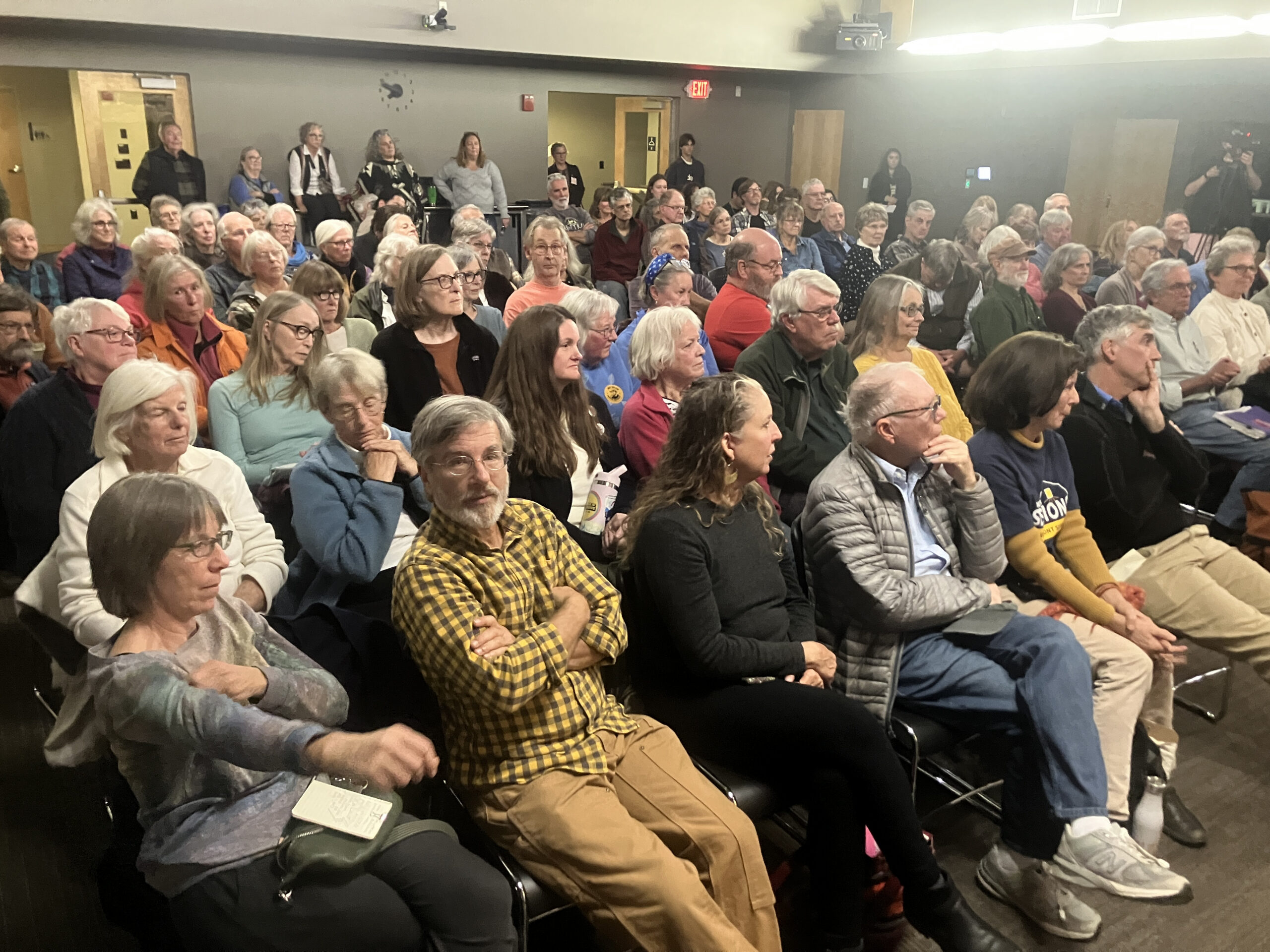
MIDDLEBURY — This past Saturday, Vermont Poet Laureate Bianca Stone launched her fourth book in the Vermont way, which is to say up close and earnestly among community.
The launch for “The Near and Distant World” in the new wing of Middlebury’s Town Hall Theater began with an opportunity for cocktails and conversation, and culminated with a Q&A between Bianca and her husband, the poet Ben Pease.
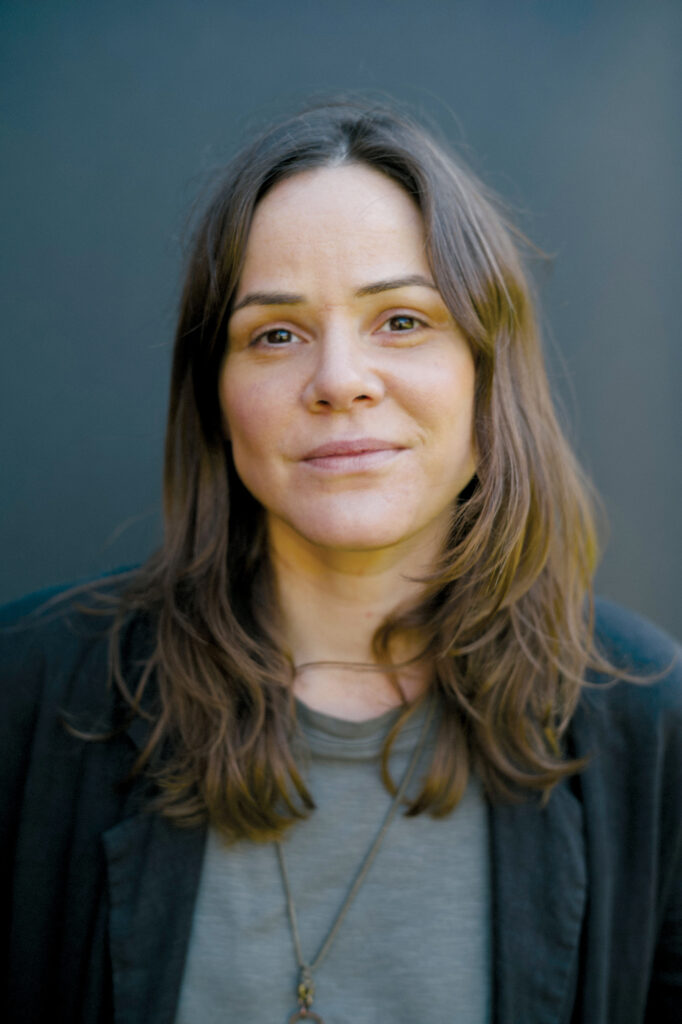
Also on hand was Ruth Stone House’s current Writer in Residence, Carson Jordan, who observed that she was mainly up on stage just for the privilege of watching the thought-provoking exchange between husband and wife which concluded the event.
During her time alone at the podium, Stone was not afraid between wry, witty enunciations to let some silence into the room.
“An Hour,” she said, reading the title of her poem. “What can you really do with it?/ Condense the metaphor further?/ Glimpse God beyond the atom?/ It isn’t a question./ It’s an official statement.”
Stone riffed off her poem differently from how it appears printed on the page, inspired to expand its rhythms in the moment, or else channeling a past draft of the work that she could see and her audience could not, even with the freshly printed book open in their laps. The effect, of course, was like a warm hearth against the cold, the earthy tone of Stone’s voice an invitation to contemplate the deeper mysteries, the ancient heroes, the furrow-browed philosophers whose hubris it was, or might have been, to attempt to wrest meaning from the heavens.
Figuring in the collection are Narcissus, Rapunzel, Mephistopheles, Oedipus, Antigone, Ovid, Santa Claus, Fleetwood Mac, Saint Anthony, Paul de Man, Andrei Tarkovsky, Sigmund Freud, Wallace Stevens, Tomas Tranströmer, Goethe, and Rilke, who receives the honor of delivering two epigraphs, including a line, as translated by poet Franz Wright, that resonates with Stone’s chosen title: “How can a distance be so unendingly near yet not come any nearer—not all the way?”
And of course the collection features most prominently the character of the poet herself.
Stone set out the theme of the night at the beginning—“endings,” it turned out to be—which she stated would resonate with the famous lines from T.S. Eliot’s “Four Quartets.” At each stop on the tour for “The Near and Distant World,” she intends to organize her reading around a different theme. “We have to look towards where truth is hidden,” said Stone, between poems. “We have to look towards, in part, where there are lies. Where there’s an admission of not knowing. There is uncertainty. So how do you approach art where you have to say What This Means? And what does it do to stand there and investigate, anyway? We find the answers in the poems themselves.”
Despite the evening’s somber tones, Stone’s artful meditations on non-being, both the pull toward and bodily recoil from that eventuality, she did, too, manage to squeeze some humor from it all, which her audience met with gushes of laughter.
“It’s good to see everybody here. There’s so much time between your face and my face, with some of you. [For] some there’s been no time — this is the first time we’re facing each other. Some of you there’s been too much time…” She glanced teasingly toward husband Pease, daughter Odette, and others who might be familiars to Goshen artists’ space the Ruth Stone House, named for her grandmother, a giant of 20th century American poetry. “Love you all so much.”
Stone treated the audience to a reading of her poem, “What’s Poetry Like?” which first appeared a few years ago in the pages of the New Yorker (although perhaps, before that, it’s fair to speculate, at a Ruth Stone House reading); the title is taken from a question asked of Stone during her time in New York City by a Time Warner Cable technician.
In reaching for an answer in the poem, Stone finds herself grappling with “the treacherous inadequacy with which one/ finds oneself explaining in a few loose/ deficient words something with lungs/ and no face, the immortal freak/ of language you haunt and hunt/ which is the original state of language/ you’re trying to get back to from within —”
Although in her work Stone openly questions the power of her work, that power and grace is self-evident to anyone with ears to listen, even as she opens herself up to relinquishing it. Harkening back to the question she had asked earlier (“What can you really do with it?… Glimpse God beyond the atom?”) it is difficult not to think of the poet Renée Nicole Good.
Good’s killing in Minneapolis at the hands of a division of law enforcement that the current occupants of the White House want to decree above public accountability has brought to prominence her award-winning poem “On Learning to Dissect Fetal Pigs.” That poem wrestles with how to find religious, or spiritual transcendence, when we are so awash in biological knowledge, a motif encapsulated with concision and timelessness by Stone’s own questions. “The immortal freak of language,” indeed.
As poetry gave Good bravery in life, it is a great thing, too, that there are working poets like Stone, and Pease, who champion what language can do, and which spirits a well-honed line might bring into the present tense.
It is a unique weight that Stone carries as a poet, given that she is the granddaughter of a giant of American letters and entrusted, along with Pease, with the perpetuation of her grandmother’s legacy, in the very home where Ruth Stone lived and worked and raised the daughter who would become Bianca’s mother.
When asked, toward the end of the Q&A, by Carson Jordan where in the body poetry lives, Stone made reference to a poem by her grandmother called “Speculation,” published in the same year that Ruth’s second husband took his own life. In that celebrated poem, Ruth Stone imagined what the grave might hold for her, or more specifically, her bones. In contrast with the mordant humor toward which an author like George Saunders approaches similar questions, Ruth Stone plays it mostly straight, with eerie composure, in giving voice to “speculation” about her own non-being. Bianca Stone channeled that voice for the Middlebury audience, “At/ my center/ The bone glistens; of wondrous bones I am/ made…”
Sometimes, Stone said, the bone glistens when the poetry is right.