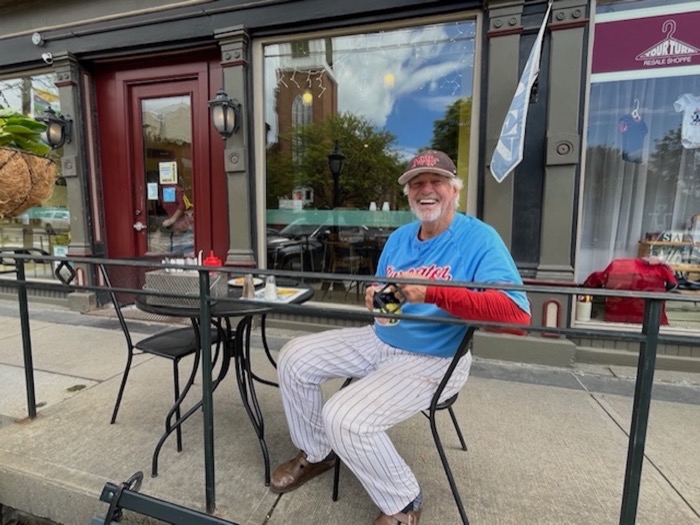
There he was, Bill Lee, in his baby blue and red Burlington Cardinals baseball uniform, in front of the 3 Squares Café in Vergennes on a beautiful day last May. He had just finished playing a Vermont Senior Baseball League game.
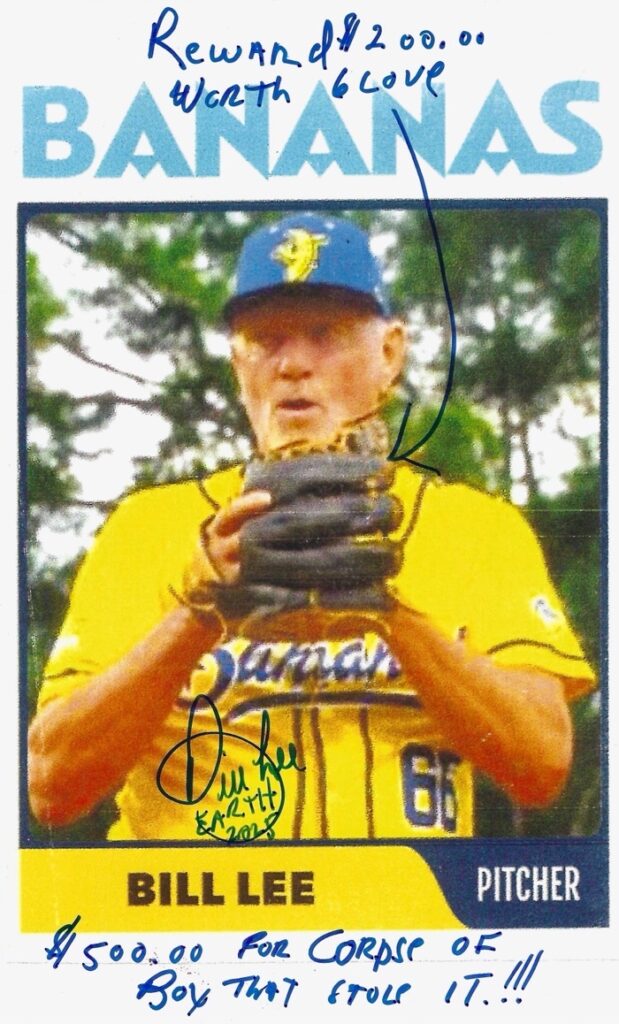
We exchanged a light fist bump and he handed me a poster of a sort, an 8 x 11 color photo of his Savannah Bananas baseball card on which he had scrawled with a blue sharpie these words:
At the top “Reward $200.00 Worth Glove” (“Worth” is a brand of baseball glove) with an arrow pointing to the glove — and at the bottom “$500.00 for corpse of the boy that stole it!!!”
“Get it?” he asked.
“Yeah, I guess,” I said. “Someone stole your glove and you want it back.”
“It’s from Mark Twain!” he responded and gleefully explained to me, the literature teacher and purported baseball scholar, the historical reference, a famous Twain anecdote, though unknown to me, alas.
This exchange has prompted me to consider Mark Twain and baseball.
Twain in fact was an avid baseball fan, a “crank” in the slang of the day. He lived in Connecticut from 1874 to1891 — there he wrote and published both “The Adventures of Tom Sawyer” (1876) and its sequel “The Adventures of Huckleberry Finn” (1884). He frequented games at the Hartford Ball Grounds, a 2,000-seat stadium, and was an investor in the Hartford Dark Blues base ball team.
In his passion for baseball, Samuel Clemens proved to be a man of his time. Baseball evolved from the English games of cricket and rounders (the Abner Doubleday/Cooperstown myth was thoroughly debunked decades ago). Though there are references to “base ball” (two words at the outset) in the 18th century, the first actual games were played in the 1840s, mainly in and around the environs of New York City.
The first team of entirely professional “ballists” were the Cincinnati Red Stockings who toured the country in 1869 from Boston to San Francisco, playing all comers, and winning every game, 57 wins and no losses. Led by the Wright brothers, Harry and George, former cricket stars, the Cincinnati Red Stockings took their talents east two years later and became the Boston Red Stockings (later, the Red Sox).
On May 18, 1875, Samuel Clemens attended a game between his beloved Dark Blues, whose record stood at 12-0, and the best team in the game, those Boston Red Stockings (16-0), both teams in the National Association, the precursor to the National League (the “senior circuit,” organized in 1876).
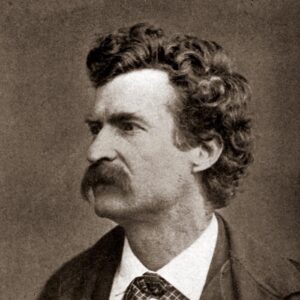
It seems that Twain’s umbrella was swiped at this game (won 10-5 by Boston), so he took out this ad a few days later in the Hartford Courant:
“TWO HUNDRED AND FIVE DOLLARS REWARD — At the great baseball match on Tuesday, as I engaged in hurrahing, a small boy walked off with an English-made brown silk UMBRELLA belonging to me and forgot to bring it back.
“I will pay $5 for the return of the umbrella . . . . I do not want the boy (in an active state) but will pay two hundred dollars for his remains. Samuel L. Clemens.”
I assumed Twain knew baseball because, some time ago, I read “A Connecticut Yankee in King Arthur’s Court.” Published in 1889, it’s a tale about a time traveler, Hank Morgan, who is transported back in time from the 1880s to the sixth century of King Arthur and Merlin the Magician and the Knights of the Round Table.
Hank is an engineer, full of Yankee ingenuity. Armed with contemporary knowledge and skills, he is able to perform the miraculous, which places him in direct conflict with Merlin. He has other challenges and problems — what to do with those pesky Knights, for example:
“It was a project of mine to replace the tournament with something which might furnish an escape for the extra steam of the chivalry, keep those bucks entertained and out of mischief . . .
“The experiment was baseball.”
Twain’s account of their intramural base ball games reads well, still funny. Hank divides the Knights into teams but couldn’t get the players to “leave off their armor.” Any ball that struck a player “would bound a hundred and fifty yards sometimes.”
And they actually did kill the umpires.
In April the same year that “A Connecticut Yankee” was published (1889), Twain gave a rousing speech at Delmonico’s Restaurant in New York, a grand event celebrating the return of Albert Spalding and the ballplayers who participated in their “Tour around the World” from October 1888 to April 1889, playing exhibitions from Hawaii to Australia, South Asia, and Europe.
In his speech, Twain connected baseball to the American spirit, calling the game “The very symbol, the outward and visible expression of the drive and push, and rush and struggle of the raging, tearing, booming nineteenth century!”
This discussion of Twain and time travel and baseball brings to mind the writing of a more contemporary novelist, Darryl Brock. In his “If I Never Get Back” (1990), Brock’s 31-year-old protagonist Sam Fowler (“Samuel Clemens” Fowler: he was named by his grandfather, a Twain aficionado) is disillusioned and depressed by setbacks in his life. After a night of drunken excess, he awakes in the 19th century, 1869, and soon enough hooks up with Cincinnati Red Stockings as they cut a swath through National Association teams in the East and eventually west to San Francisco.
Early in the novel, Sam finds himself on a train with the actual Samuel Clemens, and they hatch a plan that sets the plot in motion. Twain recedes from the action, but wonderful adventures ensue. Brock is a master of historical detail in “If I Never Get Back,” and in its sequel, “Two in the Field” (2002), where Twain also makes an appearance.
“Mixing fantasy with historical detail,” wrote Peter Carino in his review of “If I Never Get Back,” “this episodic plot generates a panorama of an America in flux.”
It appears that Twain never got his fancy umbrella back, nor has Bill Lee’s favorite glove been returned.
I like to imagine Mark Twain and Bill Lee together. I think they would hit it off.
—————
Karl Lindholm taught two baseball courses in the American Studies Program at Middlebury College: “Baseball, Literature, and American Culture” and “Segregation in America: Baseball and Race.” He can be contacted at [email protected].