
Sports
True believers and kindred spirits meet in Louisville
August 1972: My last (of six) Army Reserve “summer camps,” this one at Fort Knox, Kentucky, working in the hospital there.
After my two weeks of duty, I was headed back to Cleveland in my VW Beetle (bought new for $1,995) where I was teaching high school English and coaching baseball.
I made one stop on the way, in Louisville, about an hour from Fort Knox, to attend a baseball game at the Fairgrounds Stadium there, now long gone. The Louisville Colonels were the Red Sox AAA affiliate, and the Red Sox were my team.
I have one vivid, enduring memory of that game. I don’t remember anything aside from a spectacular home run, a blur, a shot, a line drive to straightaway center that got out in a hurry, hitting a light stanchion. I was surprised it didn’t topple the stadium lights — it was hit that hard.
The batter: 20-year-old Californian Dwight Evans.
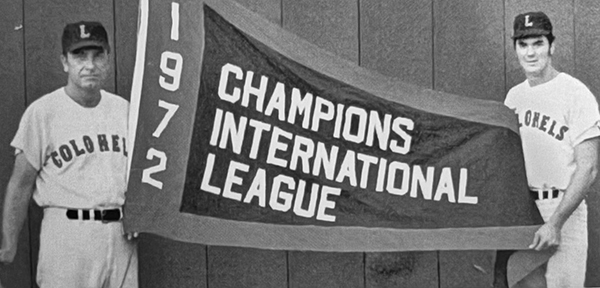
AT AGE 20, future Red Sox star Dwight Evans (right) was the Most Valuable Player in the International League led the Louisville Colonels to the league championship. Louisville Manager Darrell Johnson (left) managed Evans and other stalwart Red Sox players in the 1970s.
Photo courtesy of Louisville Slugger Museum Archives
I recognized the name when he came up to the Red Sox the next year — and enjoyed watching him play with the Sox for the next 19 years. Only Yaz played in more games for the Red Sox.
Evans was the MVP of the International League that year, 1972. Red Sox stalwarts Jim Lonborg and Cecil Cooper were his teammates on the Colonels, which won the International League Championship. Hall of Famer Carlton Fisk played in Louisville the previous year.
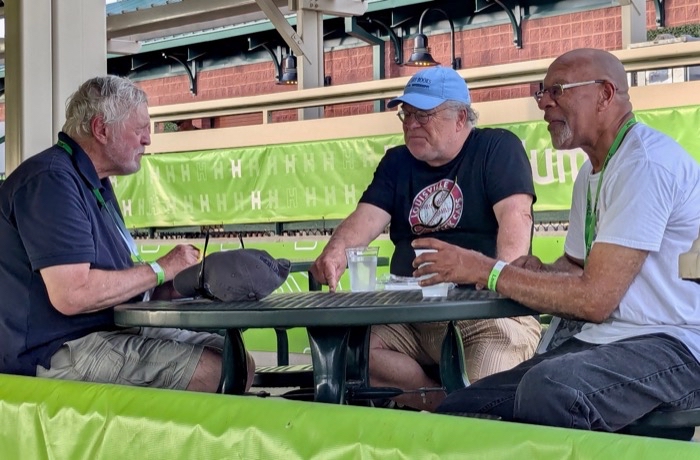
I went back to Louisville, just a couple weekends ago, this time without a military obligation: it was all about baseball. I attended the 25th annual Society of American Baseball Research (SABR) Jerry Malloy Negro League Conference, held every year in a different city, a gathering of true believers and kindred spirits.
I try never to miss it. This was my 10th Jerry Malloy and wish I had found it earlier (Malloy was a brilliant researcher of the early game. He died in 2000 at 54.)
The conference itself was excellent, with over 100 attendees. The first afternoon included a tour of the Louisville Slugger Bat Factory and Museum — a 125 foot high wooden bat stands in front of the building on Main Street.
There, we saw a new film on the Nashville Elite Giants produced by Dr. Harriet Kimbro-Hamilton, daughter of Henry Kimbro who played in the Negro Leagues for 12 years (1937-48).
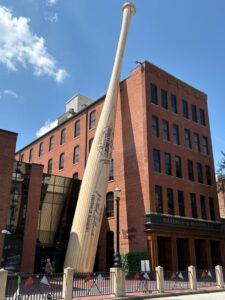
THE LOUISVILLE SLUGGER Museum and Factory on Main Street in the heart of downtown Louisville features a 120-foot-bat in front of the building. Though no longer having the near monopoly it once had in wooden bats, Louisville Slugger is still the bat of choice of 15-20% of Major League players.
Photo by Karl Lindholm
That first evening, Thursday, we were treated to dinner and a stimulating program on baseball and Black life at Roots 101, the African American Museum in Louisville. The next night, Friday, as fans and scholars of baseball, we did our “field work.” This year, it was an AAA game between the Louisville Bats (Reds) and the Toledo Mudhens (Tigers) at Louisville Slugger Stadium.
The last night, the banquet, featured the finals of the Significa Contest — others may call it “trivia” but not us: I have two wins and two seconds in this event, but I am an also-ran now, slowed, like ballplayers, by age.
The research papers are the core purpose of the conference and they were outstanding this year. My favorite presentation was not a research paper, but a reading by poet Dorian Hairston from his book of poems, “Pretend the Ball is Named Jim Crow,” about the short and difficult life of Josh Gibson, the Black Babe Ruth, who died at 35 in 1947, a few months before Jackie Robinson integrated Major League baseball.
Louisville was somewhat of an unusual choice for the Jerry Malloy as it did not have a signature Negro league team with heralded players as did other American cities (Chicago, Pittsburgh, New York, Philadelphia, Kansas City, Detroit, and others). Other Southern cities had strong Black baseball teams and traditions (Birmingham, Atlanta, Nashville, Memphis).
The most notable Negro League player from Louisville was Sammy T. Hughes, born and bred there. Many consider Sammy the best second baseman in Negro League history. Hall of Famers Cool Papa Bell, Monte Irvin, and Buck Leonard all placed him at second base on their Negro League all time All-Star teams.
Tall (6’3”) and graceful, he was a slick fielder — and a good hitter. He was selected for eight East-West (all-star) Games and
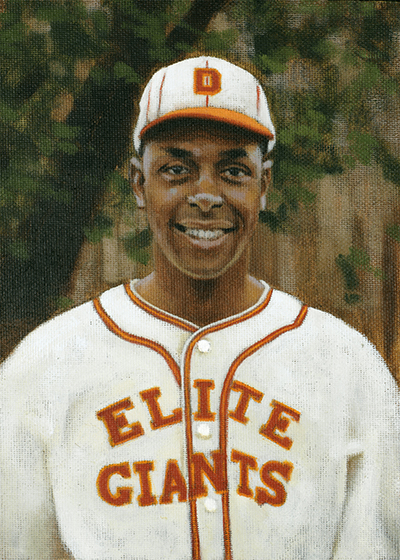
SAMMY T. HUGHES was born and raised in Louisville and is generally considered the best second baseman in Negro League baseball. Tall (6-foot-3) and graceful, he was a slick fielder and a good hitter (.320 batting average).
Painting by Graig Kreindler, used with the permission of Jay Caldwell
batted .320 in his Negro League career, .353 in exhibition games with white Major Leaguers. Sammy played 14 years in the Negro Leagues, from 1930-46. He lost three years to World War II (’43, ’44, ’45) and retired just as Jackie Robinson was making his dramatic entry into the white game.
Artist/researcher Gary Cieradkowski observed, “The biggest problem with the Hall of Fame in Cooperstown is that Sammy T. Hughes isn’t in it.”
Louisville’s favorite son in baseball is Harold “Pee Wee” Reese, who was born and raised and lived in his retirement there. A Hall of Famer, he was Jackie Robinson’s keystone partner on the great Brooklyn Dodger teams of the 1950s, playing shortstop to Jackie’s second base. Pee Wee was the Dodger captain and an important player in baseball’s integration story.
In 1946, Jackie’s one season of minor league baseball playing for the Montreal Royals, he came to Louisville to play the Colonels in the International League championship. He was treated with withering hostility: “A torrent of mass hatred burst from the stands with virtually every move I made. . . . the worst vituperation I had yet experienced,” he wrote later.
Pee Wee was in the Navy on a ship in the Pacific in 1945 when he heard that Jackie, then playing shortstop for the Kansas City Monarchs, had been signed by the Dodgers, “if he’s man enough to take my job, . . . he deserves it,” he said.
When Dixie Walker and other Dodger players from the South circulated a petition objecting to Jackie presence on the team, Pee Wee refused to go along, effectively ending the effort.
Dodger captain Kentuckian Pee Wee Reese was Jackie Robinson’s ally and friend.
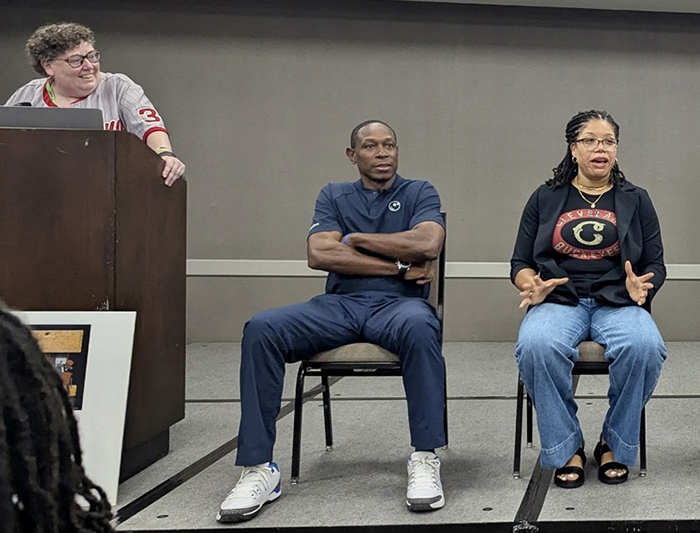
FILMMAKER EVELYN POLLARD discusses her recent documentary on the Cleveland Buckeyes at the recent Negro Leagues Conference in Louisville. The Buckeyes were in the Negro American League from 1942-50 and World Series Champions in ’45. Kenny Lofton (center) played 17 years in the Major Leagues (10 with Cleveland), and was a producer of this film. Historian Leslie Heaphey (left) is a founder of the Negro Leagues Conference, which has met annually for 25 years.
Courtesy of SABR
The location of next year’s Jerry Malloy has not been announced. I’m hoping for either Chicago or Memphis. I have never been to Memphis and I have a special interest in the Memphis Red Sox:
Imagine — a whole Red Sox team of Black players from 1923-1948, such a dramatic counterpoint to the famously recalcitrant Major League Boston club.
Karl Lindholm, PH.D., is the Emeritus Dean of Advising and Assistant Professor of American Studies (retired) at Middlebury College. He can be reached at [email protected]
More News
Sports
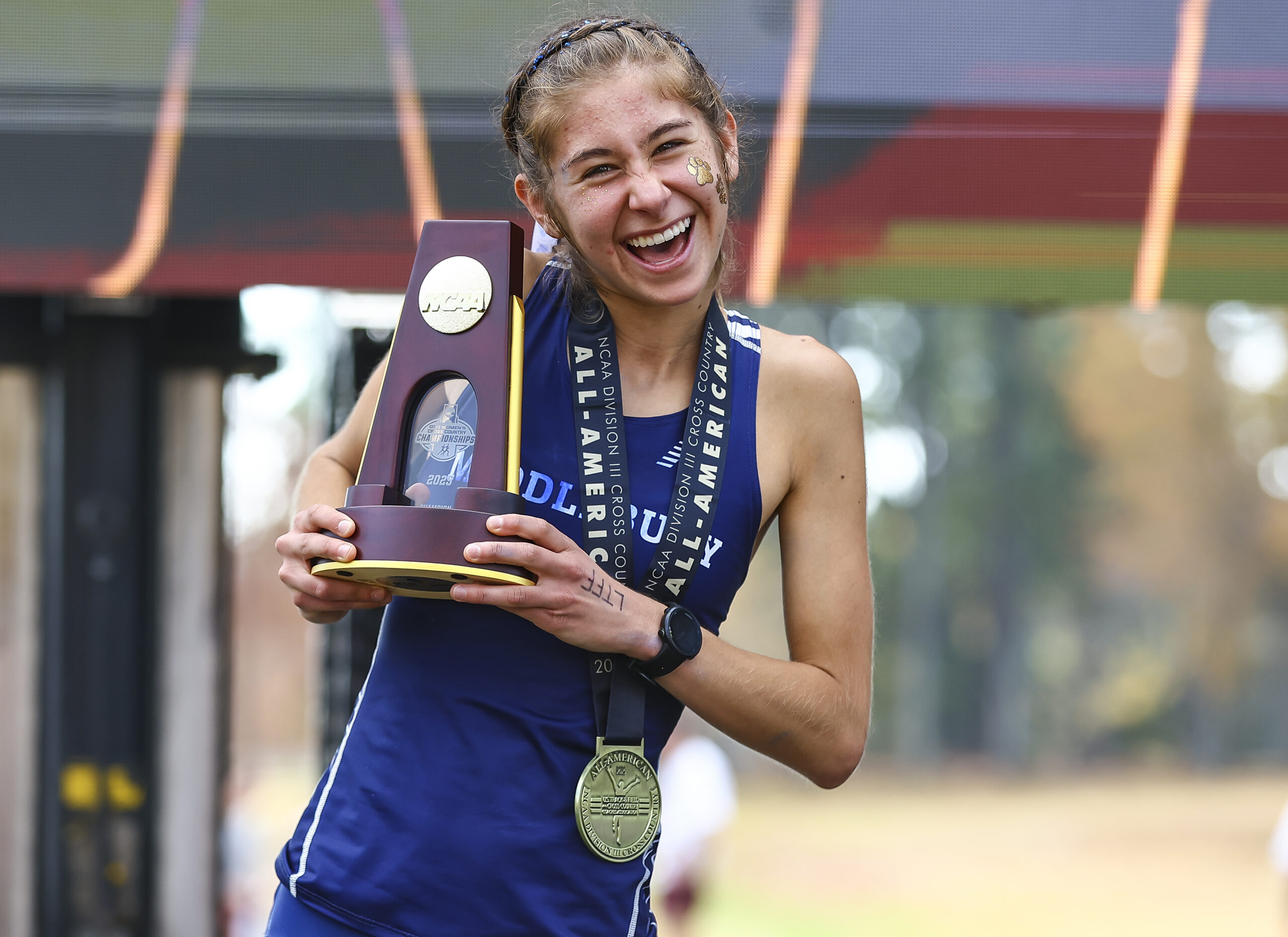
Midd’s MacLean puts NCAA title in perspective, credits teammates
The Middlebury College junior touts a running resume about as long as the 6K she won at th … (read more)
Sports
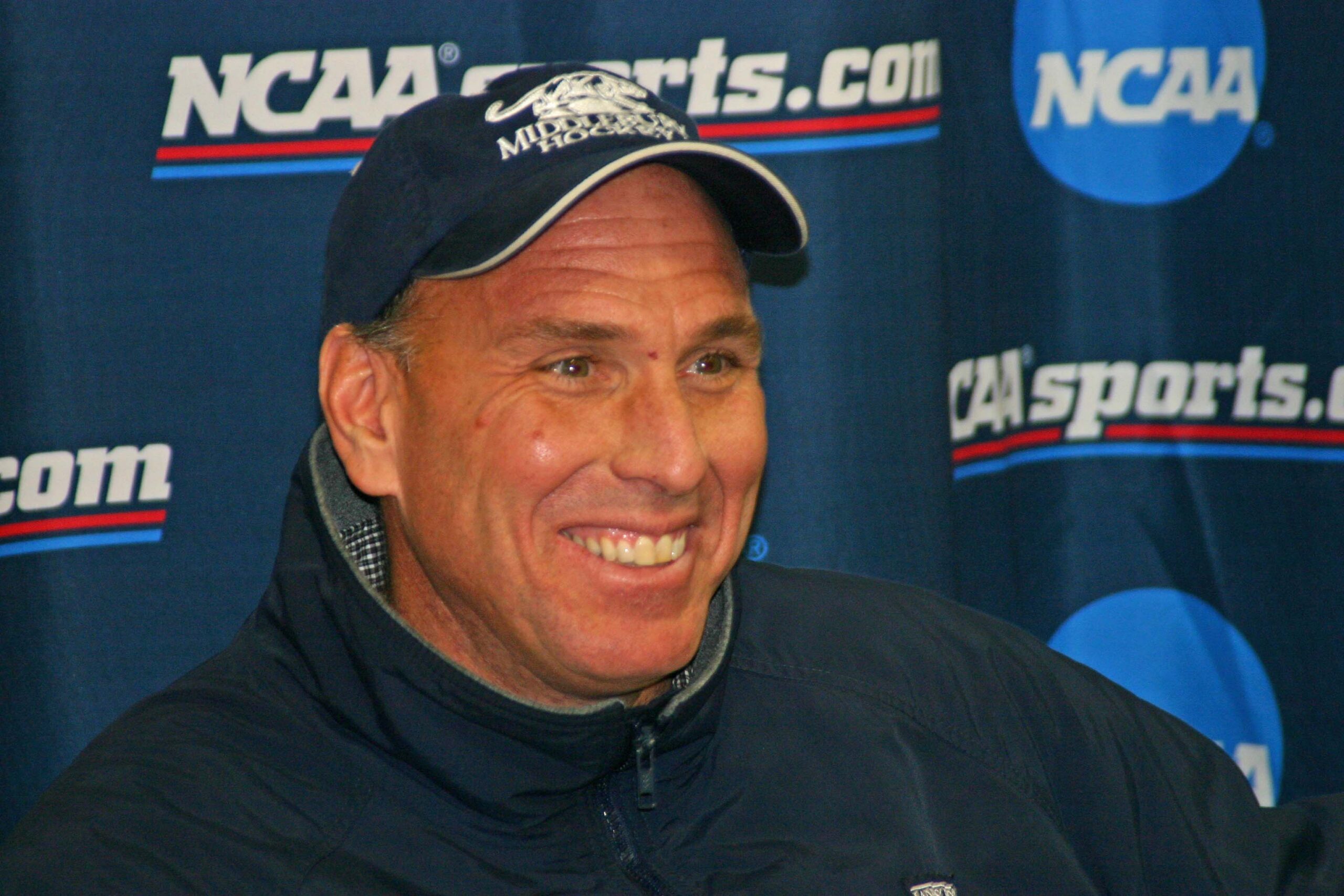
Storied Panther women’s hockey coach Mandigo retiring
Middlebury College women’s hockey head coach Bill Mandigo has been at the helm of the domi … (read more)
Sports
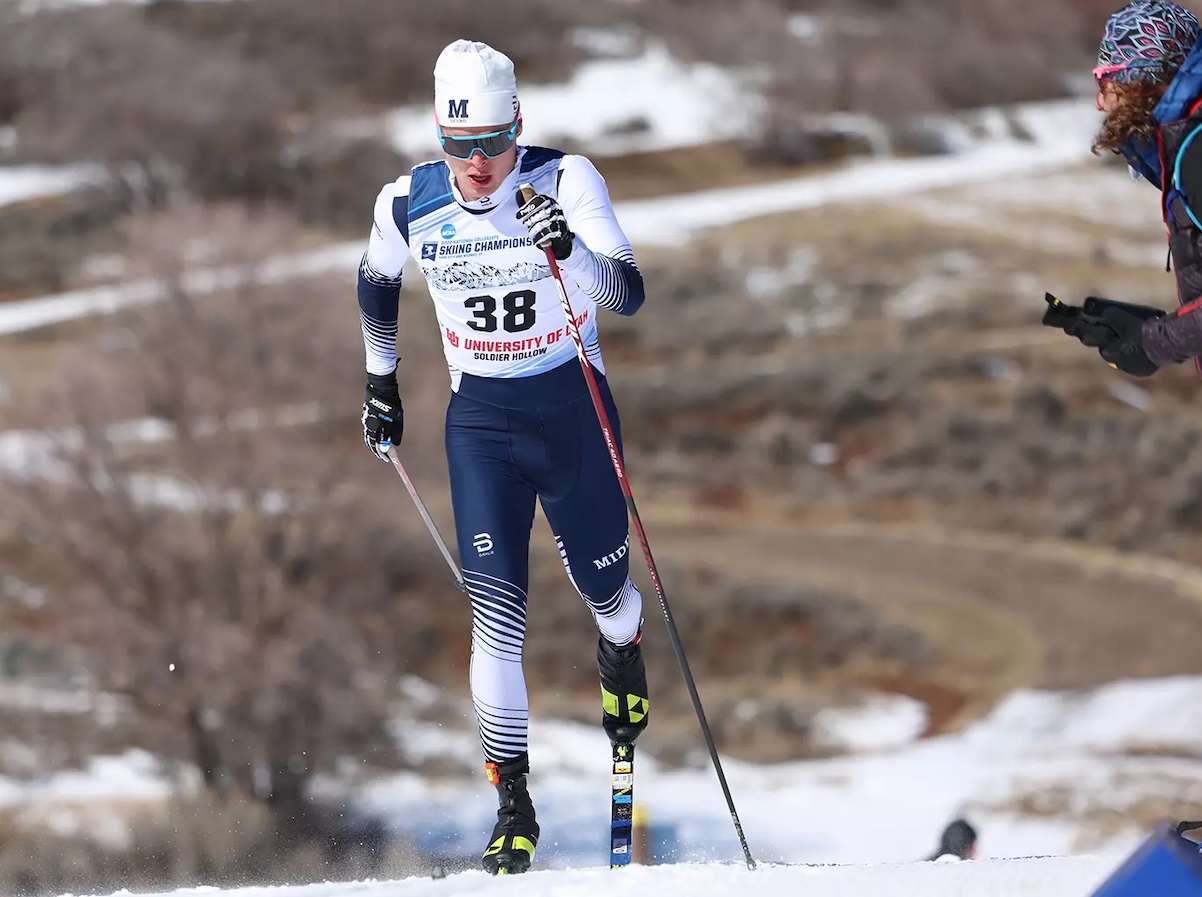
Middlebury alum helps earn gold at 2026 Paralympics
Jake Adicoff (Bowdoin ‘19) and Peter Wolter (Middlebury ‘22) skied two gold-medal earning … (read more)