
News
Lawmakers wrestle with how to regulate runoff from dairy farms
In late February, and again in late March, Gerard Vorsteveld sat in front of a room of state lawmakers. After remaining mostly quiet during years of legal battles and media scrutiny centered on pollution coming from his family’s Addison County farm, he had the floor.
“We’ve spent hundreds of thousands of dollars on this, and there’s no end in sight,” he told lawmakers in the House Judiciary Committee on March 26, his voice breaking.
In 2020, Dennis and Vicki Hopper, the Panton farm’s neighbors who spend summers in Vermont, sued Vorsteveld and his brothers, Hans and Rudolph, over runoff that ran from the 1,400-cow dairy farm, through their land, and into Lake Champlain.
Though the lawsuit focused on damage to the Hoppers’ land, during a six-day trial that wrapped up in January 2022, the Hoppers’ attorneys showed striking photos of the runoff flowing into the lake, splaying out into vast brown plumes. The lawyers would ask various witnesses, including Vorsteveld, some version of the question: Do you think this is OK?
In March 2022, Judge Mary Miles Teachout issued a sweeping, 32-page order that required the farmers to stop the runoff. And in September 2024, the judge found them to be in contempt of court: The Vorstevelds hadn’t done enough to mitigate the problem, she decided. The three brothers insisted that complying with the order would be a significant financial strain.
Amid a statewide effort to improve water quality in Lake Champlain, and while farmers are facing unprecedented hardships from climate change and worsening economic conditions, the lawsuit has come to stand for broader issues. The Vorsteveld case often behaves like a prism — people see different things, depending on their vantage point.
For many in the agricultural community, it is an example of how well-resourced outsiders pose a threat to farmers and the broader culture of farming in the state. To others, it represents the environmental risks of Vermont’s larger dairy farms, and a deficient regulatory system that has yet to solve the problem.
This winter, the case has been relitigated in the Senate and House Judiciary Committees, which heard from attorneys representing both sides, along with Vorsteveld himself. Committee members have been wrestling with the case’s implications as they decide whether to update Vermont’s so-called right-to-farm law to give farmers more protections against lawsuits like the one that has embroiled the Vorsteveld farm.
Meanwhile, prompted by a forceful nudge from the federal Environmental Protection Agency, lawmakers in the House Environment Committee and Senate Natural Resources Committee are mulling bills that would address longstanding problems with farming-related water quality regulation in Vermont.
A changing landscape
When Sen. Samuel Douglass, R-Orleans, introduced his proposed update to Vermont’s right-to-farm law before members of the Senate Judiciary Committee, he said the bill was a response to people moving to the state who “then will complain about the smell of the farm that’s next door, that they moved in next to.”
“A lot of those farmers are worried about getting sued,” Douglass told the committee.
Vermont’s landscape and culture is measurably shifting away from farming. In 1970, Vermont’s population was around 420,000 people, and now stands at roughly 647,000, Steve Collier, an attorney for Vermont’s Agency of Agriculture, told lawmakers.
“Our population has gone up since then by about 50%, but we’ve lost 56% of our harvested crop land, so while our population is expanding, our capacity and our ability to grow food is declining,” he said.
Between 2017 and 2022, the state lost 32% of its dairy farms, according to Collier, and nearly 20,000 acres of farmland, according to the USDA’s 2022 Census of Agriculture — some of which was likely developed. Faced with increasingly dire economic conditions, many of the surviving farms have had to decide whether to “get big or get out.” While the total number of farms and total farm acreage declined in those five years, the average farm acreage increased.
While a “large” farm in Vermont is still small by many other states’ standards, these conditions have left Vermonters reckoning with an agriculture industry operating at an increasingly industrial scale.
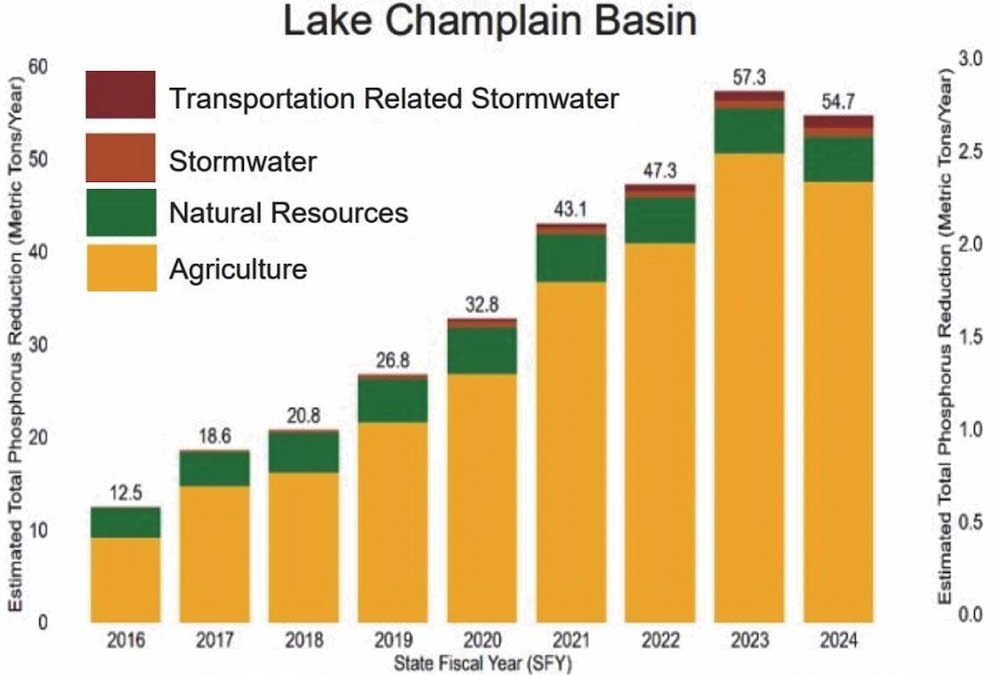
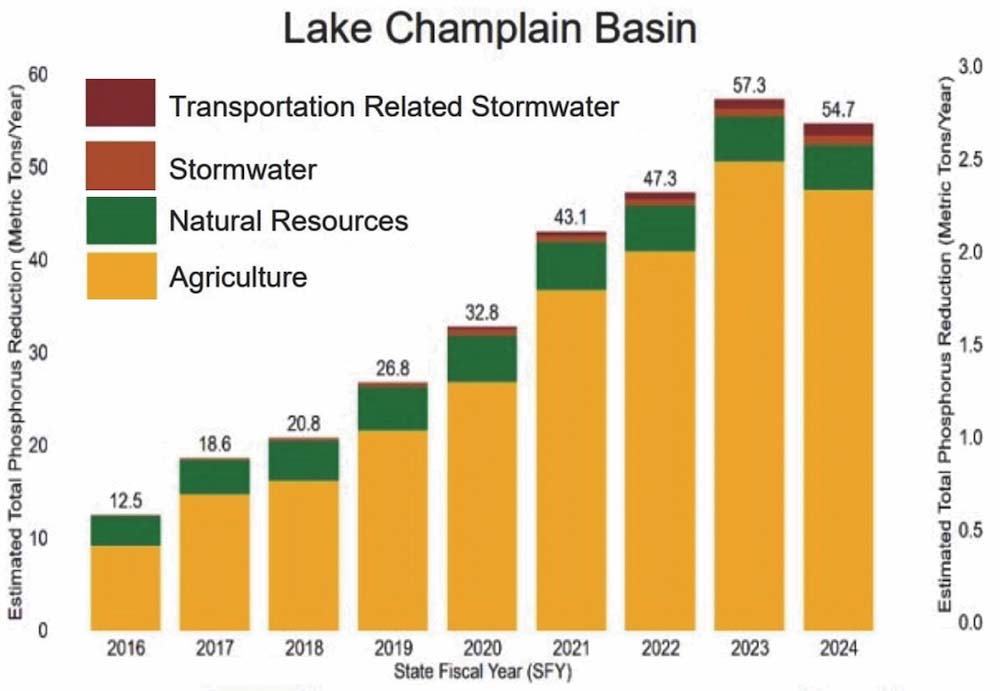
At the same time, Vermonters have become increasingly concerned about the quality of the water in some of the state’s most beloved lakes, ponds and rivers. Farmers have both contributed more to the water quality problem and have engaged in more work to remediate it than any other group.
The state invested an unprecedented amount of funding into water quality projects in recent years, but much of that funding came from federal sources and is teetering due to federal funding cutbacks and freezes under the Trump Administration. Flooding and climate change further threaten water quality.
After all its efforts, Vermont still has a long way to go to meet its federally-required water quality goals. And algae blooms have become a more frequent problem and summertime norm on Lake Champlain and elsewhere, posing both environmental and health risks.
Meanwhile, in 2020, employment across the country made a substantial online shift, enabling people with big-city incomes to move to rural areas. Though the effects may not have endured, the trend has made farmers nervous.
All 50 states have right-to-farm laws, giving farmers special protection from nuisance lawsuits as long as they meet criteria, like they’re complying with state and local laws, for example.
But some witnesses have stressed to lawmakers that, despite the concerns, nuisance lawsuits don’t seem to be a widespread problem for farmers in Vermont. In fact, the Vorsteveld case is the only such case in recent decades that any of the Statehouse committees’ witnesses have been able to reference, and it’s without a doubt the only one in that time frame that has prevailed in court.
However, Collier, the Ag Agency lawyer, said that general conflicts between farms and neighbors that happen all the time. “Any one of those can quickly evolve into a nuisance or trespass lawsuit,” he said.
Compared to other states, Vermont’s right-to-farm law is less protective for farmers. The update, as outlined in the bill, S.45, would strengthen it by nixing criteria in the current law that farmers would need to meet and giving farmers protection from lawsuits as long as they are “in accordance with generally accepted agricultural practices.”
It would also change the burden for the person bringing the lawsuit. Instead of requiring them to show how their property has been affected by the alleged farming practices, they would also have to prove that the farm is not complying with farming rules.
Right to trespass?
Of the proposals in the bill, the largest change might be adding new protections from so-called trespass lawsuits. In legal terms, “trespass” means a physical invasion of property — a stream of water running through someone’s backyard that comes from a farm, for example, according to Cornell University’s Legal Information Institute.
In the Vorsteveld case, trespass came into play because of the farm’s tile drains, which are underground pipes designed to carry water away from farm fields. The farmers have 113 miles of tile drains installed, according to the 2022 court decision, and while the water formerly ran off the surface of the fields, the drains changed the flow and volume of the water, channeling it toward the Hoppers’ property.
Much of the discussion at the trial focused on whether climate change was to blame for the increasing amounts of water that flowed from the fields. Tile drains are permitted by the state’s Agency of Agriculture, and the Vorstevelds worked with researchers at UVM who studied the technology’s effects on the farm.
“Nobody ever said it wasn’t a good idea,” Vorsteveld said in an interview.
One Vorsteveld lawyer argues for increased protections against trespass lawsuits. But others think the potential new protections from trespass lawsuits could limit the way private citizens are able to protect themselves from pollution that could be harmful to their health, wellbeing or the environment.
This concern has popped up during the right-to-farm discussions, in part, because of another conversation playing out in different committee rooms in the Statehouse.
There, lawmakers are trying to reform Vermont’s farming regulations more broadly in response to the federal EPA’s determination that the current system does not comply with the Clean Water Act.
The federal law requires farms that are considered Confined Animal Feeding Operations to obtain permits if they are discharging effluent into state waterways.
But, in September, the EPA wrote in a letter to Vermont that “no individual CAFO permit has been issued to a facility even though there are 37 large CAFOs within the state, 104 medium, and 1,000 small size farms that are potential CAFOs.”
The problem with the state’s regulatory structure came down to the split responsibilities between the Agency of Natural Resources and the Agency of Agriculture, Food and Markets, according to the EPA.
To Jon Groveman, policy and water program director for the Vermont Natural Resources Council — one of the organizations that complained to the EPA about Vermont’s regulatory structure in the first place — the lack of regulation makes citizens’ ability to file trespass lawsuits more valuable.
“I do think that that civil backstop is important, given that we’ve seen real problems — and EPA has validated these problems — with our water quality regulatory system,” he told lawmakers.
As state policymakers struggle to come up with a fair but effective enforcement system, Vorsteveld reflected on the impact on his own farm.
He plugged the tile drains last fall, he told lawmakers. He’s waiting to see whether the field is too wet to grow corn there again. If it’s not cultivable, he suggested he’d have to consider other options.
“It’s beautiful ground,” he told lawmakers with a shaky voice. “It’s faced toward the lake. I’ve contacted a developer. I’m glad we have not sold our development rights.”
More News
Homepage Featured News

Starksboro native Olympic-bound for third time
Look for alpine skier and Mount Abe alum Ryan Cochran-Siegle gunning for the podium in the … (read more)
News
Hockey community nets big assist for family
The Middlebury Amateur Hockey Association organized a skating benefit for Pieter Perrine, … (read more)
News
Bernie Sanders condemns Trump’s ‘authoritarianism’
U.S. Sen. Bernie Sanders, I-Vt, tuned in virtually to a constituent lunch at the Mount Abr … (read more)