
News
A new take on Bristol housing
BRISTOL — From establishing a community fund to pursuing wastewater treatment system upgrades, there are several opportunities for Bristol officials to encourage the development of housing around town.
That’s according to research conducted by Middlebury College students over the recent winter term. The students were all enrolled in a policy innovation lab led by Jessica Teets, a political science professor and Bristol selectboard member.
They spent the winter term working with the Bristol Planning Commission to explore the impact of current zoning regulations on affordable housing, identifying best practices for supporting affordable housing and coming up with ideas for encouraging the creation of more housing in Bristol.
The class shared its findings and offered recommendations at a Jan. 30 planning commission meeting. Students presented on four topics:
- sustainable and affordable wastewater solutions;
- increasing density without new construction;
- best practices for new affordable infill; and
- community education.
WASTEWATER SOLUTIONS
Students exploring wastewater solutions offered suggestions for how the town could affordably and sustainably expand its wastewater management in a way that supports housing development.
They noted that overall, the town’s municipal system is in pretty good shape.Though, while the system’s hydraulic loading capacity is only being used at half of what it could be, the system’s organic loading rate is maxed out at 110% of capacity.
“A lot of this is coming from some of the units being connected to the system producing really highly concentrated wastewater — again, involvement with FOGs, so your Fats, Oils, Greases,” student Emma McNealy explained. “That’s really kind of clogging up the system, and as a result, the system faces a lot of corrosion, blockages and overall lessened efficacy.”
Students suggested pretreatment for connections that produce highly concentrated FOG wastewater pre-treat, such as incentives for installing sink traps that would filter out fats, oils and greases.
When it comes to building septic for new developments, students noted that problems faced by homebuilders include navigating extensive regulations and expensive installation costs. One solution for new developments could be pursuing cluster septic systems, which serve multiple units and lower installation costs.
“The best example of this is the Bristol Cohousing that serves 14 units,” student Jack Dyer said. “These options are really good and really viable because they reduce a lot of the costs involving getting the septic site set up properly and installing it because you only have to do it once for many units instead of doing it again and again.”
Students also highlighted several funding sources that could support expansion of Bristol’s municipal system, which they pointed to as a long-term option the town could possibly pursue in 10 to 15 years. They estimated that effort could cost $30 million-$45 million, based on a case study of the $25 million city sewer project in Vergennes.
INCREASING DENSITY
A group of students focused on how to increase density without new construction found that current Bristol zoning regulations already benefit parties looking to develop additional residential units in existing structures.
“We came into this project thinking that zoning changes would be the most important thing to consider,” student Ellie Odefey said. “But what we found is that, because most of these rehab projects are done by local property owners, individuals, a lot of the regulations in place already favor people, as opposed to regulations that make it harder for external developers to come in and do (new) projects.”
Odefey noted that Bristol’s regulations regarding units per acre were about the same as in other towns students looked at, such as Vergennes and Montpelier.
“So, it seems that Bristol is already kind of ahead of the curve in terms of promoting density, or at least on par with our examples that we’re hoping to match,” Odefey said. “That’s not to say that zoning isn’t relevant because obviously it is, but it’s just more important to infill…and for rehab we’re already in a pretty good place with what we have in play.”
Students found that funding and the willingness of property owners to take part in alternative solutions appeared to be more important factors when it comes to rehabilitation projects.
According to students, areas with the most growth potential for increasing density include efficient use of larger homes, subdivision of larger apartments and accessory dwelling units, specifically in existing structures.
Students pointed to financial resources available to support rehab projects. They also highlighted the potential of creating a community fund to supplement project costs.
In Montpelier, a Housing Trust Fund established in 2005 supported rehabilitation of 18 formerly vacant, upper-level apartments for mixed-income housing. Students suggested a similar fund in Bristol funded by a potential Airbnb rooms tax or local options tax.
Such a fund could help cover project costs, which students noted were among the challenges faced in increasing density.
“There are a lot of different funding options, but none are entirely sufficient on their own,” Cali Jantzen said. “Knowing which ones to make use of, knowing which ones to recommend to individuals in the town, but then also thinking about how the commission could come in and maybe creating a community fund to be an added resource.”
AFFORDABLE INFILL
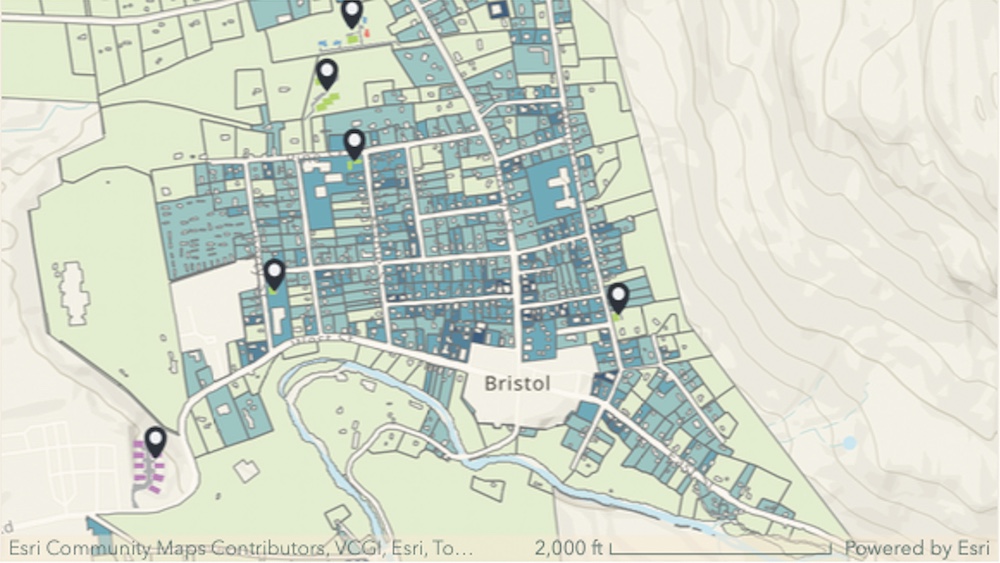
Students also explored best practices for using infill development to increase affordable housing in Bristol. The group used GIS analysis (computer mapping) to calculate plot development density and identify open spaces around town suitable for infill projects.
They also spoke with Bristol residents to learn how they feel about current and future infill projects.
“The chief concern that we got from (the planning commission) and also from several Bristol residents was the detriment that development might pose to the deep set community values held in Bristol,” Joe Morsman explained. “We believe that a few of these planned unit developments, prefabricated buildings, co-housing sites, large multi-unit developments like that; they’re going to foster community development through community common spaces (and) would not only avoid harming the town’s sense of community but provide an opportunity to build more community.”
Students recommended focusing on the creation of larger housing projects in the less dense outskirts of Bristol, which they noted would be the most efficient for increasing housing while reducing per-unit costs.
They also identified potential sites for infill projects in Bristol, emphasizing that the examples were purely hypothetical.
“No conversations have been had with property owners, we just wanted to show that building footprints could be there,” Isaiah Bennett explained.
Those suggestions included the potential for apartments on Bristol’s North Meadow Drive, cohousing on North Street, and a mobile home park near the town’s gravel pit (which sits in an area not currently zoned for residential use).
“We also wanted to propose different types of large-scale projects because we know just putting apartments only serves a specific demographic or just single family units only serves another demographic,” Bennett said. “We wanted to show the variety of new housing that could be implemented into Bristol.”
Bristol Planning & Zoning Administrator AZ Larsen noted that one of the parcels identified by students was recently approved for a six-unit Planned Unit Development, which will add two duplexes and two single family homes.
“So, big infill is already happening, very exciting stuff,” Larsen said.
Students also pointed to accessory dwelling units, or ADUs, as a potential small-scale infill development solution.
“We gathered that the two main concerns with developing ADUs are that lowering construction and design costs and adhering to an aesthetic that conforms to the design of the town are two of the most important things that people are looking at as far as what goes well and what has been somewhat problematic in the past,” Bennett said.
With that in mind, students suggested streamlining the ADU development process by proposing ready-to-build design plans.
COMMUNITY EDUCATION
That recommendation was further explored by students looking into community education opportunities. The group focused on how to encourage responsible density and increase density in town while building with foresight for the future and maintaining community relations.
“Most of the public opposition we’ve talked about is situational,” Hugh Hutchinson said. “It’s not sustained, it’s not usually organized, it’s usually reactive to a development that will disrupt the quality of someone’s life.”
Hutchinson noted that students felt it was necessary to develop community education in the context of projects happening around town. They created a couple of one-page, educational resources related to smaller builds like ADUs.
The first is a permit process flowsheet that provides an overview of the permitting process and highlights where it would be helpful to consult with neighbors in order to hear their concerns.
Students also created a one-page “Want Happy Neighbors?” guide.
“This creates a resource, which indicates the process and what you should talk about with your neighbors outside of the legal parameters of your ADU build,” Hutchinson said. “This empathizes communication between neighbors for ADUs to make sure that ADU construction has good communication and transparency between all of the parties involved and make sure that new builds are something that everyone can be happy with.”
Students provided several other recommendations, including the potential to create a pre-planned ADU program. The effort would create a website featuring design plans for ADUs that have been pre-designed by local architecture firms and sold at a reduced cost.
“This allows for the town and local architects to work on plans that are more hospitable to the community’s identity while giving an option of pre-planned designs where they can see what’s already been done and what they can do for cheaper,” Michael Matheson said.
Matheson noted that due to the nature of Vermont’s laws and the lack of municipalities’ ability to regulate ADUs beyond a certain point, it would take the same amount of work to establish a county or state-wide program as it would be to launch the effort in Bristol. That could provide an opportunity to find partnerships across the state, he said.
Planning commission members thanked the students for their work.
“We as a planning commission are indeed very fortunate to have (Teets’s) leadership with you and the work and the visions that you all worked on and presented here tonight,” Bristol Planning Commission Chair Kevin Hanson said.
The entirety of students’ presentations can be viewed at tinyurl.com/55pn683a.
More News
News

Sign up to be a 2026 salamander escort
Otter Creek Audubon and the Salisbury Conservation Commission will patrol an amphibian cro … (read more)
News
Vergennes dairy farm has the best milk
Tim and Kristen Essex have been receiving a lot of congratulations this winter after their … (read more)
Homepage Featured News

Addy Indy earns top honors among New England newspapers
The Addison County Independent took top honors at the New England Newspaper Press Associat … (read more)