Editor’s note: Liza Cochran is a Lincoln resident who pens the substack Brave Little Voices. In this piece — part news, part analysis — she delves deep into the Aug. 8, 2026, ICE raid of Mary Richards’s home in Cornwall, in which two roofers were detained by ICE without warrants or warning and taken out of state to face deportation. One has been released and is back in Vermont. Some names have been changed out of their fear of U.S. government retaliation.
When Mary Richards and her teenage son moved to West Cornwall in 2023, she knew their roof would need to be repaired. The 19th-century Gothic style farmhouse had steep pitches and soaring dormers and was tiled with gray slate: elegant and durable, but difficult to maintain.
For nearly two years Mary tried to find someone who knows slate to do the repairs. But roofers are in short supply in Vermont, and she kept striking out. This past May, when stains bloomed across the ceiling in the dining room and a crack appeared above her father’s portrait, Mary got desperate. The slate would have to go. She called a roofing company in Burlington and got on their summer schedule for tar shingles.
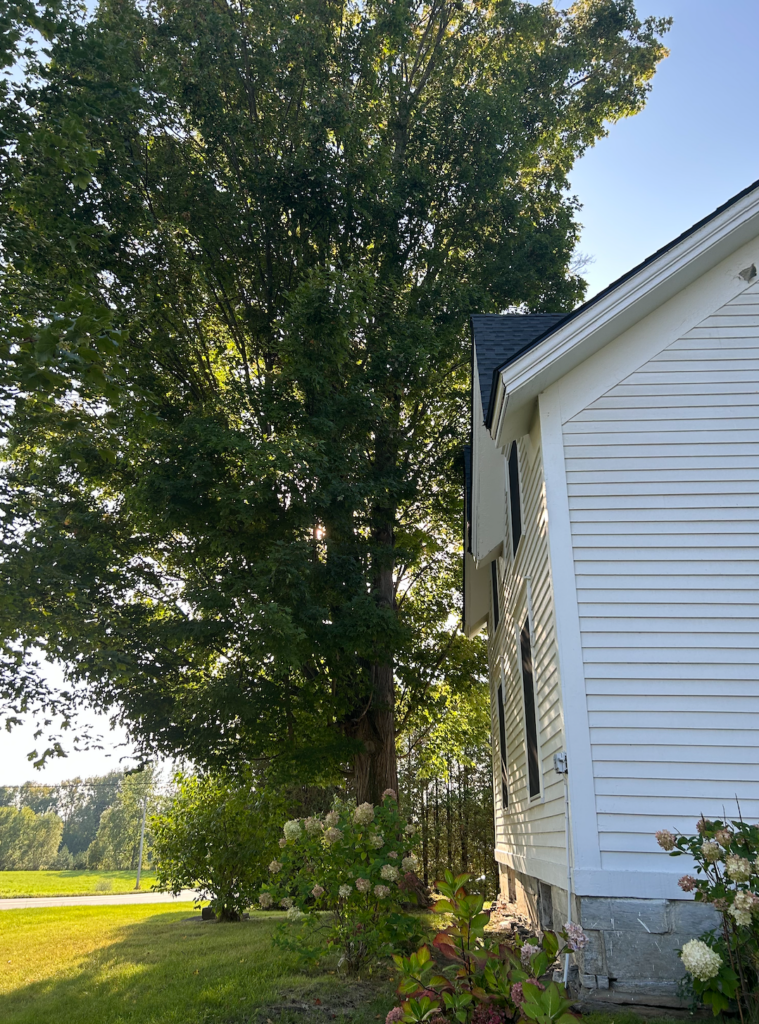
On Friday, Aug. 7, a crew of nine showed up at her house, two women and seven men. The group seemed friendly and close-knit, laughing and bantering in Spanish. It was a sweltering day, but a towering silver maple next to the house cast shadows across part of the roof, giving respite from the sun. The following day, the tree, which Mary has dubbed “Grandmother Maple,” would offer the crew much more than shade. Her limbs would become a sanctuary for two of the roofers as they fled from ICE, her highest boughs their protection.
*****
Mary had chosen Vermont for its stable climate. Leaving Alaska meant leaving her home of 30 years and uprooting her son, but she’d become acutely aware of the changing weather patterns in a region warming twice as fast as the global average. Anchorage’s snowstorms had turned volatile — heavy or absent entirely. Wildfires and droughts were more frequent now, one fueling the other. And across the state, Mary knew that the permafrost was thawing, destabilizing the very ground beneath their feet. When the region’s snow got “so heavy that peoples’ roofs started collapsing beneath the weight,” Mary decided it was time to go.
For someone else, moving to Cornwall just weeks before Vermont’s catastrophic floods of July 2023 could have been taken as a bad omen. Not Mary. Vermont had healthy forests and fertile soil and a longer growing season. But the state’s biggest selling point was its small communities, known for taking care of themselves — which means taking care of one another. In Mary’s mind, storms were coming for everyone, and she saw Vermont as the place with the strongest social fabric to weather what’s brewing.
But storms wouldn’t be the force that emerged to threaten Mary’s sense of safety here. That would be something quite unimaginable to her 2023 self — and to all the previous versions of ourselves who believed our nation’s democratic institutions to be as solid as the bedrock shoring up these Green Mountains.
******
The next morning, Saturday, the crew arrived at Mary’s house by 8 a.m. It was a humid day. From their perch, the roofers would have been able to see thunderheads starting to build in the west.
This part of Vermont is a patchwork of farmland, scrub and forest sweeping between the spine of the Green Mountains and Lake Champlain. There were once 65 working farms in Cornwall. Now there are just a few, but much of the town remains as bucolic as in decades past. Acres of conserved or privately owned hayfields, pastures, and orchards surround small hamlets, like the crossroads where Mary lives. The houses around Mary’s are encircled by generous yards, but — and this is important — they are close enough that one can see what’s happening in the neighbor’s driveway, on the neighbor’s lawn, in the neighbor’s tree.
Sometime around mid-morning Barbara Hofer, a recently retired Middlebury professor, walked by with a friend who lives in Cornwall. Barbara knew Mary from a local Indivisible chapter — part of a nationwide grassroots movement to defend democracy — and, as it happened, she knew the roofers, too. As she turned the bend and saw the crew at work, she said to her friend, “Oh look, I think that’s the same company that did my roof two years ago. They’re the nicest people!”
The crew danced across the roof’s steep pitches with ease, efficiently deconstructing the labor of other workers — most likely migrants who came to Vermont after the discovery of the slate belt in the 1850s. By noon, most of the slate was gone. A neighbor from across the street, a middle-aged man named Jeff, had been watching from his window as it “came off in drifts and draff.” He was impressed, he later told me, and thought to himself, “I gotta find out who this roofing crew is!” Jeff could also see down the street to the neighborhood auto body shop. The garage’s lot borders Mary’s lawn, and he noticed a large SUV with tinted windows parked in the gravel.
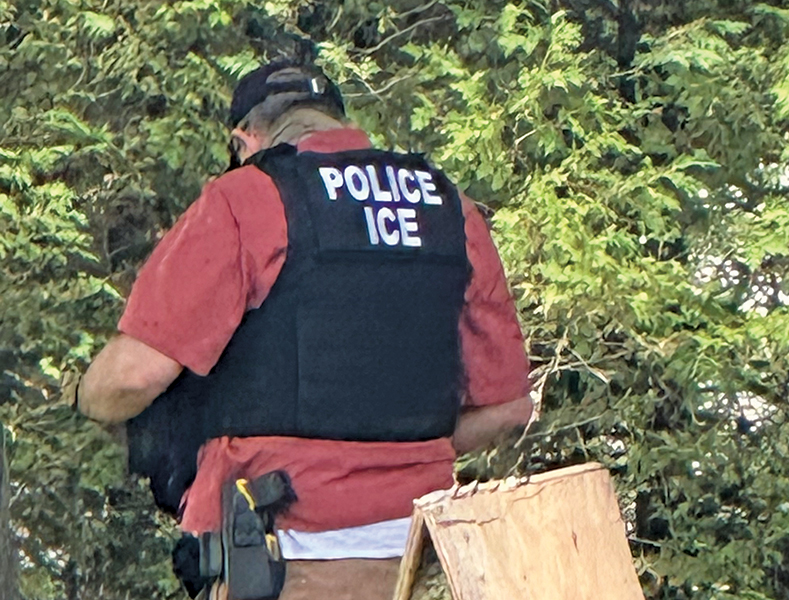
Around the same time, a neighbor named Anya was driving by with her 12-year-old son Luke. They had just finished brunch in town. They were about to turn toward home when they saw two men standing in Mary’s lawn, handcuffing someone and hauling him toward their SUV. The men were masked, in uniform, but it took Anya a few moments to register what was happening — to understand that the men were agents from Immigration and Customs Enforcement, and that she and her son were witnessing an ICE raid.
From his window vantage point, that’s when Jeff noticed the two women, who had just been carting away wheelbarrows full of discarded slate, “running full tilt” toward his backyard. He couldn’t compute what they could be running from. “I’m thinking ‘Is the house going to blow up? What is going on?’ And so I open the door to the deck. One’s already past the garage and the other is rounding the corner and I yell, ‘Hey what’s going on?’ I get three words in Spanish, and then she’s gone, disappeared.”
The women had taken off through the hayfields beyond Jeff’s house, toward a thicket of striped maples and sumac on the far side. Jeff had just gotten back inside to collect himself when, in rapid succession, he saw out the window another roofer following the same path. The man shot through the backyard, heading for the woods. When Jeff looked back toward Mary’s house, he saw the masked agents. “They’ve got a guy on his knees, with his hands behind his back,” he recalled. That’s when he noticed Mary out in her driveway, yelling and animated.
Jeff isn’t one to involve himself in politics. When I asked him if he’d seen any of the footage from ICE’s siege of Minneapolis, he shook his head. “I don’t watch the news, and I stay away from all of it. Because it is so negative and it just takes me down.” But when he saw Mary, Jeff clicked into action. Without hesitation, he headed out the door. “I don’t know what’s going on,” he remembers thinking, “but she might need my help.”
******
ICE’s quiet surge began this past spring. The government’s massive immigration crackdown in Minneapolis, which left two Americans dead in the street, had prompted intense backlash across the country. It didn’t take long for controversial agency figureheads to be exchanged for nominally more palatable leaders. “We are going to take a different approach that can be more effective and less public facing,” Markwayne Mullin explained after he replaced Kristi Noem as Homeland Security Secretary. “What I’m trying to do is remove us from the headlines every single day.”
Mullin seemed to perceive what Noem, Trump and former Border Patrol Commander Greg Bovino had not: that Americans couldn’t stomach the overt violence. But he also intuited that what was out of sight was also out of mind. ICE’s combustible city-wide raids gave way to quick, more opportunistic strikes — intercepting immigrants on the road, outside their homes, at work, even at the hospital and church. As Mary summed it up, “They just creep in like sharks. They want the public to think that everything is normal.”
Indeed, Mullin’s strategy was about avoiding bad press, not about changing course. Since the spring, the numbers of arrests have soared, “with 43,000 in June, more than 49,000 in July and nearly 51,000 in Aug.,” the New York Times reported last week. In January, by comparison, at the height of the high-profile crackdowns in Minneapolis, Portland, Maine, and elsewhere, ICE arrested fewer than 40,000 people nationwide. And yet for so many of us, ICE has — by Mullin’s design — slipped off the radar.
“The shadow surge is a much quieter, but no less violent or deadly, enforcement,” explained Jill Garvey, the director of States at the Core, a nonprofit organization helping people fight authoritarianism. Most horrifically, ICE killed two people in July raids: Lorenzo Salgado Araujo, who had lived and worked in Texas for more than 30 years; and Joan Sebastián Durán Guerreroa, a father of a young daughter in Maine.
Over the course of the summer, ICE detained more than one person per minute. And as The Marshall Project told PBS News Hour, the vast majority of those detained had no criminal conviction.
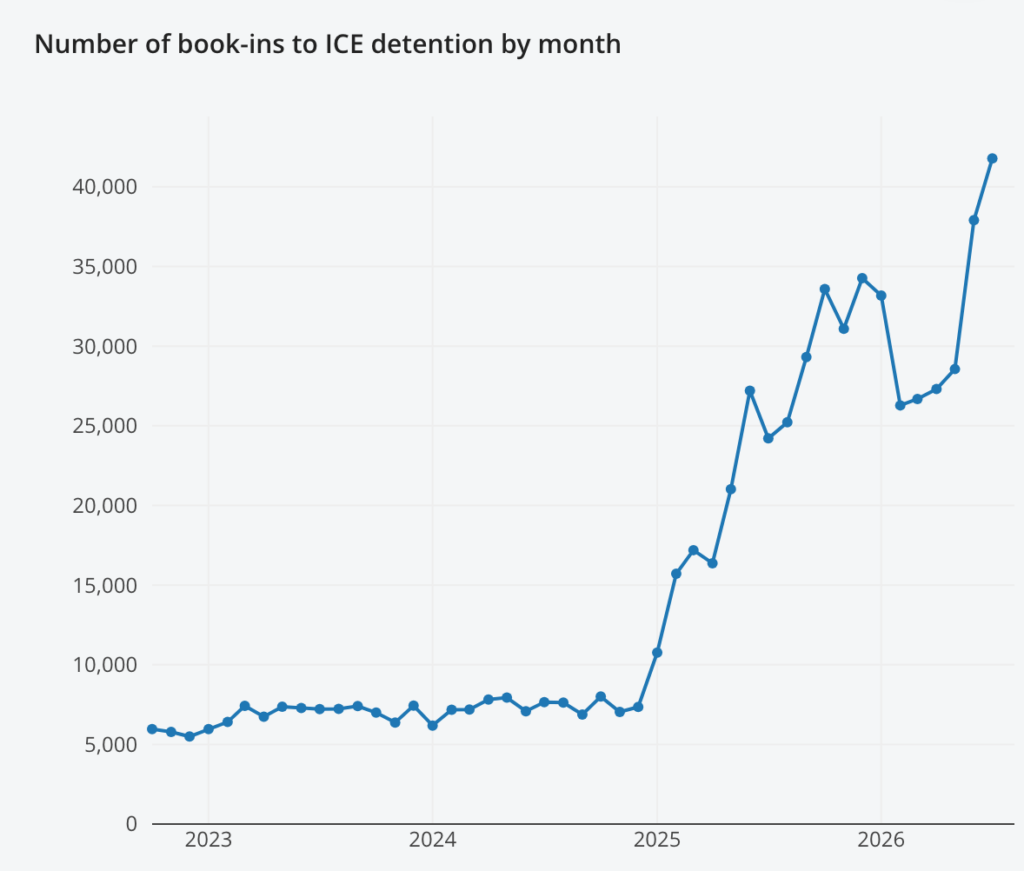
As the number of arrests have surged, so has the money flowing toward these operations. In June, Congress approved another seventy billion dollars for immigration-enforcement, 100% funded by U.S. taxpayers.
*****
When Mary peered out her window at noon that Saturday and saw three black SUVs parked in front of her house, she knew immediately it was ICE. She slipped on her clogs and bolted out the door.
First, she pounded on the SUV windows, but no one was inside. When she turned, she saw an ICE agent next to her house. Mary snapped a photo, then sprinted across the street, screaming for her neighbors to come help. She didn’t yet know that the agents had already detained one man and were in the process of detaining a second. Nor did she know that two roofers were high in the silver maple tree above her head. Or that three were fleeing across a nearby field.
By the time Mary returned to her house with her nearest neighbors, a couple in their 70s, an agent had already questioned her 18-year-old son, who had heard a commotion and opened the front door.
“Can I help you, why are you here?” he called out to an officer.
“I’m just here to talk to workers,” the agent had said.
Weeks after the raid, Mary would discover that her home security camera had taken video of this moment. Her son is standing on the porch in his socks. An ICE agent in a bulletproof vest is at the bottom of the steps, looking up at him. His left hand is on the gun in his hip holster.
“Rage,” Mary would say later, describing her response to finding the footage. Her boy on the porch alone, Mary gone for help without knowing she’d left him with an armed agent. A practicing Buddhist, Mary told me: “I keep seeing myself as a sitting Buddha with my insides just burning.”
*****
When Mary and her neighbors returned, the agents were headed for their vehicles. She could see that they had at least one roofer with them.
“I need to see your warrants right now,” Mary shouted. She had pulled out her phone and hit record as she moved toward the SUVs, two of which were already backing up and turning around in the street, rolling in her direction.
In the video, she says again and again: “I need to see your warrants.” Her voice is firm, clear. “You can’t just take people.”
A bicyclist — a woman who looks to be in her 60s — stops, and is now yelling alongside Mary, fury erupting from her. “Get the fuck out of here,” she shouts in a gruff voice. “Son of a bitch.” She is wearing a red, white and blue cycling jersey.
For a fleeting moment, the third agent exits his vehicle to say something to the women, but his voice is muffled under his mask. Mary asks again, “Do you have a warrant?” As the agent turns back toward his car, desperation fills her voice. “You gotta have warrants to take people. You can’t just take people. You can’t just take people. You can’t just take people.”
“Get out of here, you son of a bitch,” the cyclist says. “You horrible man.”
The agent gets back in his car and rolls away.
Eight times more Mary yells after the last SUV as it leaves: “Do you have a warrant?”
And then they are gone.
When I watch the recording, what strikes me is how resolute Mary is in the 55 seconds she is confronting ICE. She says all the things that are our constitutional right to say, to hold feral federal agents to account, to protect those on her property who have come to fix her roof. Then, as soon as the last agent leaves, Mary’s voice deflates. She lets out a long, shaky “Ohhhhhhh,” a cry of defeat as she drops her arm and clicks off her phone. Before her is the roofers’ van, the sliding side door open, her roof open to the skies, the rest of the crew scattered. What now?
*****
As ICE’s arrests across the country have skyrocketed this summer, the numbers in Vermont have stayed relatively steady. It was the beginning of Trump’s second term that marked the uptick here, Will Lambek, a staff member for Migrant Justice, explained to me: a tenfold increase in arrests over the past 21 months.
It is difficult to track exact detention numbers, since the federal government does not supply reliable data. The state doesn’t monitor these detentions since a person can be arrested in Vermont and taken across a state border, never to be in state custody. The best data available is from Migrant Justice, which “is certainly an undercount,” Lambek acknowledged, but represents the number of people that have contacted the organization following detention.
Most of the people being detained in the interior of the state — people who are living and working in Vermont, as opposed to being apprehended at the border — are construction workers. In 2025, there were 108 detainees across 41 different enforcement actions, Lambek said. This year, there have been 54 detentions so far, across 33 different enforcement actions.
There have been peaks and valleys that seem to correspond with when Boston sends additional agents to bolster Vermont’s Enforcement and Removal Office (ERO), Lambek explained. “There will be a week where more agents will be in the state and able to arrest more people and then those agents seem to go onto another state and the numbers go down a bit.”
Across those fluctuations, ICE’s tactics have stayed consistent: swift, tactical strikes carried out by just a few agents. With limited resources, the arrests have almost always been executed in the shadows, away from public scrutiny. One could say that ICE is now deploying nationwide the shadowy tactics it has been using in Vermont all along.
*****
By the time Jeff arrived at Mary’s, the three SUVs were rolling away. Neighbors had started congregating in the yard, with more arriving by the minute, including community members who had received messages from Indivisible or Migrant Justice, asking people to show up to help.
Two of the workers that had been on the roof when ICE arrived had leaped into the arms of the silver maple. “They looked like treed bears,” Mary said. Her 18-year-old son, who’d grown up going to a Spanish-immersion school, was calling up to them, urging them to come down. But fear kept them roosted overhead. The agents had of course seen the large crew. Would they come back for more? The men were so high in the canopy that Anya worried a branch would break and her son would witness someone fall to their death.
After they’d seen ICE detaining someone, Anya and Luke had pulled around the other side of Mary’s house and parked. Anya was aware how volatile the situation could become and she sat tight with Luke, waiting to see if anyone was brandishing a weapon. As soon as they saw ICE leave, they rushed out of their car. The first thing Anya did was hug Mary.
Jeff headed into the fields with a couple of neighbors to look for the three who had fled. The hayfield hadn’t been cut — it was up to their knees — and they could just make out a trail of bent grass. On the far side, where the field gave way to scrub, Anya and Luke joined the search.
“We didn’t want anyone lost in the woods, afraid, alone, thirsty, hungry,” Anya explained to me afterwards. “We felt no sense of danger in the prospect of finding someone — the sense of danger left when ICE left.”
The woods were almost too thick to walk through, but feeble game trails made it possible to cross the threshold into the tangle of blackberries and sumac. None of the neighbors searching spoke Spanish. Anya recalled using basic sign language, putting two thumb ups and yelling “Amigo! No ICE aqui!” It felt wholly inadequate, and yet what else could they do? She was worried it would be dark soon. “These fields belong to me, my neighbors,” she said. “How would we sleep at night with the knowledge of human suffering at our doorstep?”
They had given up hope of finding someone and were making their way back through the tall grass when Anya “saw someone reluctantly step forward” from the trees. “It must have helped to have a young boy with us — made us seem less threatening,” she reflected later. “The man used his phone and called, I believe, his wife. They spoke. I couldn’t understand anything. He seemed so kind, so harmless, helpless and frightened.”
Anya knew how needed these skilled construction workers were in the community — some of her neighbors had waited years for a roof repair. What hit her even more acutely, though, was the awareness that they had come here for a reason. They were fleeing danger, and Vermont was their safe harbor.
“I’m not an activist, I don’t go to protests, but this was a wake-up call for me,” Anya said. “This is happening right in my backyard.”
******
The two men who were arrested, Alex and Angel, are from the same large extended family who live and work together in Vermont. Both are from rural Ecuador, Maria Tixe, Angel’s wife and Alex’s sister, told Seven Days. Tixe came to the U.S. in 2024 to seek asylum from the escalating violence in Ecuador. It was work opportunities in the roofing industry that led the family to Vermont. She said her husband, Angel, has a pending asylum case.
After their arrests the men were brought to ICE’s Boston field office in Burlington, Mass., and then transferred to Plymouth County Correctional Center. Within a few days, immigration attorneys had filed habeas petitions, which prohibit the federal government from transferring the men out of jurisdiction or deporting them while the petitions are under consideration.
On Aug. 20, an immigration judge issued a bond order of $5,000 for Angel. Vermont Freedom Fund paid the bond, and the following day Angel returned to his family in Essex, Vermont.
Meanwhile, Alex remains in ICE custody at the Plymouth Correctional Center, his case in limbo as he awaits a ruling on a motion filed prior to his detention. The impact on his family has been devastating, Lambek said. In addition to the rest of his extended family in Essex, he has been separated from his wife and toddler.
The laws ICE may have broken in arresting Alex and Angel are difficult to parse. Fourth and Fifth Amendment rights—requiring warrants and due process—certainly could have been violated. What I keep coming back to, though, is what kicked off the raid to begin with. In his incident report, ICE agent Colton Riley wrote that he was driving from a “target address” in Middlebury to another “target address” in Shoreham, when he passed by Mary’s house. He “observed several subjects covering their heads and faces with hoods and neck coverings working on the roof.” Then he wrote, as justification for stopping: “Based on prior experience I found this suspicious given the lack of sun and any extreme heat.”
In the photos I’ve seen from that day, shadows are cast onto Mary’s lawn—by the trees, by the house, by the crew’s van, and by the looming body of the ICE agent talking to Mary’s son, his hand on his holster. Beyond the shade from the silver maple on the southwest corner of the house, the roof would have been in the direct sun.
It is not uncommon for roofers to protect themselves from the elements. Google “roofers, Vermont” and every resulting image shows workers with hats, hoods, and helmets. Riley’s suspicion, then, seems suspicious itself—a flimsy pretext for targeting individuals or groups based on race, which violates the Equal Protection Clause of the Fourteenth Amendment.
When I asked Lambek about the legal proceedings, he declined to share anything more about Angel and Alex’s cases. What he said instead was that the community initiative to raise money through a GoFundMe campaign for their legal defense has made all the difference.
“It is a reality,” Lambek explained, “that many people who are detained in Vermont will never have an immigration lawyer, and that will have a direct bearing on the results of their case.” There is no guarantee in our state that when someone is arrested for a civil immigration violation, they will have access to a lawyer to represent them.
“It is a fundamental injustice that Vermont does not provide the same rights to immigrants in detention and deportation proceedings as they do to people in criminal proceedings,” Lambek added. “It is the responsibility of the state to end that disparity and to ensure that all people in Vermont have access to a lawyer.”
******
Two hours after Barbara Hofer, the retired Middlebury professor, had passed by on a walk, she returned to Mary’s house to what felt like mayhem. She’d been preparing lunch when a signal message popped up on her phone. “URGENT,” it read, Mary Richards reports there is an active ICE raid occurring on her property.
Barbara knew instantly what was unfolding, and where. She had never responded to a rapid response alert before, but she acted quickly. Apologizing to some visiting house guests, she rushed to her car, and drove back the way she had come. “It’s hard to explain how chaotic it feels in the moment,” Barbara recalled later. As neighbors were trying to gather the crew into Mary’s house, they were thinking: “What do we do next? Are they coming back? Every time a new car would show up, there would be paranoia. Is this person with us or not with us?”
Alison Nihart, who lives in Middlebury, had just returned home from canvassing for gubernatorial candidate Amanda Janoo when she saw a Migrant Justice alert pop up on her phone. Nihart knew thunderstorms were in the forecast. She chucked a rain jacket, water, and hat in her car, grabbed her half-eaten lunch, and headed to Cornwall. She didn’t know what she’d find there, but she also had this guiding sense, she said later, of “I know I just have to go and show up, and whoever is there… we’ll figure it out together.”
Like Barbara, she was one of the first community members to arrive. Someone told her to go inside and talk to Mary. The women knew each other from Indivisible and other community groups; they’d been canvassing for Janoo together over the summer. So, she wasn’t surprised that Mary was there, too. It wasn’t until she walked through the front door and Mary looked at her and said “Welcome to my house,” that Alison realized Mary hadn’t shown up as a supportive neighbor. Mary lived here.
By this time, the men in the tree had climbed down, and joined their fellow crew members around Mary’s dining room table. They were on their phones, some talking, some texting, clearly trying to process what had just happened. Mary and a neighbor were on the phone with Migrant Justice, figuring out how to support the roofers who were still on site.
This was not Alison’s first time navigating an ICE detainment. Since early in 2026, she’s served on the community support team for Steven Tendo, a Ugandan torture survivor and asylum seeker who was, as VTDigger reported, “violently arrested by ICE agents” back in February, ambushed when he arrived for work at a Vermont assisted living facility in Shelburne.
Alison knew how ICE worked, how quickly they would try to get the detainees out of Vermont —away from their supportive communities and the state’s liberal judges, and into the labyrinth of federal detention facilities where a person could become unreachable. Without a habeas petition, a detainee could be deported to a country they’ve never set foot in, or they could be deported back to their country of origin where they face threats of torture and death, or they could disappear right here in the United States of America.
It took two hours for community members to assemble a plan for supporting the roofers. All the while, tension built. The possibility that ICE might return cast a pervasive pall of anxiety. More people kept showing up, and curious drivers would slow down or pull over. Alison and Barbara both described the discomfort of paranoia. They found themselves profiling people and their vehicle models, reducing other Vermonters to stereotypes. Could they be ICE? Could they be trusted? They were employing the very tactics they abhorred.
Ultimately, though, the suspicion proved unwarranted. The neighbors that streamed to Mary’s lawn continued to act, through the chaos, in pursuit of a shared and abiding goal: the wellbeing of the roofing crew, Mary and her son, and the community as a whole. Tanya Byker, chair of Cornwall’s selectboard and first-time candidate for an Addison House seat, was one of two dozen, she estimated, at Mary’s that day. “Do you ever have the experience of reading an article about Minnesota or other places where terrible things happen, and you say, ‘boy, I hope that we are the community that does this, that shows up this way,’” Tanya reflected afterwards. “And, well, we are.”
The two women on the crew remained unaccounted for. One of the men in the house had location sharing with one of the women. “He was willing to go out of the safety of Mary’s house,” Barbara explained to me, awed at his courage, “get in the car with someone he didn’t know, and find the women and bring them in.” Not long after, Barbara recalled, “when the women came out of the field, one was sobbing hysterically. She had an infant that was being taken care of by her niece that day. And there’s no knowing where anyone is or what’s going to happen, or when they’ll all be together again.”
******
The life that a detainee has been building, has been living—their daily rhythms to and from work, their goodnight routines with their children, the care they have extended to an elderly parent—the details that had once made up their days, all of it is obliterated in a moment. To state the obvious: the act of detainment is an act of destruction. But there is also destruction in the wake. The swift violence of an arrest ends, and leaves behind a crater made of absence and fear.
In a sense, Jeff, the neighbor who had watched the roofers flee through the fields, wasn’t far off the mark when he wondered if perhaps a bomb had gone off, and whether the women were running from an explosion.
The ripple effects of that bomb-like raid impact families, schools, communities, workplaces. Seven Days reported that in July, after three workers from Kingdom Creamery in East Hardwick were detained, additional employees left “out of fear,” crippling the farm’s operations.
When I asked Lambek if Angel is feeling safe now that he’s back home, he said from a legal standpoint, yes, but “psychologically, it doesn’t feel that way. We see this all the time: when people are released from immigration detention, it takes a really long time to settle back into a sense of safety. And often times, the most scared people are of detention is in the weeks following their release. That is certainly something we saw with Angel.”
Angel and Alex’s family are living every day within the crater the detention left behind—the hole of Alex, and the fear that the terror could be unleashed again without warning. “It’s so incredibly cruel and atrocious,” Lambek said, “and the pain that this family is experiencing…” he trailed off. “I have talked to them every day since Aug. 8th, and it’s not diminishing by any means.”
******
By the time the rest of the crew had left Mary’s, it was late afternoon. Storm clouds were building in earnest and Mary’s house was roofless. The next step became entirely practical. The construction company sent a couple additional roofers down from Burlington, and a few neighbors pitched in, climbing up on the roof to secure tarps in case it rained. It was well after dark when they finished.
A new crew was back the next morning, Sunday, to finish the job. By the end of that day, the work was done. Aside from the gleaming new shingles and some scraps of slate left in the bushes, there was no outward sign any of it had happened. And yet Mary has described a feeling of exposure since then. On a recent night, she came home to find that her bathroom window screen had been pushed in. It may have been her cat, she said, but what if it wasn’t? What if she has some kind of target on her back now?
******
When I first started talking with people about the raid, I found myself looking through the lens of the law. I wanted to delineate one violation from the next, understand precisely which rights had been infringed upon and how. The more I heard, though, the less adequate this lens felt. “Whatever laws there are, they are going to break anyway,” Alison told me, referring to ICE. “When they are wearing a uniform and have weapons… they are going to act with impunity.”
It was not the law, but a moral clarity that animated every neighbor I talked to. A few weeks after the raid, I sat with Anya in her living room. It was late in the day, and she had a hearty soup simmering on the stove behind us. The large windows looked out onto the fields and forests with their myriad hiding places. Our conversation had turned toward Luke’s response to it all, and his courage. “My son’s impression was very black and white,” Anya reflected. “There was no nuance to his sense of justice. That person is in distress and needs help.”
Later, Anya would reflect that “while the event in question was an ICE raid—by definition complex, infused with controversy and divisive opinions—the response, I think, was far simpler. It was the real-time enactment of a long-standing Vermont value: help your neighbor. What my son and others instinctually responded to was a neighbor in distress, and, more generally, people experiencing trauma.”
Many of the neighbors I spoke with were frustrated, some livid, that there hadn’t been a louder response from Vermont’s politicians. I tuned into Governor Scott’s press conference the week after the raid to see if he would acknowledge the event. He did not. And while Senators Bernie Sanders and Peter Welch and Representative Becca Balint all supported behind-the-scenes efforts to assist Angel and Alex and their families, none of them put out a statement in the immediate aftermath. The only public official to do so was Ruth Hardy, the state senator representing the Addison District, including Cornwall. Hardy was unequivocal: “This ICE raid at a private residence and abduction of people without a legal warrant or public safety reason is unacceptable,” she wrote in a statement on Aug. 10th. “These repeated ICE raids throughout Vermont and the United States are a human rights issue, a public safety issue, and an economic issue.”
If you call Governor Scott’s office, which Mary has done, and ask about the raid, his staffers will tell you politely that it’s a federal issue, and therefore out of the Governor’s hands. Which feels like a slap in the face if ICE has just raided your backyard. As Anya put it, “The raid brought danger into a safe neighborhood that had not been under threat.” Elected officials in Vermont not only have “the responsibility to protect those who are under attack by the federal government,” Lambek told me, “but it’s also important for them “to understand and really grapple with the terror that’s being inflicted on their constituents.”
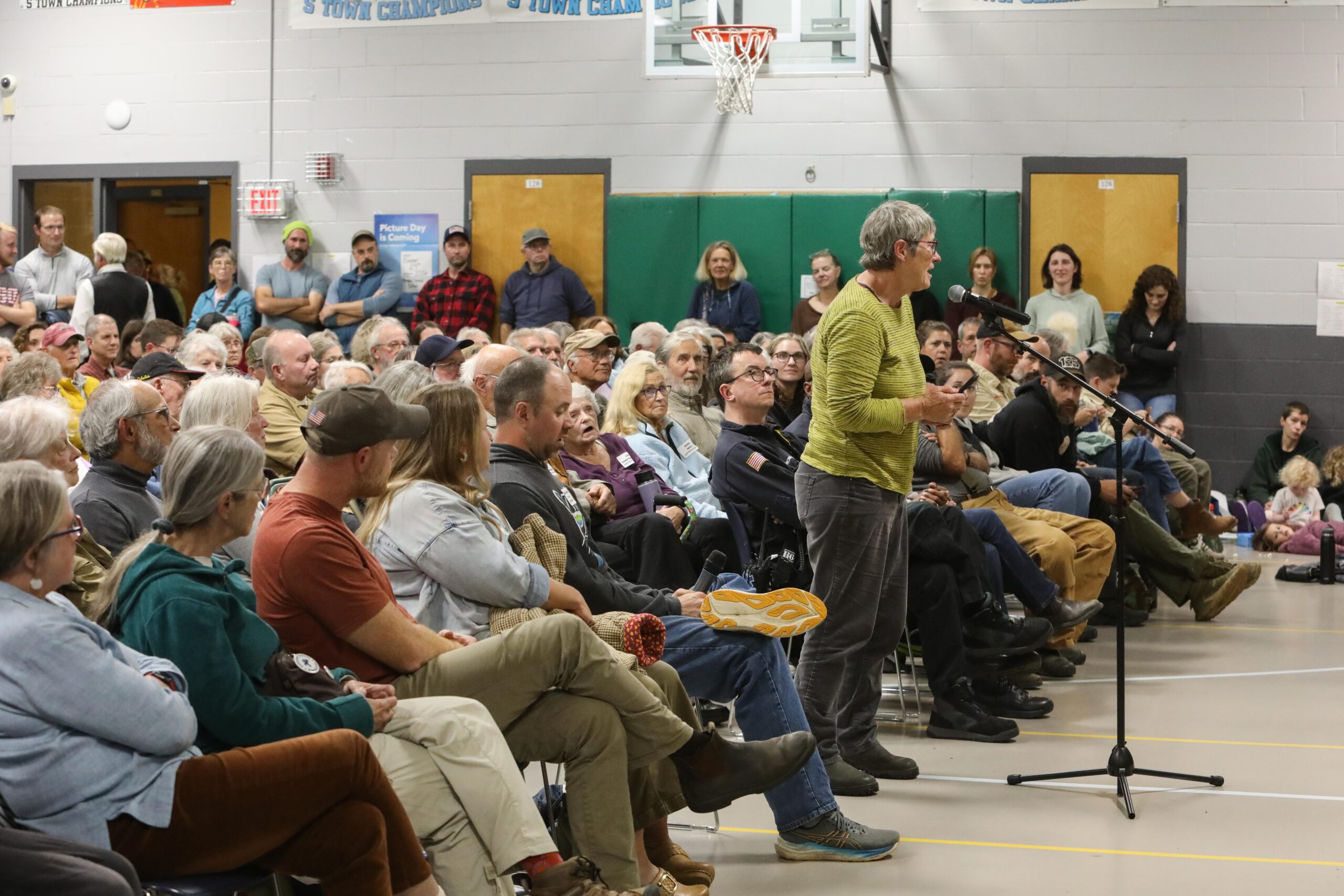
At the Q&A during a recent campaign event in Richmond, Mary asked Democratic candidates for governor and lieutenant governor whether they would condemn the raid. Amanda Janoo and Molly Gray both agreed without hesitation. “The cruelty and inhumanity is unparalleled,” Gray said and rebuked leaders for “just staying silent.” And that is the problem,” she continued, “because the silence breeds fear. The silence breeds division. We have a role to play.”
Janoo concurred. “I genuinely believe that states have a lot more power right now than we recognize,” she said. “And in fact I believe this is the moment when I don’t think we can wait or hope for our federal government to intervene. What are the strategies for nonviolent political resistance in this moment?”
In the current vacuum of state-wide governance, other community leaders have stepped up. Reverend Jessica Derise, a minister in Burlington, was arrested on Sept. 4th along with six other Vermont clergy. For three hours, the group blocked the entrance to the White Cap office building in Williston, which houses one of ICE’s national surveillance centers. “At the heart of civil disobedience,” Derise explained afterwards in an interview with Vermont Public, “is that the injustice is so grave that we would have to do something that we do not do in our ordinary lives.”
Reverend Elizabeth Gleich, a pastor of the Congregational Church of Middlebury, was arrested alongside Derise. Gleich had been to plenty of protests over the years. She was a theology and peace studies major in college, and is well-versed in nonviolent movements. But she never assumed she would put herself in a position to be arrested—especially when she was 17 weeks pregnant with twins.
A trip to Minneapolis this past winter is what “radicalized” her, she told me, using the word that is often used to undercut legitimacy. But for Gleich, becoming radicalized meant an absolute lucidity of values. She grew up in Minnesota and still has family and friends in the Twin Cities. In January, she joined 600 hundred faith leaders from across the country to protest ICE’s occupation. What she saw there confirmed her worst fears—how ICE separates families, inflicts violence, denies due process to immigrants, to people who are not white. “By design, they are treating them like they are not humans,” she said. It all “clarified a theological and moral conviction that people—all people—regardless of their citizenship status, deserve dignity and safety in life.”
But it wasn’t just the cruelty that radicalized her, it was the neighborism. The way every-day people showed up to take care of one another. “No one was coming to save them,” Gleich recalled. “And so they had to keep each other safe.” That “paradigm shift,” she acknowledged, “is both incredibly destabilizing, and at the same time, quite empowering, too.”
Nonviolent direct actions require a long runway of training and planning. Sometime after Gleich became pregnant, the date for the White Cap sit-in was set. By this time, she knew she was carrying twins, a shock to Gleich and her husband, who already had two young daughters. She was especially worried, she said, that with four kids at home, she would lose her sense of purpose out in the world. How could she possibly continue to do this kind of work, this kind of resistance?
She and her husband talked carefully about the risks involved, but in the end, her conviction to participate was as clear as the lucidity she felt in Minneapolis. “To live in a world that is just, where my children can thrive—it means we have to fight for the rights of all of our neighbors,” she said.
They planned out the day. Their daughters would be at school. Her husband would be ready to bail her out. And she would wear overalls, so when handcuffed—her hands in front, atop the bulge of her belly—she’d be able to reach into the chest pocket for a Cliff Bar.
******
One of the recurring themes in my conversations with neighbors was the cognitive dissonance involved. On the one hand, there was a huge showing of support. On the other hand, this happened in their backyard. “Forces of evil are running through this,” one neighbor said. “There’s threads of it right here, right around us.” It reminded her of an experience in college where an act of violence happened right outside her apartment. “It was so jarring to think this cozy campus”—this cozy state—“could be a place where something so terrible could happen.”
And whether we’re aware of it or not, it’s unfolding again right now or will soon, somewhere along a country road, or on a rooftop, or in a yard. As Lambek summed it up, “This was a horrific event that deeply affected the lives of many people, and traumatized individuals, separated families, and terrorized a community. And it’s an outrage that this is happening in our backyards, and to our neighbors, and it’s happening all the time, literally all the time.”
When I asked Lambek what stands out most to him about the raid, he pointed not to the horror of it—which has become perversely commonplace—but to the way people rallied to support their neighbors. “The community response in Cornwall should be an example for other communities to follow: taking immediate steps to provide protection and safety to those on the scene. Raising money to support the legal defense for those who have been detained, and taking steps to advocate for their release. This is what represents the best of Vermont in this moment.”
Not long after the raid, many of Mary’s neighbors participated in Migrant Justice’s rapid response training. “I think for a lot of people who showed up that day,” Barbara reflected, “it was really motivating. For every one of those people [detained], there are going to be dozens of us who are going to be more motivated to work against this… because we saw what happened and we’re seeing the effects on families and the effects on people who are terrified now, and feel that they have no rights and no recourse.” But like Gleich, it wasn’t just the brutality that spurred Barbara to action. She described being deeply inspired by the community’s response, and how even amidst the turbulence of that day, Migrant Justice’s net of support held them all together. “I immediately came home and signed up for the rapid response training. I thought: I want to know what to do next time. I want to respond every time I can. I want to be there.”
“Mom,” Mary’s son told her afterwards, “the silver lining is: look how many people came out and helped.”
That help—the durable social fabric that lured Mary to Vermont to begin with—is a source of solace, even as she looks, eyes wide open, to the future of our Brave Little State. “We can’t escape from this,” Mary said. “We have to be thinking about how we are going to support each other.”
Lambek acknowledged the same. “Unfortunately, we see no end in sight for the presence of these rogue deportation agents in our state. So what’s required of us in this moment is to have more responses like the one we saw in Cornwall.”
“I have the best neighbors in the world,” Mary told me. “We watch out for each other.”
Concerned Vermonters can help in the following ways:
• Support the work of Migrant Justice.
• Support the Vermont Freedom Fund.
• Participate in the Shut Down Ice Week of Action in Williston, Oct. 4-10.