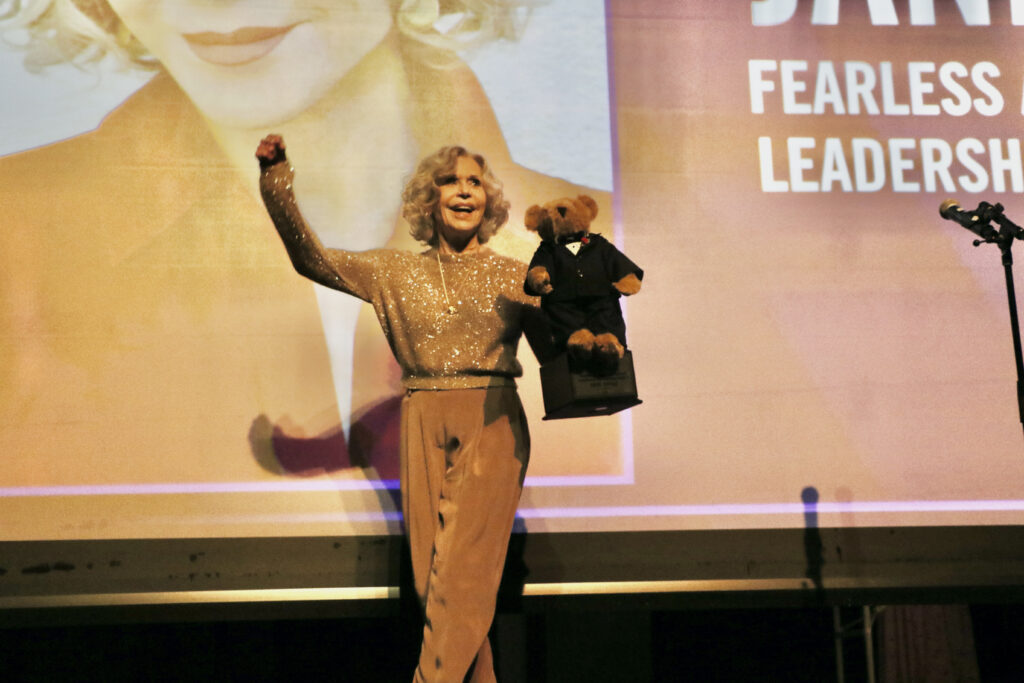
MIDDLEBURY — Actor, entrepreneur and activist Jane Fonda brought her star power to the Middlebury New Filmmakers Festival (MNFF) and Town Hall Theater on Sunday, regaling a packed Main Stage crowd with anecdotes about her film career, her relationship with the late Dolly Parton, her crusades against the Vietnam War and global warming, and her joy in getting older.
Under MNFF Artistic Director (and renowned filmmaker) Jay Craven’s gentle and incisive probing, Fonda proved ebullient, congenial, candid and voluble.
No topic was off limits.
She allowed herself, on occasion, to veer onto tangents, only to apologetically circle back to the topic at hand.
And when she took a narrative detour, she playfully — and proudly — reminded the audience of her 88 years of age. While slight in frame, Fonda still possesses the intellect and vocal timber that helped propel her to a six-decade career in film, along with successful chapters as a fitness guru and activist.
“It’s fun being old,” she said, beaming at an audience with many folks who also had high mileage on their biological odometers.
“It’s like you’ve got nothing the f*** to lose.”
During her hour-long, on-stage interview, Fonda also discussed her relationship with her late father (the legendary actor Henry Fonda), taking direction from filmmakers, using her celebrity to promote social change, and showing empathy for those you don’t like.
But she spent a good chunk of her time eulogizing Dolly Parton, with whom Fonda (and Lily Tomlin) made the film “9 to 5.” Parton died on Aug. 25 at age 80 following a brief battle with cancer. Parton was perhaps best remembered for her kindness and philanthropy, though her musical and comedic talents made her famous.
Fonda said she got the idea for making “9 to 5” from a friend who’d relayed some of the abuse that office secretaries were experiencing at the hands of their male bosses during the 1970s. She said she picked Tomlin for her superb character acting skills, and Parton after hearing her sing the song, “Two Doors Down.”
“Imagine Dolly as a secretary,” Fonda recalled thinking at the time, noting Parton’s platinum blond hair, makeup, tight clothing and curves that would be sure to trigger a lecherous boss.
“She can’t see her fingers when she types,” Fonda joked of her late friend’s trademark bustline. “I didn’t know if she could act. She’d never been in a movie, and it didn’t matter.”
“9 to 5,” released in 1980, would go on to gross more than $103 million.
Fonda began to tear up thinking of Parton, whereupon Craven offered this: “She was extraordinary. She was the last person everyone loved.”
Fonda said she later lobbied for a “9 to 5” sequel that focused on the three women having to work “two or three jobs” to get by.
“I couldn’t get the Hollywood writers to do the research,” Fonda lamented.
The two-time Academy Award winner also thanked Parton for allowing her to spend 10 days on her tour bus for a stretch during the early 1980s as it rolled through remote sections of Appalachia in Tennessee and Arkansas. At the time, Fonda was researching what she called a “hillbilly” role for 1984’s “The Dollmaker,” for which she won an Emmy.
On Sunday, she revisited her hillbilly tutelage under Parton.
“The only hillbilly I knew was Dolly,” Fonda recounted. “She knew I was working on this project and I would ask her for ideas… I was looking for someone I could spend time with who could frame my character. And that’s exactly what happened.”
The pair of friends spent all 10 days drunk, Fonda joked, adding she imbibed moonshine from a still maintained by one of Parton’s cousins.
“I asked (Parton), ‘What makes this the ‘best’ white lightning?’ and she said, ‘It’s been put through the sieve three times.’ She came out with this big earthen jug and she taught me how to hoist it,” Fonda said.
Fonda was struck by some of the people she encountered in Appalachia, who lived in tarpaper shacks and kept all their photographs underneath the bed in a shoebox. No electricity, no radio, no TV.
Parton proved the consummate host, according to Fonda.
“Dolly could not go to bed unless everybody around her had laughed so hard they had to cross their legs so they wouldn’t pee themselves,” she said.
BECOMING AN ACTIVIST
Fonda said she became an activist in 1970, with a particular focus on ending the Vietnam War. She recounted going to Detroit to learn how to become an organizer. She invited Craven — a fellow opponent of the war — to participate in the “Winter Soldier” investigation organized by Vietnam Veterans Against the War in the Motor City from Jan. 31 to Feb. 2, 1971.
She also connected in Detroit with a lawyer named Ken Cochrell, who’d send Fonda out with organizers from the United Auto Workers union. She learned how to network for a cause, enjoyed it, and informed Cochrell she was done with Hollywood.
Cochrell disabused her of that idea.
“He said, ‘Listen to me, Fonda; we have hundreds of organizers. We don’t have movie stars. We need you. Go back to Hollywood and take your career seriously. Start making movies that reflect your values. Be a movie star.’ And I did,” Fonda said.
She’d go on to make, among other films, “Coming Home,” “The China Syndrome,” “Julia,” “Klute,” and “9 to 5.”
Craven credited Fonda with being a risk-taker, noting her activism could have ended her acting career. Fonda is still reviled by some — especially those in military circles — for her January 1972 protest trip to North Vietnam. She was dubbed “Hanoi Jane” by her detractors.
“I didn’t care,” Fonda said of the potential professional repercussions. “My prior life had been so frivolous. I was not happy. The acting wasn’t what was going to save me.”
She asked audience members to ask themselves a fundamental question: “Why am I here?”
Her own response to that question was, “I don’t like the thought of being left behind by history.”
She recalled being on pregnancy-related bed rest in 1968 and watching footage of the Vietnam War’s Tet Offensive, violent images juxtapositioned with footage of protestors sticking flowers in the barrels of National Guard soldiers’ rifles here in the U.S.
“I remember thinking, ‘What the (expletive) am I doing?’” she said. “I felt left behind.”
GAINING PERSPECTIVE
Just as Fonda had issues with Presidents Lyndon Johnson and Richard Nixon, so does she oppose most of the policies of current President Donald Trump.
She has mellowed some with age, taking a more practical and philosophical approach to politicians she doesn’t like.
“Evil behavior is the behavior of the traumatized. You hate the behavior, but you don’t hate the traumatized,” Fonda said. “Just deal with the behavior. Let’s end the behavior.”
With that in mind, Fonda is urging people to vote out the politicians advancing authoritarianism, wars and climate change. To that end, she has created the “Jane Fonda Climate PAC,” which supports candidates that commit to protecting the environment and weaning the nation off fossil fuels.
“If you can’t change the people, change the people,” she said of her efforts to elect a more environmentally friendly Congress.
“What needs to happen is legislation that’s commensurate with what science is talking about.”
Ending climate change is Fonda’s latest rallying cry, and she’s putting the full force of her celebrity behind it.
She plays a prominent role in a heralded environmental documentary called “Gaslit,” which screened at MNFF12. Produced by Greenpeace, “Gaslit” follows Fonda as she travels across the oil fields of the West Texas Permian Basin and through the Gulf Coast of Louisiana visiting communities and talking with residents adversely affected by oil and gas production. At the festival she was honored with aa VTeddy Award for Fearless Artistry.
Fonda was also asked about her acting collaboration with her late father in the film “On Golden Pond.”
She had an at-times strained relationship with her dad, who proved emotionally inaccessible. “On Golden Pond” allowed the two to spend time with each other as peers and friends.
“It was (cathartic) for me,” she said of the film collaboration with her dad. “I don’t know if it was for him.”
John Flowers is at [email protected].