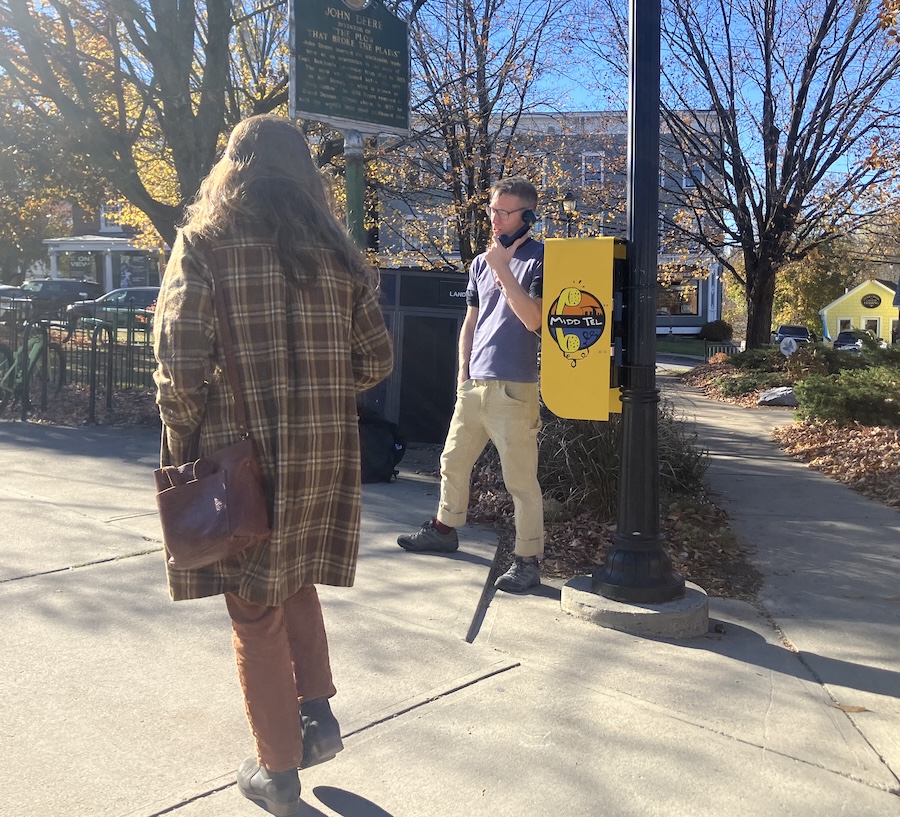
MIDDLEBURY — In Cannon Park across from Ilsley Public Library sits a citrine yellow payphone with a hand-painted logo that reads “Midd Tel.” The phone — which is completely free to use — was born out of Middlebury College’s Makerspace.
Daniel Houghton, who teaches industrial design and manages the Makerspace in the Christian A. Johnson Memorial Building, was the driving force behind the Midd Tel project.
Always interested in doing stuff and in helping people learn new things, Houghton gained inspiration this past summer after learning about the work of Patrick Schlott, an engineer in Randolph. Schlott, encouraged by others with similar ideas, created the company RandTel, which aims to connect people by installing free-to-use phones in rural areas.
That idea deeply resonated with Houghton.
“I thought that would be cool in Middlebury. There’s tons of upgrades you can do to the town of Middlebury, and [the phone] was one of them that felt within reach. It would cost a bit, but not a ton. It would take a bit of learning, but not years and years, and it would last for a while,” Houghton shared. “This town is so well structured for walking around in. So that bit of connectivity felt cool. Something that’s not that black rectangle as not your only portal into life was fun to think about.”
Houghton enlisted two interns to help him make the project come to life, Helena Goskreutz, a visiting intern from California, and Middlebury sophomore Noah Klompus.
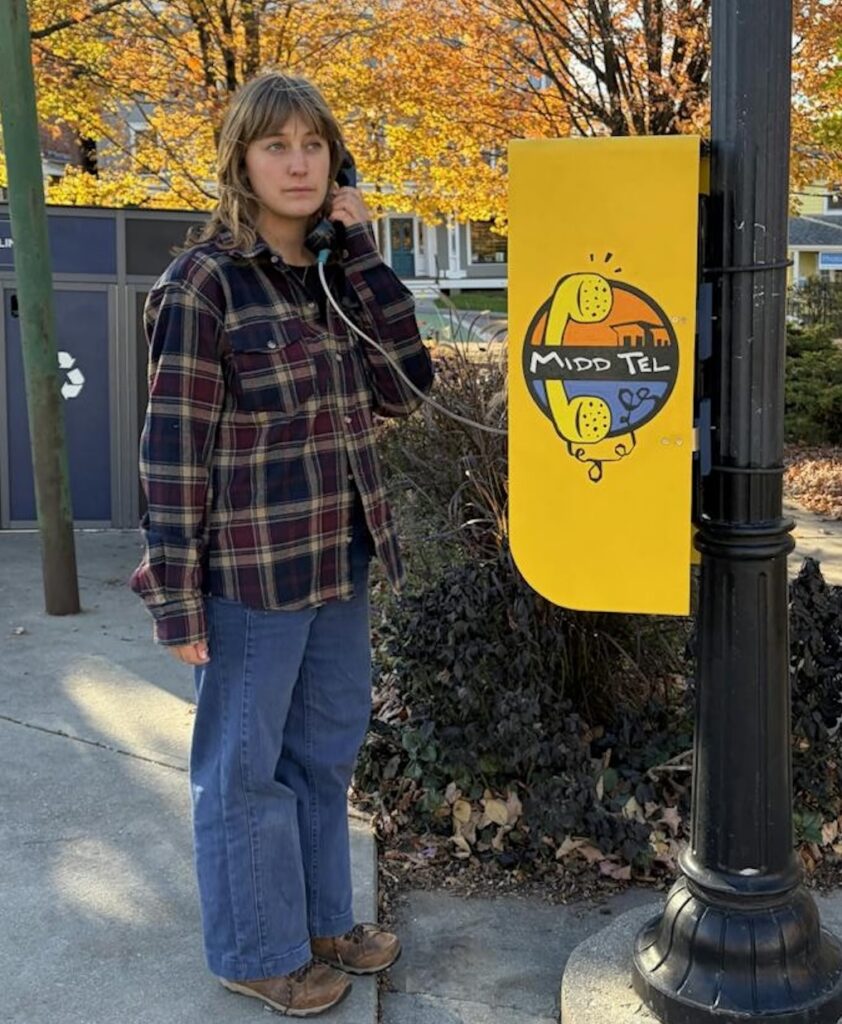
Over the summer, Klompus met with Schlott, who personally donated the phone that would turn into Midd Tel. “He was super kind and he donated the phone that is now in town, along with its components which was pretty incredible,” Klompus said.
The team then had to present and propose the project to a Middlebury town board and enlist the help of an electrical company to source the Wi-Fi and organize who would pay for electricity.
Klompus, like most students on Middlebury’s campus, did not grow up with payphones and feels that this project is a great way for younger generations to communicate.
“It’s a total novelty,” Klompus said. “I’d never seen, much less used, a payphone. I think that in itself is super cool. I think the movement as a whole is a pretty interesting and neat way to get kids involved and like, actually allowing for communication that’s not entirely cellphone-based.”
Klompus’s experience over the summer was a special way for him as a student to have a positive impact on the town.
“It was a pretty cool opportunity, the town just being really supportive with having a couple of kids in an internship to come in and get experience putting [the phone] in an actual piece of infrastructure for the town. It was cool to be able to feel as a student that I was doing something that will stay and be intact,” he said.
As a parent, Houghton was motivated to create ways to communicate outside of smartphones.
“[Midd Tel] basically started as a bit of silliness and then genuine consideration for what it feels like to be a father of two kids who are of an age where I want them going out into the world, but I don’t want them to have a cellphone yet because I don’t think it’s the best thing for them. The existence of some way to make contact just feels like a way to release some of those feelings of anxiety that you might feel as a parent,” Houghton said.
Midd Tel has taken off.
It is easy to use. Anyone can pick up the handset, punch in a phone number — anywhere — and it will connect the call. Someone has posted a laminated sheet with important phone numbers: a 24/7 crisis line, Charter House shelter, bus service
Within the first two weeks after it was installed last month, 300 people made calls, flying past the threshold of allotted calls, prompting the phone company to shut the line down. Houghton is currently working on an alternative way to keep the phone functioning. He has heard that some in the library are telling youngsters that they can use the Midd Tel phone to call parents or others, which, for Houghton, is one of his motivations behind starting it.
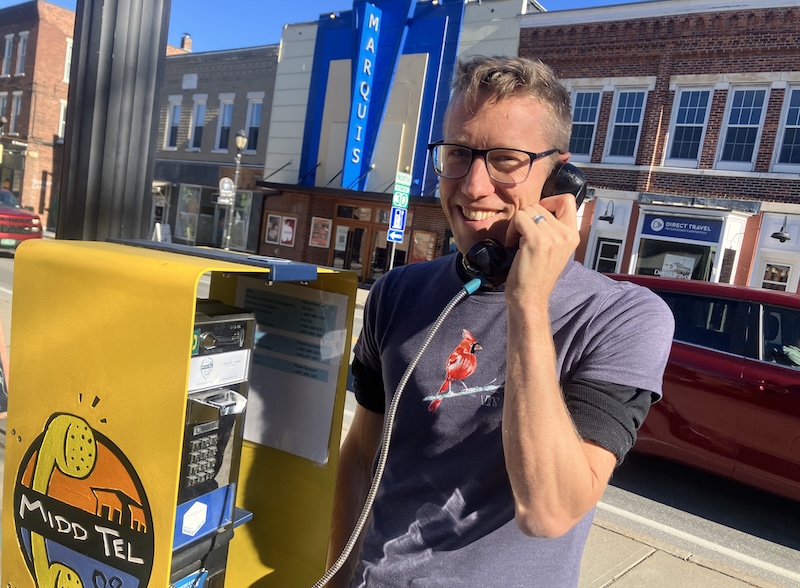
Independent photo/John S. McCright
For now, the project has been entirely funded and supported by the Makerspace, but Houghton aims to turn ownership and operation completely over to the town.
The cost of all those calls? Very little.
“You can just pick [the phone] up and talk. That’s all being supported by the Makerspace for now, and then the town will take over. But so far the phone bill has been $3. It’s a penny a minute.”
The location of the phone was a thoughtful choice for the Makerspace team. Houghton feels that for Midd Tel to be an actual social project that lasts, it must be publicly owned and considerate of the heavily felt division between the college and the town.
Editor’s note: Norah Khan is the editor-in-chief of the Middlebury Campus newspaper, where this story first appeared.