
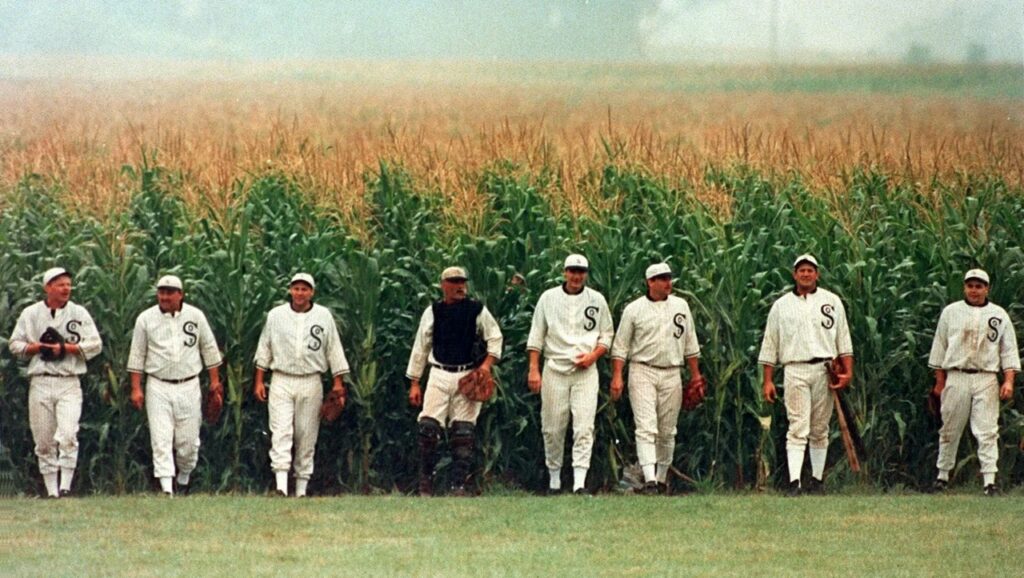
 There are those who don’t like the baseball movie “Field of Dreams.” They find it too sentimental, corny. It is based on the cliché of the once-timeless bond of fathers playing catch with their sons.
I understand their resistance but do not count myself in their company. I am a sucker for “Field of Dreams.” I loved the movie when I first saw it — and still do.
Many a night when I was a kid, I played catch with my dad when he came home from work.
I saw the movie when it first came out in 1989. My excitement was spurred by having read the book “Shoeless Joe” by W.P. Kinsella from which the film was adapted — and follows closely. As wonderful as the movie is, the book is even better.
In 2008, on one of our family trips cross-country, I saw a sign that read “Chisholm 15” miles, so the family succumbed to my pleas to make a detour to Chisholm, Minnesota.
We couldn’t be that close to Chisholm and not set foot in the hometown of Dr. Archibald “Moonlight” Graham, just about my favorite secondary character in all of literature.
W.P. Kinsella plucked Moonlight Graham from real life, an actual ballplayer who appeared in only one major league game for just two innings the last game of the season for the New York Giants in 1905 playing in right field. He never got to bat.
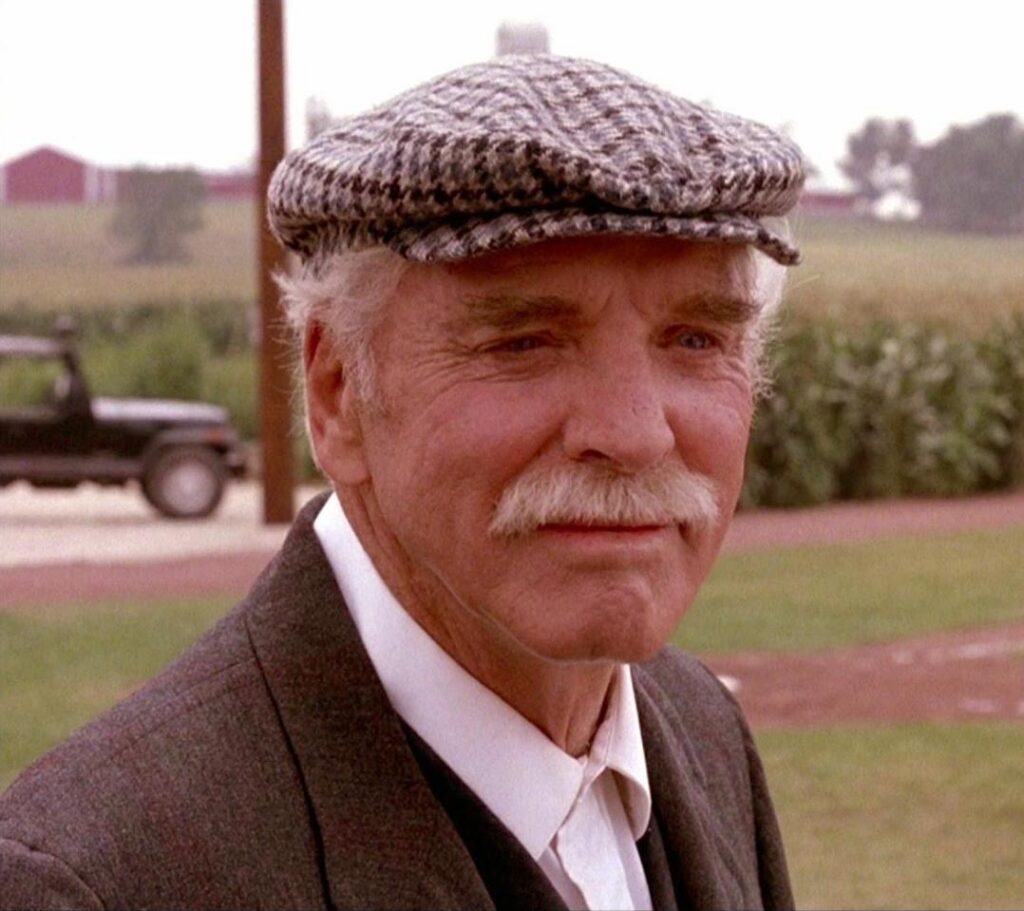
In baseball’s minor leagues, he played many years all over the country. In the off-seasons he went to medical school and ultimately became a beloved family doctor in Chisholm.
Moonlight Graham was played in the movie by famous ’50s movie star Burt Lancaster in his final film role — and he nailed it.
Both the novel “Shoeless Joe” and the movie “Field of Dreams” open eerily. Ray Kinsella, a young corn farmer in Iowa with a wife Annie and a five-year-old daughter Karin, hears a mysterious voice emanating from his cornfield, instructing, “If you build it, he will come.”
(W.P. Kinsella gave his protagonist his own surname. That’s allowed: it’s fiction!)
Ray plows part of his cornfield and builds a ballfield — and he does come and he brings his teammates. “He” is Shoeless Joe Jackson, the greatest player in the era before Babe Ruth. Jackson disgraced baseball by accepting a bribe to throw games in the 1919 World Series. He and seven of his teammates were banned for life and branded forever the “Black” Sox.
Joe and those teammates, all dead in the present, are brought back to life on the ballyard that Ray constructs in his cornfield and emerge spectrally out the cornstalks for joyful nocturnal ballgames.
Joe asks Ray at one point, “Is this heaven?” and Ray responds, “No, it’s Iowa.” That line has become the film’s signature.
Ray receives other whispered instructions by the mysterious cornfield voice: “Ease his pain” is next and this sends Ray off to New England to rescue from despair famous recluse J.D. Salinger (in the novel) and the fictional Terrence Mann, a disillusioned counterculture icon from the Sixties (in the film).
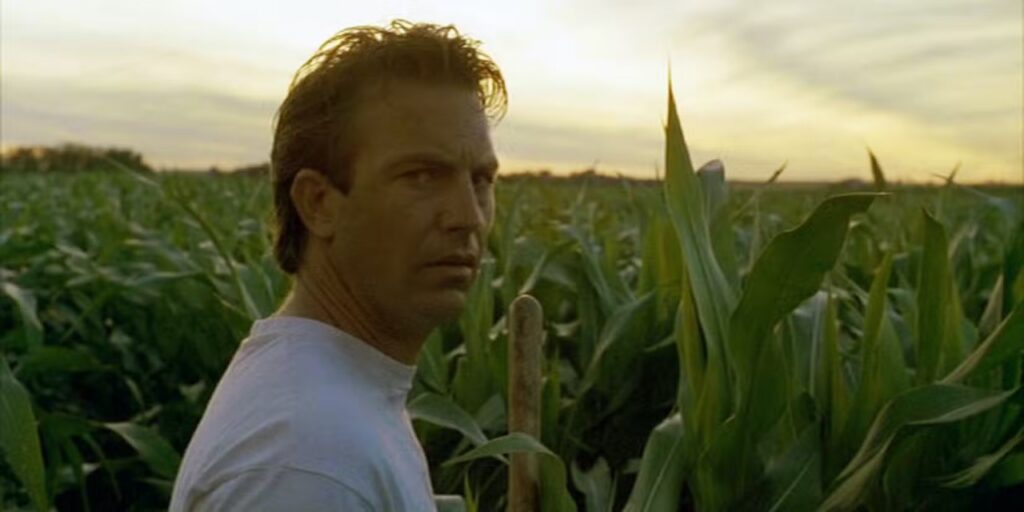
Mann is played robustly by James Earl Jones (Salinger never would allow his privacy to be violated in this way).
Then, heeding the voice calling to them (in Fenway Park no less) to “Go the distance,” Ray and Salinger/Mann head to Chisholm to encounter Dr. Graham before traveling back to Iowa for the story’s deeply satisfying climax.
And yes, Ray does play catch with dad, John Kinsella, who appears among the ghost players. His dad died when Ray was a teenager just after they had argued, to Ray’s eternal regret.
At the end of the story, the Salinger/Mann character reassures Ray that plowing under his corn will not have been in vain. “People will come,” James Earl Jones intones in his most stentorian voice.
“The one constant through all the years has been baseball, Ray . . . . People will most definitely come.”
And people have come. In a melding of fiction and fact, the Field of Dreams has become a reality. The farm and ballfield where the movie was set in Dyersville, Iowa, (population 4,500) is a major tourist destination in the heartland of America, attracting between 65,000 and 100,000 tourists every year.
Three weeks ago, Aug. 13, Major League Baseball held its third Field of Dreams game and the Philadelphia Phillies defeated the Minnesota Twins, 7-1. These games count in the standings! Next year the Red Sox play the Kansas City Royals on Aug. 12. I already have it on the calendar.
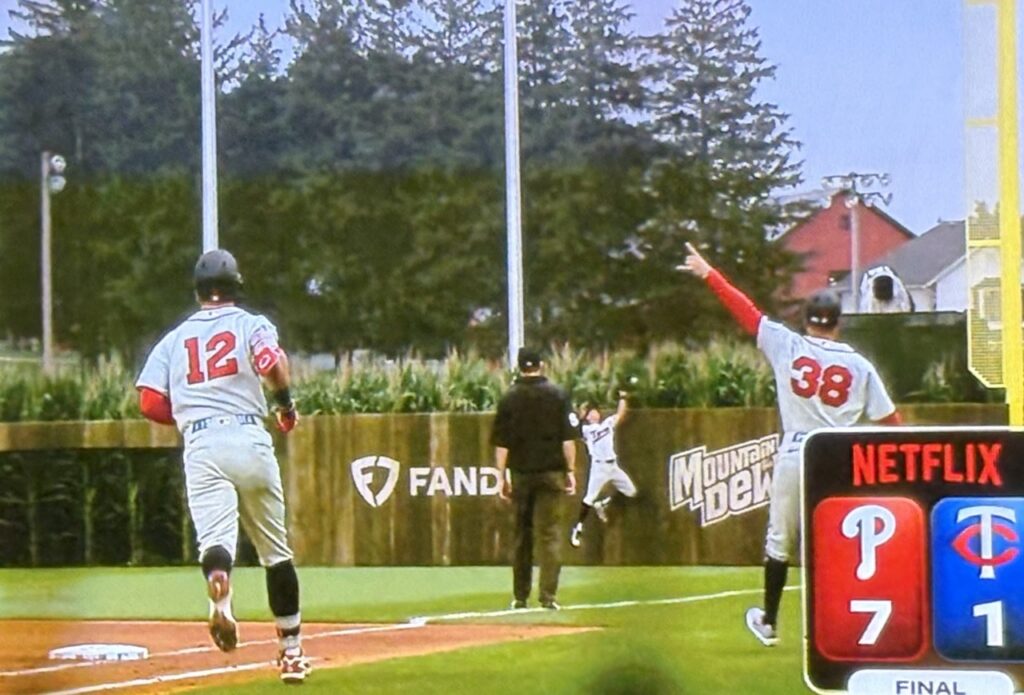
Just as I am with the movie, I am absorbed with this actual game in this fantastical setting. The best part is at the beginning when the current players in their vintage uniforms come out from the cornfield on to the ballfield, just as they do in the movie.
This year, 28 members of baseball’s Hall of Fame preceded the Phillies and the Twins players on to the field, and ringed the infield. The first of those of those great players introduced was Vermont’s own Jim Kaat, 87 years old. He spends half the year, the warm weather months, in Manchester.
Before the game, a number of fathers played catch with their sons. Roger Clemens played with his son Kody, the Twins second baseman. Phillies Manager Don Mattingly played catch with his son Preston, the Phillies General Manager — his boss!
The game itself was one-sided but not without excitement. The very first batter, Phillies slugger Kyle Schwarber, hit a home run into the cornfield and then socked another in the fourth inning. Schwarber certainly resembles an old-time ballplayer, all squat and square in his high socks.
At the end of the telecast, stars from the teams invoked the famous lines from the movie:
“Dad, wanna have a catch?” (Bryon Buxton, Twins);
“If you build it, he will come” (Bryce Harper, Phillies);
“Go the distance” (Brandon Marsh, Phillies);
“Is this heaven?” (Josh Bell, Twins);
“No, it’s Iowa.” (Schwarber, Phillies).
If you haven’t seen “Field of Dreams,” do.
While you’re at it, read the book too.
—————
Karl Lindholm, Ph.D., is the Middlebury College emeritus dean of advising and assistant professor of American Studies (retired). He can be contacted at [email protected].