 I first saw the image on a vintage postcard. Fascinated, I bought the card and stuck it up on the wall above my desk.
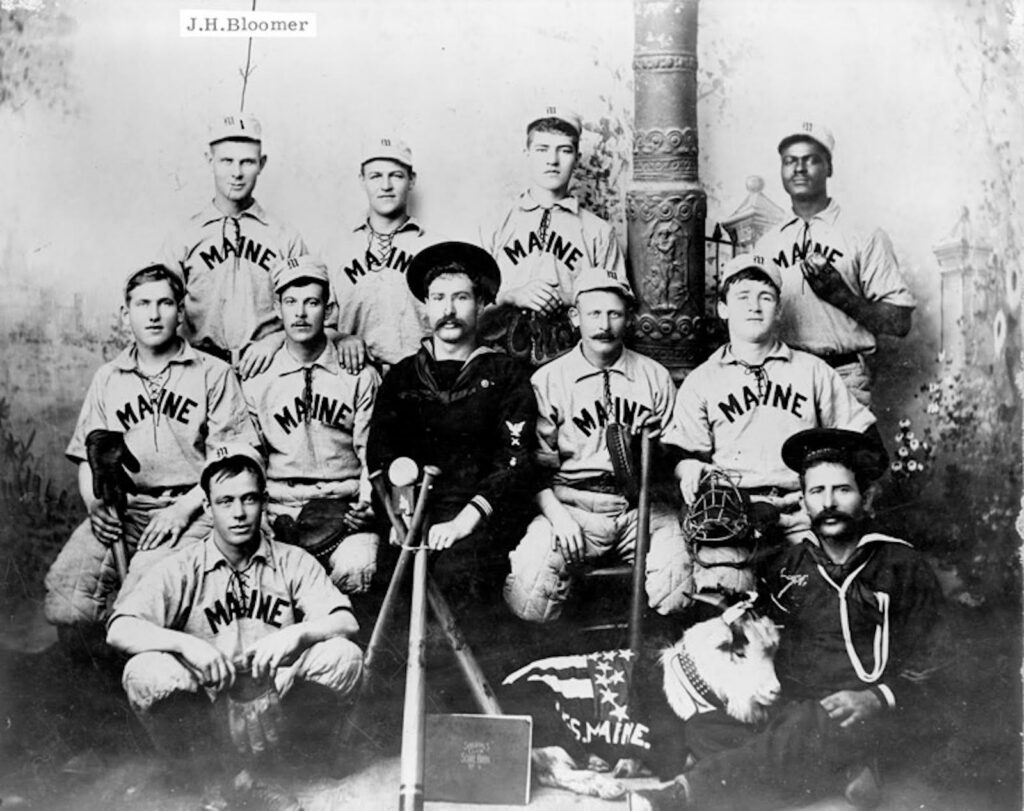
It was a picture of an old-time baseball team with “Maine” lettered on the uniform front, and no information on the card back.
I grew up in Maine, played baseball and loved the game as a kid, and was living in Maine when I first saw this photo. The interest was natural.
I had also developed an interest in the Negro Leagues and Black baseball and its history, so I was intrigued by the Black player in the back row. What was he doing on a team from Maine?
Such a strange image: what’s with the goat mascot in front, and the two guys, the non-baseball players, in the black attire — and that weird background with the stovepipe?
Why is J.H. Bloomer identified in the photo and no one else? What’s so special about him?
Perhaps most curious of all, what about that Black fellow, holding a baseball in his left hand? What’s his story?
Now that we can access all the information in the world with the blink of an eye and a click of a key, we know about this team, and it’s quite a story.
In fact, the team wasn’t from Maine at all, the state of Maine — it was the team from the Maine: the battleship USS Maine.
Those of you who stayed awake in high school for the unit on the Spanish-American War in American history class will no doubt remember the Maine.
The USS Maine blew up in Havana harbor on Feb. 15, 1898, about an hour after Marine Corps Fifer C.H. Newton from Washington, D.C., third baseman on the Maine’s baseball team, played “Taps” on his bugle.
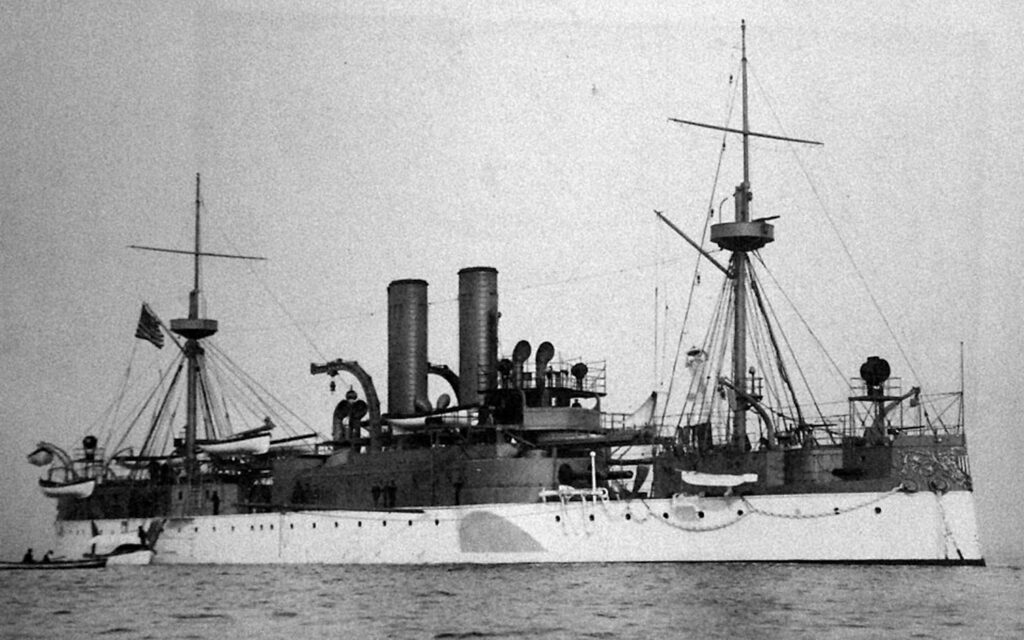
The massive explosion killed 266 of the crew of 355, including all members of the baseball team except Landsman John Herman Bloomer, 23, of Portland, Maine, the right fielder.
(Landsman was the lowest enlisted rank in the early Navy, 1830s-1920s, a recruit with little or no prior experience at sea, assigned the most basic, dirtiest tasks on the ship).
Bloomer may have survived the explosion, but was dead by 1907 of acute alcoholism, perhaps, who knows, related to his terrifying experience aboard the Maine.
There were eight other Mainers on the Maine when it exploded, three who survived. Left fielder William Tinsman (Landsman) was born in Pennsylvania but grew up in East Deering (Portland).
In addition to Newton and Tinsman, those who died from the blast itself, terrible burns, or drowning were second baseman William Gorman (Landsman, Boston), center fielder Charles Hauck (Landsman, Brooklyn), shortstop John Merz (Landsman, Brooklyn), and catcher Benjamin Marsden (Apprentice Second Class, Jersey City).
Also killed in the explosion were Manager Charles Eiermann (Gunner’s Mate) and Assistant Manager Leon Bonner (Seaman, New York City). Eiermann was from Germany and had been a U.S. citizen for only three years.
Presumably they are the two sailors not in baseball uniforms in the team photo. And the goat? He lived on, staying in Key West when the Maine sailed to Havana.
John Henry “Shilly” Shillington, from Chicago, a Yeoman Third Class and Navigator’s Writer (a position demanding specialized clerical skills), was the team’s talented shortstop.
Before enlisting in the Navy, Shilly had spent at least three years at Notre Dame University, was a popular and talented student, and shone on the baseball and the basketball teams (its captain in 1897).
A monument dedicated “to the memory of John Henry Shillington . . .” still stands on the campus. Erected in 1915, it features a 10-inch mortar shell (“recovered from the sunken battleship”) on a five-foot red granite base.
That Black fellow holding the ball in the team photo is 23-year-old Engine Stoker William Lambert from Hampton, Va., the team’s ace pitcher. A lefty, he was described by a shipmate as “a master of speed, curves, and control.”
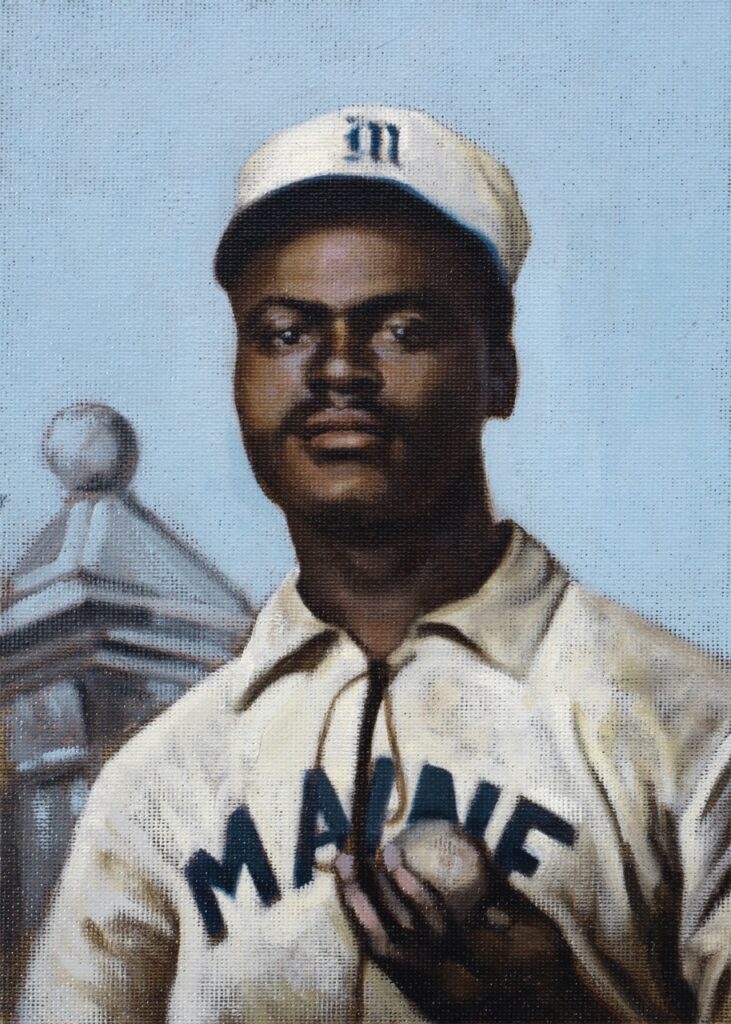
Lambert demonstrates that the Navy was integrated at the time. Black soldiers in the Army, in Cuba and elsewhere, served in segregated units, commanded by white officers. There were 30 Black crewmembers on the Maine, 22 who died in the explosion.
One can imagine what Lambert might have done in baseball had he survived the Maine disaster, perhaps playing on one of the Black traveling independent teams at the turn of the century.
That Maine baseball team was a stalwart group. In December 1897, just two months before the disaster in Havana, it defeated the team from the USS Marblehead for the U.S. Navy Baseball Championship.
It was reported that a game between the Maine boys and a team from Havana was being discussed while the ship was in port, an enticing possibility as baseball in Cuba was nearly as advanced as it was in the U.S. in the 1890s, and the country was equally baseball-mad.
The Maine was in Havana harbor to protect American commercial interests while the Cubans fought for their independence from Spain. Fanned by a lurid press (“yellow journalism”), sentiment in America ran high in support of Cuba.
The sinking of the Maine provided the emotional rationale for declaring war: “Remember the Maine — to Hell with Spain” became the rallying cry. The U.S. declared war on a greatly overmatched Spain on April 25, 1898.
The war itself lasted just over three months, 109 days, and had two theaters: Cuba in the Gulf of Mexico and Manila Bay, Philippines, in the Pacific. In the Treaty of Paris ending the war, Guam, Puerto Rico, and the Philippines were ceded to the United States and Cuba achieved its independence.
The cause of the sinking of the Maine was long debated. A naval inquiry after the explosion determined that it was the result of hostile action, an externally located mine. Later investigations by the Navy and other authorities, using more recent methods, concluded that it was an “accident,” a “fire in the coal bunker,” the likely source.
That postcard of the baseball team from the fated battleship Maine is still up on the wall in my office at home.
—————
Karl Lindholm, Ph.D., is the emeritus dean of advising and assistant professor of American studies (retired) at Middlebury College. He can be contacted at [email protected].