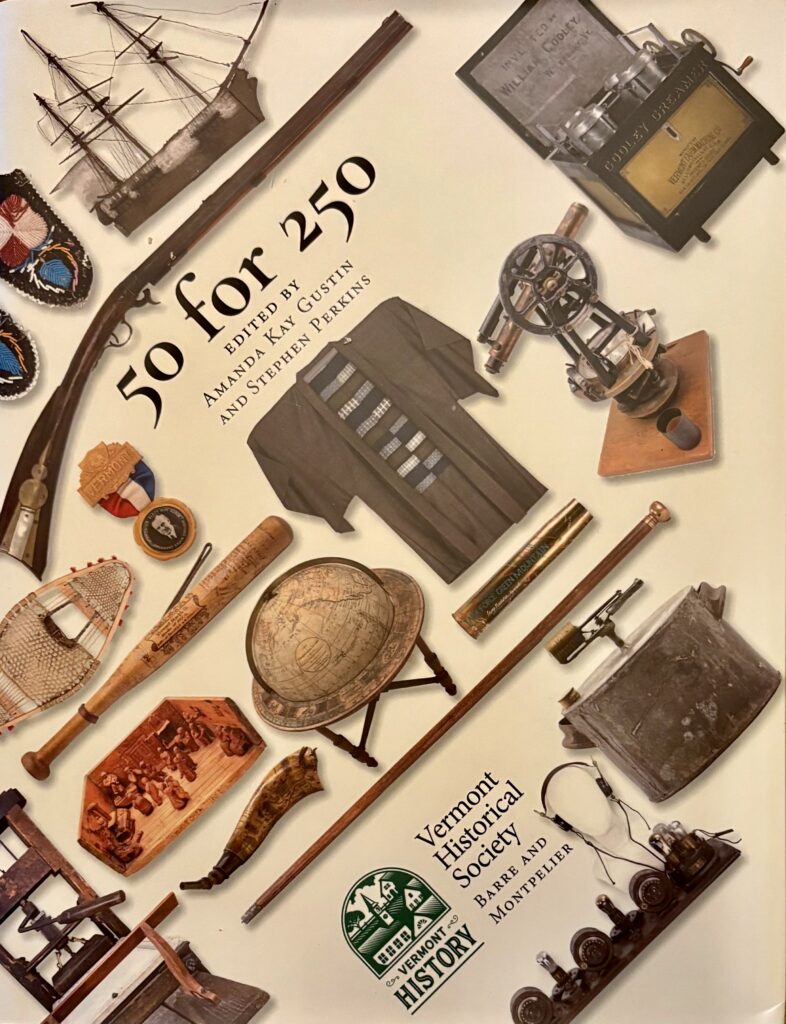
Editor’s note: A longer version of this essay appears in “50 for 250,” a book by the Vermont Historical Society that commemorates the 250th anniversary of the United States by telling the absorbing stories of 50 of the over 30,000 artifacts in the Society’s collection.
—————
 Roger Angel wrote in 1976 that “any baseball is beautiful . . . ideal (in) design and utility. . . meant to be thrown at a considerable distance — thrown hard and with precision.”
That is true today and was true for over a century before Angel wrote it. But it was not true in 1876 when the Mountaineers of Bristol defeated the Rustics of Essex 19-6 for the Vermont State Championship on the ball field at Essex Junction.
Pitchers at that time threw the ball from 40 feet, not 60 as they do today and have been since 1893, and they threw it underhand, aiming for a spot the hitter indicated was his preference. Overhand pitching was not legalized until 1884. Balls were also not thrown that hard by players in the field, as most were still playing barehanded.
The ball that Mountaineers’ pitcher Homer Nimblet threw to his catcher Charles Wilds to start the game was likely homemade and the only ball used that day. When a ball was hit out of play in those days, the game was delayed until it was retrieved.
This beautiful small artifact represents Vermont’s baseball passion, then and now.
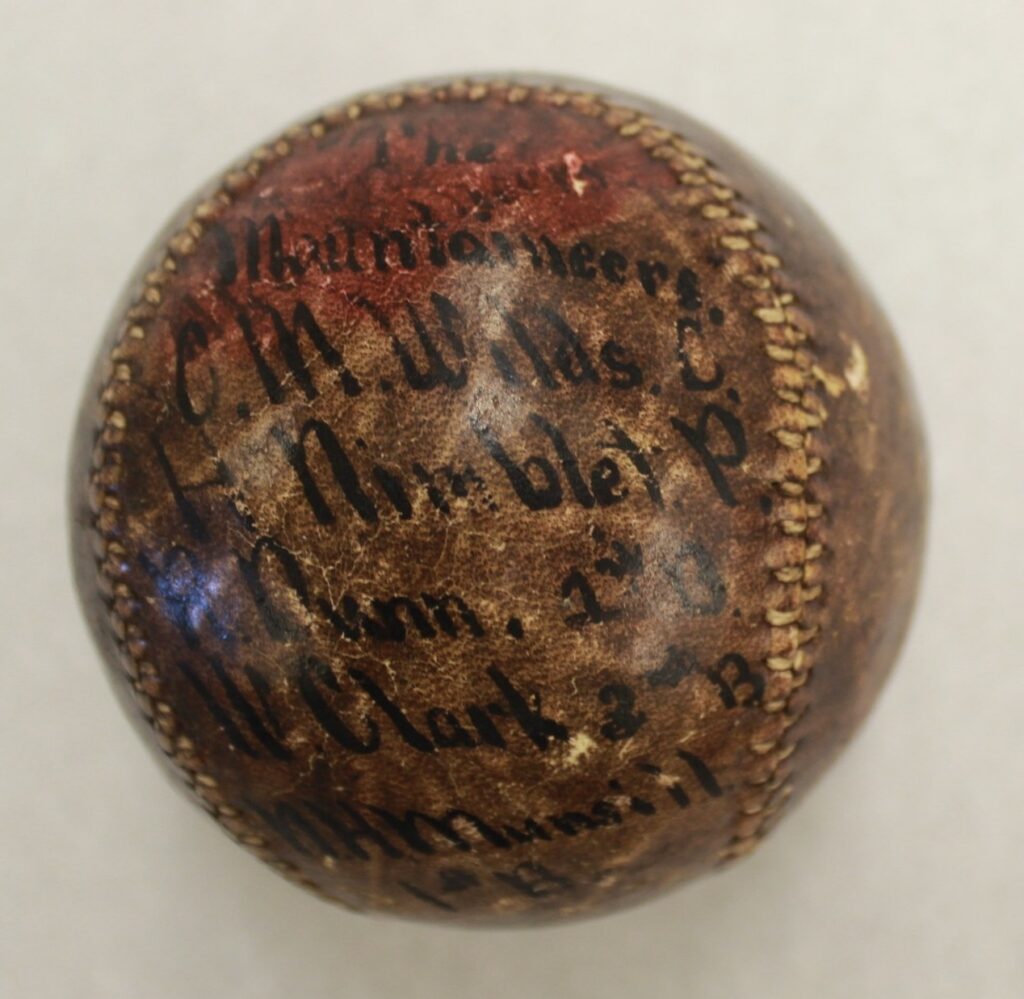
It was the responsibility of the home team to provide the ball, which was often awarded as a prize should the visiting team win the game, which explains why the inscriptions on this game ball celebrate the visiting team’s victory.
Written on the ball in black ink on one of the horsehide strips, horizontally, is “For the Championship of the State of VT. Mountaineers vs. Rustics September 6th 1876.” On the other strip to be read vertically, are the names of the Mountaineers players, first name initial and last name.
The composition of the ball was fairly standard: a rubber core surrounded by yards and yards of woolen yarn, covered by two strips of leather (horsehide) cut in a figure-eight pattern, and often stitched by a local cobbler.
By the 1870s, the dimensions of the ball, its size and weight, had stabilized to about what they are today, weighing “not less than five and not more than 5.25 ounces” and measuring “not less than nine and not more than 9.25 inches in circumference.”
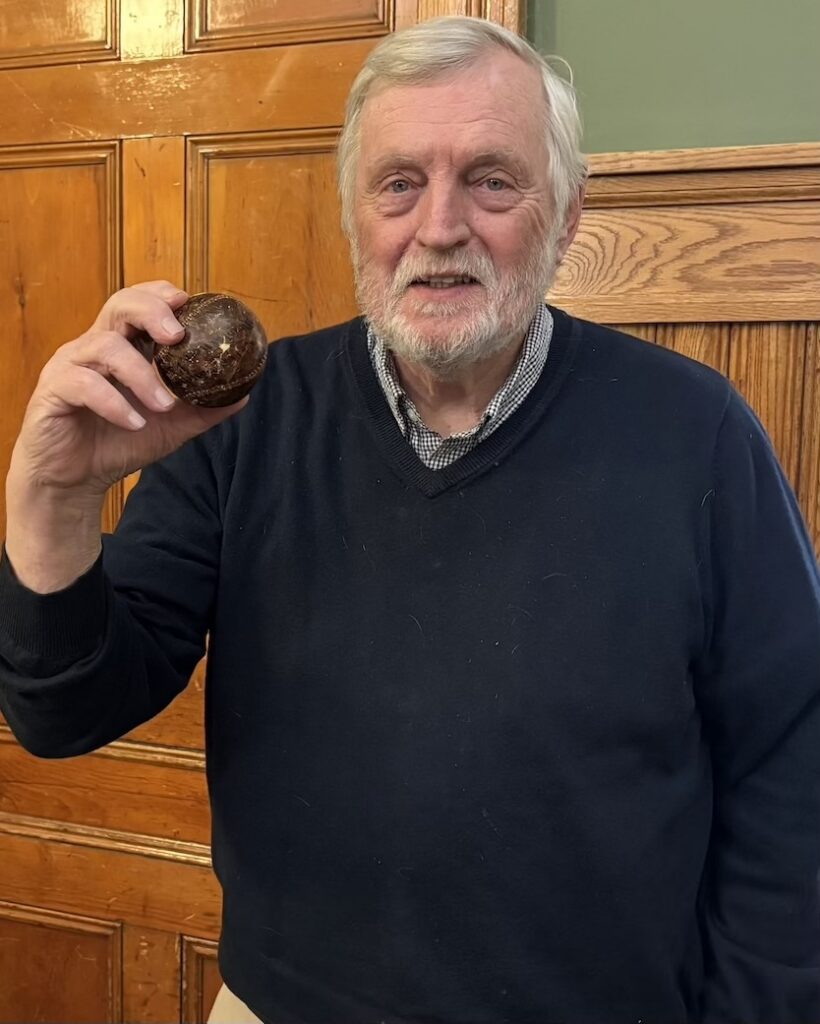
This 1876 baseball is somewhat smaller than that standard, at 4.8 ounces in weight and nine inches in circumference. It has darkened over time to a walnut color and is finished to a bright sheen. Its color was white no doubt at the start of the game until it became grass- and dirt-stained by its use.
The earliest reference to “base ball” (two words then) in America occurred in the 1790s and the first formal games were played in the 1840s. The sport flourished after the Civil War and enjoyed an unrivalled prominence in our leisure and recreation for nearly a century afterward.
In 1876, the country was baseball-mad and Vermont was no exception.
The Middlebury College newspaper, The Undergraduate, described the baseball scene on its campus in 1876: “Again base ball has become ‘the rage’ and each pleasant day the campus resounds with the hearty shouts of its lovers.”
By the early 1880s, the three institutions of higher education in Vermont — Middlebury, UVM, and Norwich met in vigorous competition on the ball field.
Newspapers in 1876, before electronic communication, were primary sources of information about games. Announcements about upcoming matches and results, clubs looking for competition, and other baseball news were sprinkled in notes on large sheets of dense text, small type, and multiple narrow columns, all typeset by hand.
Vermont had a wonderful array of local newspapers, in both larger and smaller towns, such as the Rutland Daily Globe, Burlington Daily Sentinel, Vermont Watchman (Montpelier), Manchester Journal, Enterprise and Vermonter (Vergennes), Argus-Patriot (Montpelier), Vermont Phoenix (Brattleboro), Register (Middlebury), Spirit of the Age (Woodstock), North Star (Danville).
And the teams they reported on . . . there were no Lions and Tigers and Bears: there were Resolutes (Montpelier) and Wide-Awakes and Fearnaughts (Middlebury), Crescents (East Calais), Smugglers and Hardtacks (Williston), Alphas (Springfield), Rough and Readys (Montpelier), Actives (Vergennes), Centennials (St. George), and so on.
Not all games that year were Championship matches. “There is a baseball club in Hartford called the Potato Bugs,” the Manchester Journal reported. “Another club has sprung up who style themselves the Exterminators who have challenged the Potato Bugs. The farmers of the neighborhood are anxiously awaiting the results. They are hoping the Bugs will be exterminated, but they don’t believe it.”
About the Championship game between the Mountaineers and Rustics, the Enterprise and Vermonter wrote, “There was a hot game of baseball on the grounds of the Rustic Base Ball Club at Essex Junction, . . . resulting in a glorious win for the Mountaineers.”
The Rutland Daily Globe called the big game “the most interesting feature of the first day of the Chittenden County Fair” and added that “a great excitement prevailed. . . . The Mountaineers played a handsome game.”
The final score of 19-6 was not particularly one-sided, given the inflated scores of the time. The Mountaineers led by a scant two runs, 8-6, going into the eighth inning, before scoring 11 runs in the last two frames.
All this does beg the question: by whose authority did the Mountaineers assume the title of “Champions of Vermont Baseball in 1876” as written on the ball? There were no leagues, no organized network of teams.
Champs? Sez who?
Newspaper accounts do seem to justify the claim. The Globe contended that the Mountaineers’ victory over such a worthy opponent “easily enough throws the championship of the northern part of Vermont into the hands of the Mountaineers.”
Under the heading “We Take It Back,” the Vermont Watchman on November 9, 1876, claimed that its “recent item of news which gave the base ball championship of the state to the Central Vermont nine of White River Junction was not correct.” It turns out “the aforesaid nine were beaten on their own grounds, in September last, by the ‘Mountaineers’ of Bristol. Well, we take it all back.”
And finally, the Burlington Daily Sentinel, on September 5, previewed the big game to their readers, observing that “either club has never been beaten . . . a first class game can be expected.”
So, the Mountaineers do seem worthy — and the championship match in 1876 could not have happened without the beautiful 150-year-old ball in the Vermont Historical Society’s collection.
—————
Karl Lindholm Ph.D. is the Emeritus Dean of Advising at Middlebury College. He can be contacted at [email protected].