“The questions that the use of AI is posing are questions that everybody should have an opinion upon and be able to express.” —Kay Firth-Butterfield
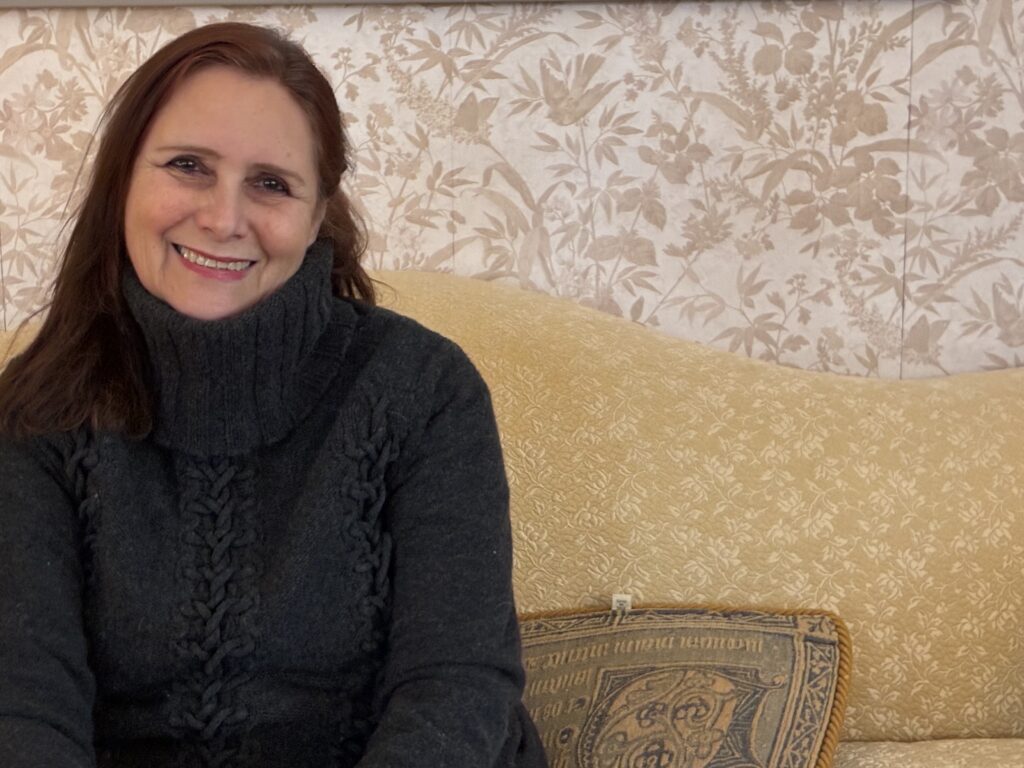
ORWELL — You won’t find artificial intelligence governance expert Kay Firth-Butterfield at home in her sprawling Orwell farmhouse much this month.
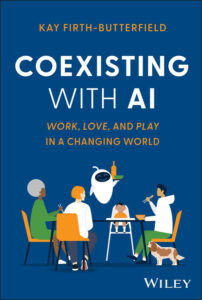
Her new book, “Coexisting with AI: Work, Love and Play in a Changing World,” was published by Wylie on Jan. 13. She’s been in London giving evidence to a British parliament committee on AI and human rights, then at a conference in Munich, where she spoke about AI’s risks to society.
Now she’s in Davos, Switzerland, for the World Economic Forum’s high-profile annual meeting, where leaders and politicians convene to discuss the world’s most pressing issues. There, Firth-Butterfield is speaking on several panels and won a Jan. 21 group debate sponsored by The New York Times. The topic:
“AI will succeed where humans have failed.”
“I’m taking the part where I’m saying I don’t think that’s true,” Firth-Butterfield said with a smile in a recent interview in Orwell.
 It’s an argument the former college professor and British human rights barrister is comfortable making. Firth-Butterfield recognizes AI’s benefits, but she’s skeptical that the promises championed by Silicon Valley tech leaders — an abundant economy, a healthier population, solving climate change — will actually come to pass. If we aren’t careful, Firth-Butterfield cautioned, AI could destabilize democracy and erode education and human rights.
“AI has been sold to us as a magic wand that will be able to do all the things that we’ve made a mess of,” Firth-Butterfield said. “But it’s causing its own problems. Although we’re told that AI will cure climate change, at the moment it’s a very energy- and water-hungry machine. This is a tool that can disrupt the act of democracy, the act of voting, the act of understanding. These are serious matters that go to the integrity of our society.”
In “Coexisting with AI” Firth-Butterfield teaches people how to determine what role they want the technology to play in their lives. AI-powered children’s toys, robotic romantic partners, AI in business and medicine, autonomous weapons systems and AI-enabled elder care are all topics Firth-Butterfield tackles as she explores how artificial intelligence is changing our world.
“I wanted to write the book because I believe that the questions that the use of AI is posing are questions that everybody should have an opinion upon and be able to express,” Firth-Butterfield said.
She noted that while many people are using large language models such as Chat GPT, Gemini and Claude, they don’t really understand how they work.
“There’s a poor level of AI literacy,” she said, “even though there’s widespread adoption of it.”
Large language models, she noted, may seem like they’re generating thoughtful or credible information, when in reality they simply predict the word that’s most likely to come next. They’re prone to errors and hallucinations. They can produce shoddy work. And, for now at least, they’re not a substitute for subject matter expertise. And that’s why Firth-Butterfield advises that people use AI wisely.
“You want to use the right type of AI for the job in question, and have the expertise to check it. If you use it wisely, you can gain benefits. If you use it unwisely, it might turn around and bite you.”
Firth-Butterfield didn’t set out to become an artificial intelligence expert. She started her career as a human rights barrister in England, and then went on to be a judge. But she wasn’t satisfied with that work. Firth-Butterfield is the type of person who likes to pose thought-provoking questions, not make quick judgments.
And she missed advocating for her clients.
When Firth-Butterfield moved to Austin, Texas, where her husband’s family is from, she became a professor, teaching human rights and international politics at St. Edward’s University. She grew interested in the idea that AI might become superintelligent and started to research and write about it. In 2014, on a plane to Texas from London, she sat, by chance, next to the CEO of Lucid.ai, a since-dissolved artificial intelligence startup. They struck up a conversation about an article on artificial intelligence that had recently appeared in The Times of London. By the end of the 10-hour plane ride, the CEO asked her to become the company’s — and the world’s — first chief AI ethics officer.
Firth-Butterfield agreed, but with a few caveats.
“I said I wouldn’t do it if they locked me in the broom cupboard and wouldn’t let me go to meetings with investors,” she recalled.
Firth-Butterfield wanted to be part of the senior leadership team, with direct access to the board, so that she would be able to flag any concerns. The company agreed, and the position propelled her onto an international stage.
Artificial intelligence use has skyrocketed in the years since — and Firth-Butterfield’s profile has risen accordingly. She served as the inaugural Head of AI at the World Economic Forum and co-founded the Responsible AI Institute at the University of Texas. Firth-Butterfield now runs Good Tech Advisory, where she advises companies, governments, nonprofits and think tanks on responsible AI use. She’s been recognized in The New York Times and Forbes 50 over 50 and was awarded TIME Magazine’s 100 Impact Award for her work.
COMING TO VERMONT
How did Firth-Butterfield end up in Addison County? It wasn’t because of her career. After overcoming breast cancer several years ago, Firth-Butterfield found she couldn’t tolerate the Texas heat. She’d visited Vermont several times and always thought it was a place she’d love to live.
“I remember sitting in what is now the Haymaker in Middlebury when my daughter was three,” Firth-Butterfield recalled, “and thinking that I’d like to live here. And now I do.”
She, her husband, Walter Burrough, and their two dogs and two cats moved to Orwell last spring (their daughter has grown up and gone off into the world). When Firth-Butterfield isn’t on the road, you’re likely to find her visiting with neighbors at the Orwell Free Library’s Friday morning coffee hour or hosting friends for a delicious feast (in addition to being an AI expert, Firth-Butterfield is also an excellent cook).
Ultimately, Firth-Butterfield hopes that her book helps people make thoughtful decisions about how to integrate AI in their lives.
“It looks at the good things we can do with AI, and also the things I think you should think about. I hope it sets people up to be able to participate in what our future looks like, and what our children’s future looks like.”